North Carolina Trooper Shot Man From the Side, Not the Front — State Buried the Evidence
A 2019 traffic stop in Shallotte, NC ended with Brandon Webster dead and contradicting evidence suppressed. The Marshall Project reveals what officials never disclosed.
Bullet Holes in the Door
The Marshall Project and The Assembly report that North Carolina state officials withheld evidence contradicting the official account of a fatal police shooting for years — until now.
On New Year's Day 2019, North Carolina Highway Patrol Trooper Scott Collins fired twice at Brandon Webster, 28, during a traffic stop in the parking lot of Civietown Mini Mart in Shallotte. Webster died minutes later in the back seat of his parents' car as they raced to the hospital.
Collins said he had fired in self-defense, claiming he was standing directly in front of Webster's pickup truck when Webster accelerated toward him. That account became the public record almost immediately. The local newspaper ran a headline the following day — drawn from a Highway Patrol press release — describing Webster as having tried to "ram" a state trooper while fleeing a traffic stop.
What the Investigation Found
The state opened both a criminal investigation and an internal disciplinary review of Collins' conduct. Months later, the Highway Patrol concluded Collins had not violated any department policies. State Attorney General Josh Stein declined to file criminal charges, stating Collins had "reasonably believed" Webster was "rapidly accelerating toward" him and "posed an imminent threat of deadly physical force."
What neither investigation disclosed publicly: the Highway Patrol's own analysis of two bullet holes in the driver's door showed Collins was standing to the side of the truck when he fired — not in its path.
The patrol's internal affairs investigator later acknowledged under oath that Collins' actions had violated state law and multiple department policies. The state subsequently reached a multimillion-dollar civil settlement with Webster's family.
Parents Handcuffed Outside the ER
Aldridge Reed had been visiting his mother in Shallotte when his son's pickup tore into the neighboring yard. He and his wife, Towanda Webster-Reed, found Brandon bleeding in a chair. His girlfriend, who had been in the truck, told them a police officer had shot him.
Reed and Webster-Reed drove their son to the hospital. Towanda held Brandon in the back seat as he bled. "He kept telling me he was dying," she said. "I kept telling him, 'No, you're not leaving me.'"
Brandon Webster lost consciousness as they reached the hospital and was rolled into the emergency room in a wheelchair by a security guard.
Outside, Towanda and Aldridge sat on a bench, covered in blood. Sheriff's deputies arrived and asked why she was bloodied. Towanda did not answer and moved toward the entrance to check on her son. Deputies followed her inside, handcuffed her in the lobby, and secured Aldridge at the curb. The two were held in separate police vehicles.
"I was praying and asking the Lord to help Brandon," Towanda said. "Sobbing and crying and wondering what was going on with my son."
She estimated she was alone in the car for 20 to 30 minutes. Officers gave no explanation for the detentions. When they were released and entered the ER, Brandon Webster was already dead. Towanda stroked his feet. No charges were ever filed against his parents. The only people law enforcement detained that night were Brandon's mother and father.
Two Families, One County
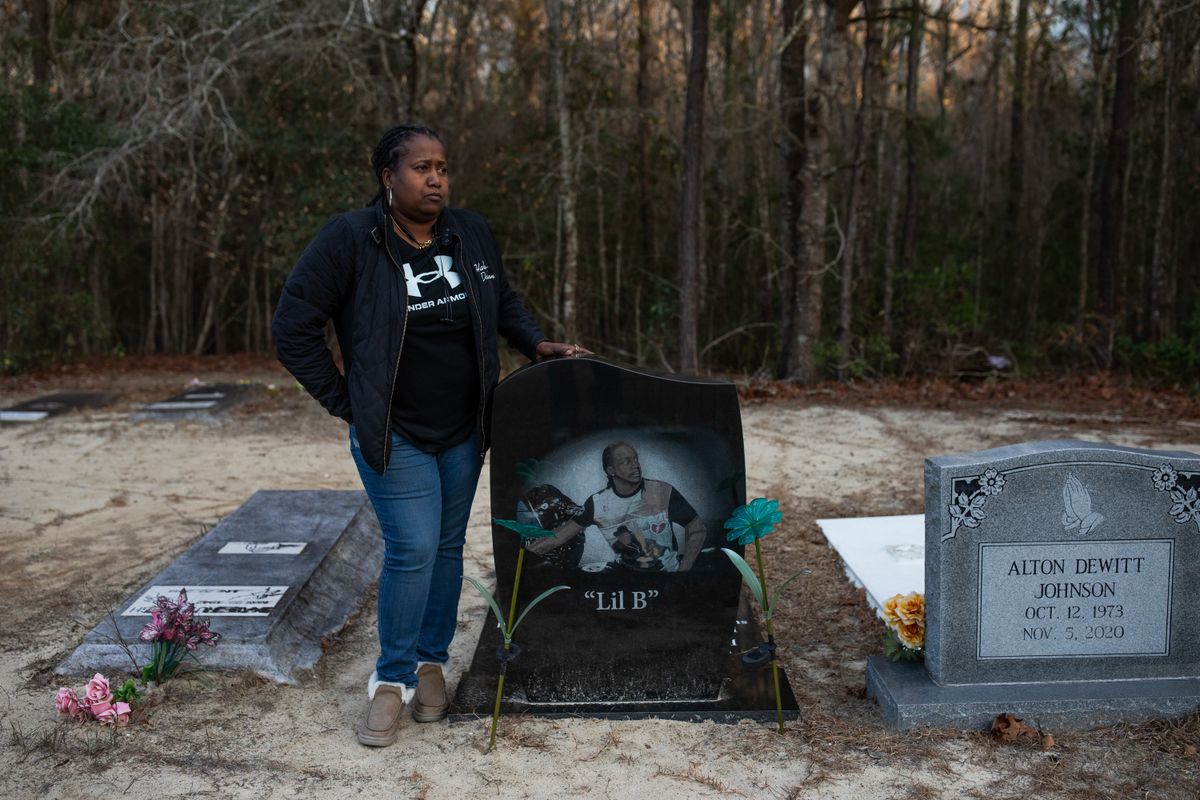
Brandon Webster was Black and grew up in Brunswick County, the southernmost county in North Carolina. His father, Aldridge Reed, owns a small trucking fleet and hauls freight for the military. His mother, Towanda Webster-Reed, has worked as a team leader at Walmart for 25 years. Both described their son as someone who never met a stranger. He had learned to drive almost anything — motorcycles, bulldozers, 18-wheelers — at an early age. "Whatever his daddy could drive, he could drive," Towanda said.
Scott Collins, who is white, grew up in neighboring Columbus County in a law enforcement family. His father, uncle, aunt, and one grandfather were all state troopers; that grandfather was later elected sheriff. A second grandfather served as a sheriff's deputy. Collins' stepmother works for the local district attorney.
Collins joined the Highway Patrol in 2017 after working as a sheriff's deputy in Columbus County. He testified in a deposition that he regularly patrolled the area around the Civietown Mini Mart looking for drunk drivers.
The Night of the Shooting
At approximately 9 p.m. on January 1, 2019, Brandon Webster and his girlfriend left his parents' house to pick up snacks for family and friends watching college football. He stopped at a traffic light a quarter mile down Shell Point Road, then turned and pulled into the Civietown Mini Mart lot. Collins was parked nearby with his lights off. According to Collins' later account, Webster's truck had "fishtailed" during the turn — behavior Collins characterized as careless and reckless driving, a misdemeanor that, in his assessment, justified a traffic stop.
Collins did not run Webster's license before initiating contact.
Sealed Records, Quiet Settlement
Nearly all evidence in the case is sealed under a federal protective order that granted Webster's family attorneys access on the condition of confidentiality. North Carolina's public records law independently shields almost all police investigative records from public disclosure, meaning state investigations of police shootings are routinely never released.
The Marshall Project and The Assembly obtained testimony from depositions in which the Webster family's attorney questioned Collins and five other troopers about the physical evidence and conduct at the scene. Those depositions, the outlets report, revealed procedural failures, preferential handling of Collins as a fellow officer, and a pattern of disregard for evidence that undermined his account.
The full account of what happened at the Civietown Mini Mart on New Year's Day 2019 had not been made public before this report.
Source: The Marshall Project