Calling 911 Led to ICE Detention for Florida Residents Seeking Police Help
As Florida leads the nation in local police-ICE agreements, crime victims and 911 callers are among those facing immigration arrest, The Marshall Project reports.
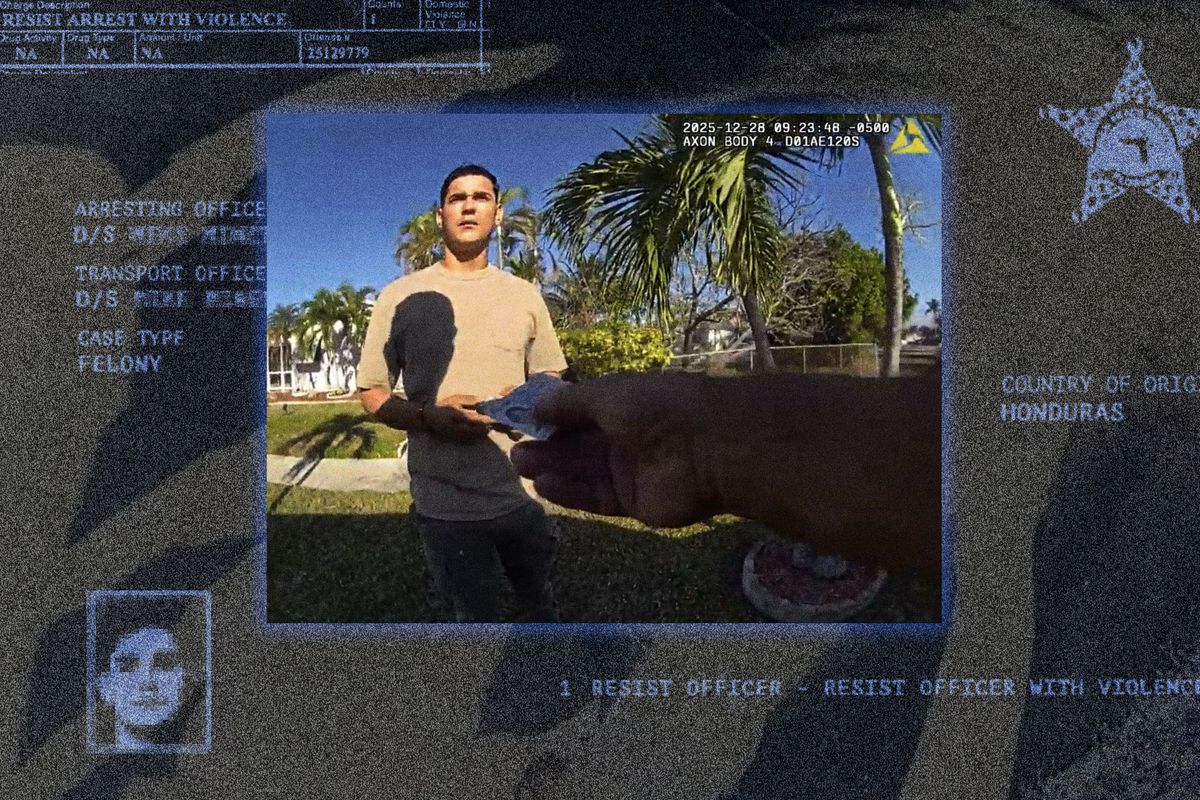
When Asking for Help Ends in Handcuffs
Axel Sanchez Toledo called 911 in December seeking a welfare check on his 4-year-old daughter. He shared custody with his ex and had heard the child was sick. He stood beside his girlfriend and their infant son when Palm Beach County Sheriff's deputies arrived. The encounter was cordial at first.
A deputy took his driver's license, returned to a patrol car, and emerged minutes later with a different agenda, body camera footage shows. Sanchez Toledo was accused of being undocumented and told he was being held for Immigration and Customs Enforcement, court records indicate.
He ran. Deputies deployed a Taser, kicked him and tackled him to the ground while his girlfriend begged them to stop. "Please, guys, I'm not a criminal," Sanchez Toledo said, insisting he had documentation — a pending asylum case, his attorney later confirmed. "I don't want to go."
"Too fucking bad now!" one deputy shouted back.
"He just wanted to know about his daughter," his girlfriend cried. "Why would you guys do this?"
Florida at the Forefront of a National Shift
The arresting deputy was assigned to the Palm Beach County Sheriff's 287(g) Task Force, an arrangement with ICE that authorizes local officers to enforce federal immigration law. As The Marshall Project has found, cases like Sanchez Toledo's illustrate how routine police interactions are now leaving crime victims and 911 callers exposed to detention and arrest.
More than 1,100 law enforcement agencies across the country have signed cooperation agreements with ICE, with the heaviest concentration in Southern states. By some estimates, the number of locally deputized officers now exceeds the roughly 12,000 new ICE agents hired under the current administration. Federal reimbursements and incentive payments have drawn many agencies into the program.
Florida leads the country in the number of such signed agreements. Palm Beach County, where Sheriff Ric Bradshaw has held office for more than two decades, has emerged as a prominent example of how the immigration enforcement expansion reaches beyond its stated targets.
At a community event last year, Bradshaw sought to reassure residents. "Do not be afraid of the Sheriff's Office," the Democrat said. "If you're a victim of a crime, we're going to be there to help you. We're not there to deport you."
Crime Victims Among Those Detained
The record on the ground tells a different story, according to documents reviewed by The Marshall Project. Among those detained by the Palm Beach County Sheriff's Office under ICE-related authority: a restaurant employee who called in a tip about a possible burglary, a mother who reported a theft and sought assistance with her son, a crime victim involved in a minor fender bender while driving his son to school, and Sanchez Toledo himself, who was also charged with resisting arrest.
Only about 150 of the department's 1,500 officers hold deputized immigration arrest authority, agency records show. Between September 2025 and March, those officers averaged more than 60 immigration arrests per month — among the highest rates in the state. Since the department signed its ICE agreement, the Department of Homeland Security has paid the Sheriff's Office nearly $1 million in immigration-related reimbursements and incentives, according to payment records obtained by The Marshall Project.
Bradshaw declined an interview request. His office instead submitted a public relations video from March in which the sheriff said his department would detain people encountered "in a normal course of business" if they were wanted by ICE. "Our emphasis is on the bad guys," Bradshaw said in the video. "The people that are involved in narcotics and gang activity."
A Department of Homeland Security spokesperson said in an email that Sanchez Toledo is now subject to deportation proceedings and that "illegal aliens are not welcome in the United States."
A Quieter Enforcement Channel
After ICE's high-profile operations in Minneapolis and other cities generated widespread backlash, the 287(g) task force model has offered the administration a lower-visibility avenue for immigration enforcement — one that draws less public scrutiny, according to The Marshall Project's reporting.
The 287(g) agreements have existed in some form for years. The Obama administration suspended the program after investigations found that several participating departments had engaged in racial profiling and civil rights abuses, including the Maricopa County Sheriff's Office in Arizona, where then-Sheriff Joe Arpaio reshaped his agency into an immigration enforcement arm. The first Trump administration revived the program. In the current term, the administration added cost reimbursements and performance incentives to encourage agencies to execute ICE directives as frequently as possible.
Critics say the civil rights concerns that prompted earlier suspensions remain unresolved — and that the regulatory environment is now far less protective. Officer training under the current program is shorter than in previous administrations. The Trump administration has dismantled the Justice Department unit responsible for investigating local departments for civil rights violations. The Department of Homeland Security has also effectively eliminated its internal watchdog, the Office for Civil Rights and Civil Liberties, reducing oversight of the task force program.
Peter Mina, a former deputy officer at that watchdog office and a former DHS official, said the rollback was deliberate. "It's not like they're short on cash," Mina said. "So I think if they wanted to put the resources into it, they could. They just don't because they just see it as a speed bump."
With fewer checks on local enforcement and financial incentives driving new sign-ons, the program's reach continues to expand — touching residents who call for help as readily as those who are sought as suspects.
Source: The Marshall Project