Uruguayan Man Faces U.S. Federal Money Laundering Accusations Tied to Cross-Border Drug Ring
A man from Uruguay stood before a federal judge in Alexandria, Virginia, accused of taking part in a scheme to clean dirty money tied to a sprawling cocaine smuggling enterprise spanning multiple continents.
Uruguayan Man Faces U.S. Federal Money Laundering Accusations Tied to Cross-Border Drug Ring
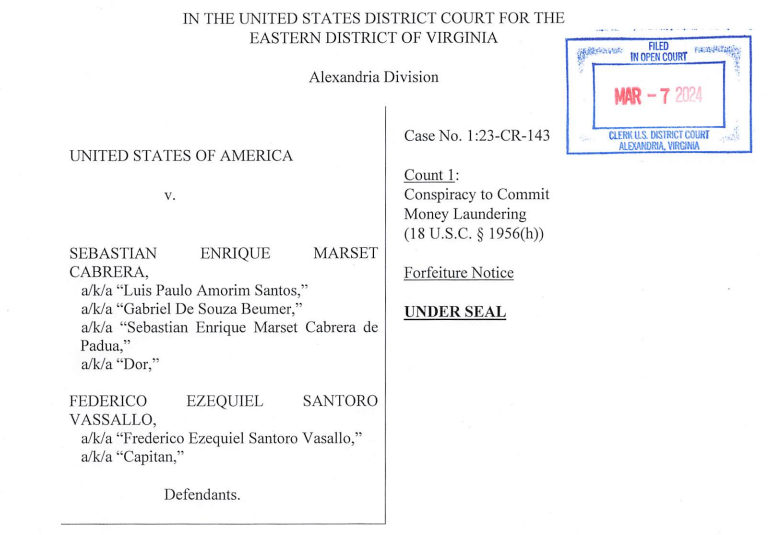
A man holding Uruguayan citizenship stood before a federal tribunal in Alexandria, Virginia, to answer claims that he helped wash proceeds from an expansive cocaine smuggling network. Legal papers name the accused as Sebastián Enrique Marset Cabrera, 34, whom investigators suspect of commanding a narcotics operation that shipped thousands of kilos of cocaine from South America, mainly headed for buyers in Europe. Some individual loads allegedly tipped the scales at ten metric tons.
Information released by the U.S. Embassy in Uruguay indicates the suspected syndicate allegedly pushes drugs through Bolivia, Paraguay, Uruguay, Brazil, Belgium, the Netherlands, Portugal, and elsewhere. A close partner of the accused, Federico Ezequiel Santoro Vassallo — referred to by the moniker "Capitán" — allegedly worked out of Paraguay cleaning cash for drug groups. He is said to have handled the movement of millions in criminal income from various European states toward South America and other regions.
Santoro and his collaborators allegedly arranged pickups of drug earnings, using runners and gambling tokens to pass large amounts — often denominated in euros — under the radar. Associates then allegedly slipped these tainted funds into the global financial system. Santoro later directed cross-border transfers, commonly through bank wires. He usually ordered that recipients be paid in American dollars, with a U.S.-based correspondent institution processing the deals. Both Santoro and Marset allegedly used threats of physical harm to guard their narcotics and financial rackets.
By January 2021, Marset allegedly had more than 17 million euros still owed to him from one cocaine load alone. Santoro allegedly arranged to collect and launder at least 5 million euros of that sum, with the bulk of it passing through American banks.
Santoro admitted guilt on May 21, 2025, and a judge handed him a 15-year prison stretch on July 23, 2025. Should jurors find Marset guilty, he could be locked away for as long as two decades. A federal district jurist will decide the exact punishment after reviewing sentencing guidelines and other legal considerations.
Assistant United States Attorneys Anthony T. Aminoff and Catherine Rosenberg are handling the prosecution. The Drug Enforcement Administration's Bilateral Investigations Unit, housed within its Special Operations Division, spearheaded the inquiry. Supporting agencies included the Justice Department's Office of International Affairs, the American Embassy in Bolivia, the Diplomatic Security Service and Bureau of International Narcotics and Law Enforcement Affairs at the State Department, Bolivia's Ministry of Government, the Bolivian National Police Intelligence Unit, the DEA New York Task Force, the DEA Aviation Division, DEA offices across South America — Bogotá, Buenos Aires, Asunción, São Paulo, and Rio de Janeiro among them — plus Europol.
In May 2025, the State Department's narcotics bureau announced a bounty reaching $2 million under the Transnational Organized Crime Rewards Program for tips leading to Marset's capture or conviction. That figure sits atop a $100,000 reward announced in Bolivia back in 2023.
Source: U.S. Embassy in Uruguay
Source: Google News UY — Crime