Ecuador spends $1.5 billion annually fighting organised crime
President Noboa revealed the annual cost of anti-crime efforts and highlighted international support received. Experts question the effectiveness of the strategy.
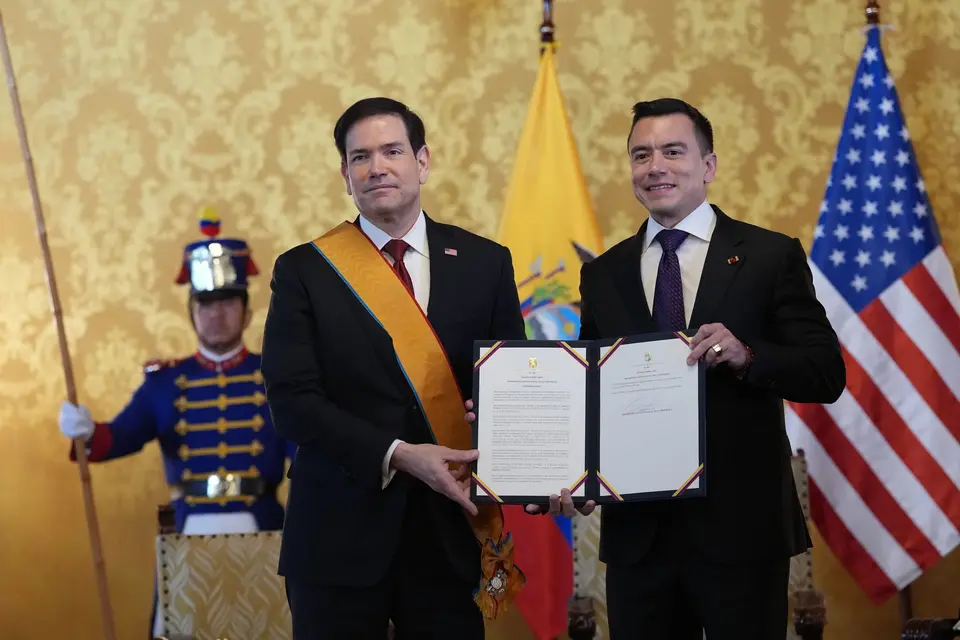
Ecuador allocates $1.5 billion annually to combat drug trafficking, according to Noboa
The government of Ecuador spends approximately $1.5 billion per year in its fight against criminal groups linked to drug trafficking, declared President Daniel Noboa on Thursday. According to expressnews.com, the president made these statements on radio Élite, where he indicated that the state faces around 80,000 members of criminal gangs.
"We have to do our duties, our Armed Forces and our police," Noboa said during the interview.
The president highlighted that Ecuador has received international cooperation from the United States—in the form of equipment, economic assistance, information and intelligence—as well as from Italy, other European countries, Argentina, Brazil, Israel, South Korea and Japan.
Noboa also emphasised the Shield of the Americas initiative, a regional coalition promoted by US President Donald Trump to carry out joint actions against cartels. "Finally there is continental agreement on the fight against drug trafficking," the president stated.
However, the alliance with the United States has been questioned for its lack of concrete results in crime reduction. Diego Pérez, lecturer at the School of Security and Defence of the Institute of Higher National Studies, told The Associated Press that "criminal dynamics in no country are reversed by heavy-handed approaches". Pérez added that it is necessary to "review indicators of social investment, what type of employment opportunities are being generated" to neutralise criminal influence.
The escalation of crime in Ecuador intensified from 2021, when local gangs linked to Colombian and Mexican cartels began competing for drug distribution routes. This sparked an increase in contract killings, kidnapping and extortion in the country.
Noboa attributed the advance of drug trafficking to lack of control on the border with Colombia and the entry of weapons through the southern border with Peru. The president noted that in Colombian departments such as Nariño and Putumayo there exists "a record of coca cultivation", which directly affects Ecuador "due to how permissive previous governments in Colombia were".
According to the latest report from the United Nations Office on Drugs and Crime, the area cultivated with coca in Colombia reached 261,000 hectares in 2024.
Since the beginning of this year, around a dozen Ecuadorian fishing boats have been sunk by the United States in the Pacific Ocean, accused of operating as floating fuel stations in service of drug trafficking. International organisations estimate that 70% of the world's cocaine is exported from Ecuador.
Source: Google News EC — Crime