Curfew in Ecuador: 1,283 detained and only one target criminal captured
Ecuador lifted a two-week curfew in four provinces with questioned results: a single prioritised criminal captured among more than 1,200 detainees.
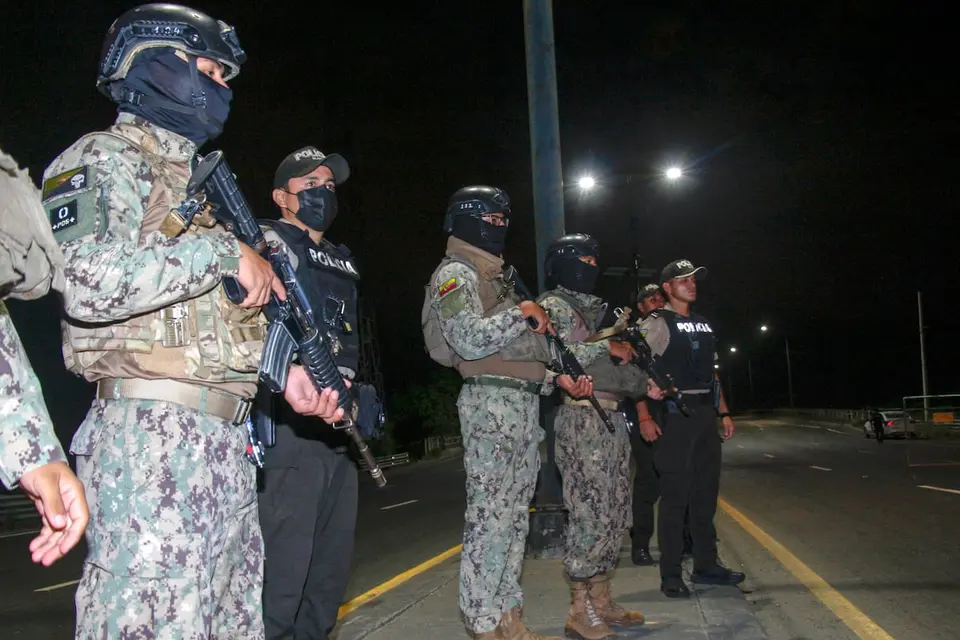
Ecuador closes two weeks of curfew with controversial balance
Ecuador ended the curfew it maintained for two weeks in four provinces across the country. According to elpais.com, approximately 6.5 million people were forbidden from leaving their homes from dusk until dawn. The restriction was total: the Government issued no safe-conduct passes even for productive sectors, and kept the press away from operations. To sustain the measure, it deployed—according to official figures—75,000 uniformed personnel, with logistical support from the United States.
Interior Minister John Reimberg became the visible face of the offensive. "Do not go out, we do not want collateral victims," he repeated during the days the measure was in effect. The Executive's message was clear: the night would remain under State control.
Only one target criminal captured
The official balance, however, does not reflect the results that Government rhetoric had anticipated. Of the 1,283 people detained for violating the curfew, barely a single "prioritised criminal target" was captured. Two other suspects with criminal links were also apprehended, including alias Perris, who was killed three days later in Guayaquil prison.
The rest of the inventory includes 56 seized weapons, 207 motorcycles retained, 781 vehicles registered, 107 recovered and nine from which tinted glass was removed. Actions that the Police routinely carry out without the need to restrict citizen mobility.
The Defence Ministry concentrated part of its offensive on illegal mining. The figures are voluminous but sparse in explanations: 806 detainees with no detail of the charges brought, more than 5,400 explosives seized, 25,613 dollars confiscated, 32 excavators rendered inoperable, 256 illegal mine entrances destroyed and five clandestine airstrips located, corresponding to the period from 15 to 29 March. The balance from the final night of the curfew had not been delivered at the time this information was closed.
"Marketing," according to security analysts
Security analyst Fernando Carrión summarises the deployment in one word: marketing. He notes that to date there is no comprehensive balance or detailed information, and that the little known has been leaked fragmentarily through the media.
Carrión also points to a strategic error: the prior announcement of the operations. "The prior promotion of the operations gave these organisations time to react," he explains. Some leaders, he argues, probably moved to other cities. It is the known "balloon effect": pressure in one territory pushes crime towards another. "Many of these structures could have moved to Quito or Cuenca, not only to wait, but to expand," he warns.
For Carrión, it was not a defeat of organised crime, but a calculated withdrawal. "They chose not to confront the State," he says. A tactic similar to that of 2024, when President Daniel Noboa declared the internal armed conflict and militarised the streets. Then homicides fell for a couple of months before rising again.
Doubts about cooperation with the United States
Cooperation with the United States also raises questions. The Government has mentioned general lines—training, intelligence, technology exchange—without offering concrete details. The first joint operation, announced in early March, consisted of a bombing against an alleged camp of the dissident group Comandos de la Frontera, in Sucumbíos. The official version was questioned by the testimony of a farmer who claims there was only a farm dedicated to livestock breeding in the location.
The Government defends the restriction as a necessary tool in its war on crime. One of its effects was to contain intentional homicides in the four provinces where it was applied, which until then had recorded sustained increases. However, murders continued to occur during the day and in the hours close to the start of the curfew.
The daily cost for citizens
Among those who experienced the restriction, doubts weigh more than official figures. Andrea Medina, owner of a small juice and sandwich shop in the surroundings of a hospital in Guayaquil, used to work 24 hours, seven days a week. "With the curfew I closed at ten o'clock at night at the latest. Everything earned at night was lost. I also could not continue paying all the hours to the person who worked there. It is a cascading impact," she recounts. Her personal balance is sceptical: "Who benefited? They continue robbing, they continue killing, they continue extorting. I see everything the same."
Carlos Pérez, a taxi driver, did not work in night hours, but felt the impact in another way. Customers decreased because people stopped going out, and long queues to refuel consumed his time. "I went to get petrol and, believe me, it took 57 minutes. That is too much time lost to work," he relates.
For Jhony Rodríguez, the conclusion is straightforward. Having witnessed a robbery during the day is enough: "Nothing has changed. Criminals stopped going out at night and now they rob and kill more during the day."
Not everyone shares that interpretation. In the Las Malvinas neighbourhood, one of the hardest hit by violence in Guayaquil, Miriam Suárez perceives a tangible change. "There were so many gangs around my house and now there are none. And the Armed Forces pass by every night," she says with relief.
For 15 days, daily life was altered: increased spending on transport, streets with accumulated rubbish because rubbish collectors could not complete their routes, and a widespread sense of a city running at half pace. The majority of those detained turned out to be people who violated the restriction schedule, with no proven links to criminal structures.
Source: Google News EC — Guayaquil