Georgia Death Row Inmate Invokes Abuse Survivor Law Hours Before Execution
Stacey Ian Humphreys, convicted of two 2003 murders, sought a reduced sentence under Georgia's Survivor Justice Act hours before his scheduled execution.
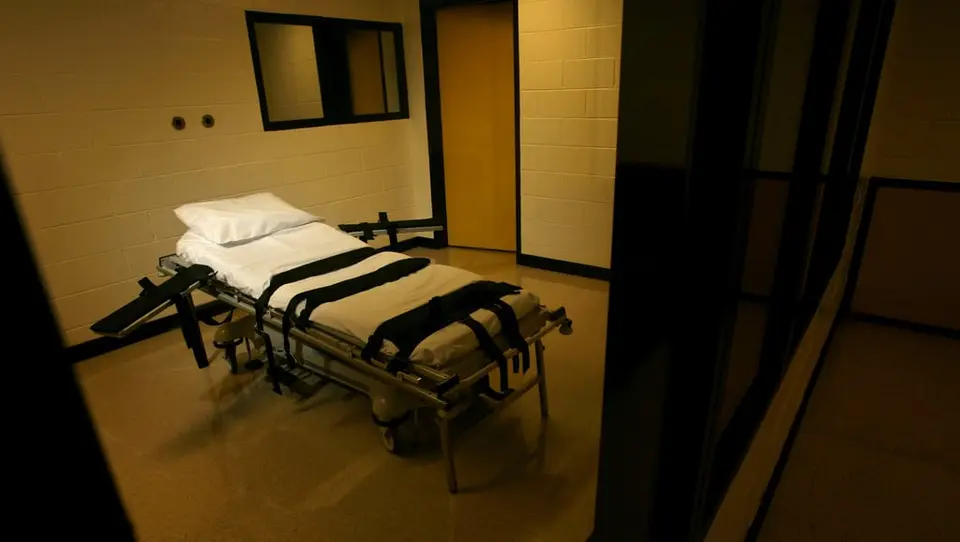
Georgia Inmate Cites Childhood Abuse Law in Last-Ditch Bid to Escape Execution
Just hours before his scheduled execution, convicted murderer Stacey Ian Humphreys appeared before a Georgia judge Tuesday arguing that a state law designed to protect domestic abuse survivors should reduce his death sentence, Courthouse News Service reports.
Humphreys, 53, was convicted and sentenced to death for the 2003 killings of Cyndi Williams, 33, and Lori Brown, 21. The two real estate agents were strangled and then shot to death inside a model home in a Powder Springs subdivision. Humphreys had been on parole for 13 months at the time, following a 1993 felony theft conviction. After the killings, he stole the women's driver's licenses and credit cards and withdrew more than $3,000 from their bank accounts.
His attorneys filed a petition to modify his death sentence to a determinate sentence of between 10 and 30 years, arguing he qualifies under Georgia's Survivor Justice Act — a law enacted last year to benefit defendants who acted in response to domestic abuse or family violence.
Severe childhood abuse cited as factor
Attorney Brian Kammer of the Federal Defender Program told the court that substantial evidence presented at trial showed the abuse Humphreys endured had severely affected his mental health and functioning well into adulthood. That evidence included years of arbitrary beatings and whippings by his father, being burned with cigarettes, a skull fracture at age 3, exposure to drug and alcohol use, and sexual abuse by his paternal great-grandmother.
Kammer argued that this documented history of persistent physical and mental abuse as a child contributed directly to Humphreys' criminal behavior and warranted reconsideration of his sentence.
State: law was never meant for death row inmates
The prosecution pushed back sharply. Senior Assistant Attorney General Sabrina Graham told Cobb County Superior Court Judge Tyler Browning that Humphreys was misreading the statute's intent.
"The Legislature never intended for this statute to be used in this manner," Graham said.
Graham pointed to the language lawmakers included in the bill, stating that the act's purpose is to provide defendants a justification for self-defense by offering evidence of family violence, dating violence, or child abuse committed by the alleged victim — not by the inmate's own relatives decades earlier. Allowing this interpretation, she warned, would open the door to every death row inmate in Georgia filing a similar petition.
"That means every single inmate sitting on death row could come along and ask for their death sentence to be modified," Graham said.
She also called Humphreys' use of the law an insult to those it was designed to protect, citing Nicole Boynton as an example — the first Georgia prisoner released under the Survivor Justice Act earlier this year. Boynton, who was convicted of stabbing her boyfriend during a fight in 1999 when she was 18, was freed after a Cobb County judge found she had been the victim of repeated violence that significantly contributed to her crime. She had served 23 years of a life sentence.
Clemency denied; ruling pending
Tuesday's courtroom hearing was not Humphreys' only avenue of appeal. Earlier in the day, his clemency hearing resumed before the Georgia Board of Pardons and Paroles — the only state body with the authority to commute a death sentence. One board member, Kimberly McCoy, was recused by a Fulton County judge after it emerged she had served as an advocate for the victims' families during Humphreys' 2007 trial.
The board, after reviewing the full facts and circumstances of the case, denied Humphreys' clemency petition. Its hearings are closed to the public.
As of 6 p.m. Tuesday, Judge Browning had not yet issued a ruling on the Survivor Justice Act petition. In October 2025, the U.S. Supreme Court had already denied Humphreys' final appeal, leaving him on death row at the Georgia Diagnostic and Classification State Prison.
The execution had previously been postponed after Humphreys raised concerns about a potential conflict of interest involving two members of the pardons board ahead of an earlier clemency hearing.
Georgia's execution history
Should Browning deny the petition, Humphreys would become the 55th Georgia inmate executed by lethal injection. Since the U.S. Supreme Court reinstated the death penalty in 1976, Georgia has put to death 76 men and one woman, ranking it tenth among states by executions per capita.
Executions in Georgia had been on pause for more than two years, partly the result of a pandemic-era moratorium that prompted legal challenges over whether the conditions to resume had been satisfied. In June, the Georgia Supreme Court cleared the way for executions to proceed. The last inmate executed by the state was Willie James Pye on March 20, 2024.
Source: Courthouse News Service