Death of Donovan Balanta in Soacha: five police officers detained him and he was found dead in hospital
Donovan Balanta, 32, died on 20 September following a police operation in Soacha. His family alleges beatings and electric shocks; seven uniformed officers were removed from duty.
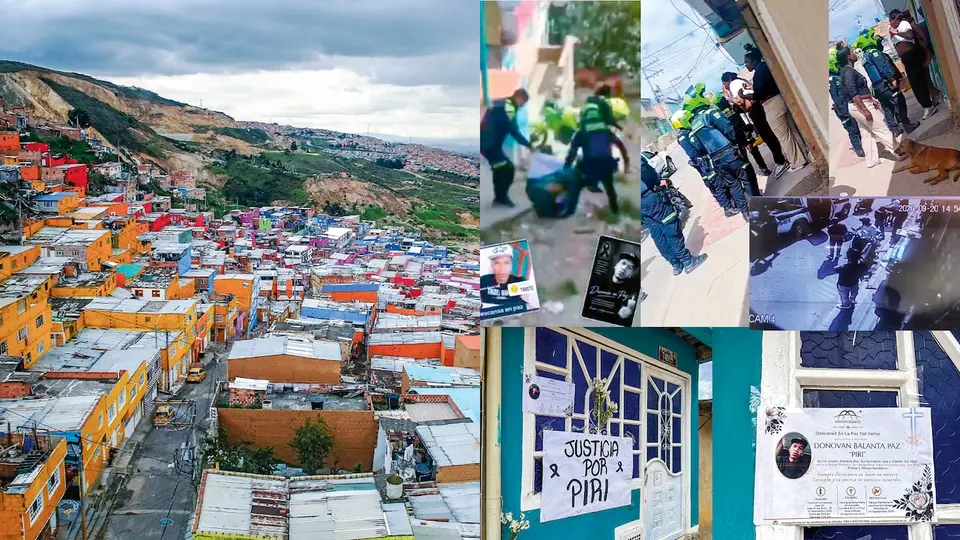
Five police officers detained Donovan Balanta in Soacha; hours later he died in the hospital
Donovan Balanta Paz, 32, died on 20 September after being detained by officers of the Soacha Police in the Caracolí sector, a border zone between that municipality and Bogotá. According to semana.com reporting, the family alleges a beating with multiple electric shocks, whilst the institution claims it responded to a report of a brawl. Seven uniformed officers were removed from duty once preliminary tests were completed.
What the Police say
According to the initial report from Soacha Police, officers assigned to the Alfa Cazucá Response Zone attended a brawl in the Caracolí sector. During the procedure, an electronic immobilisation device of the taser type was used. Balanta and another citizen, identified as José Luis Guerrero Moreno, were transferred to Cazucá Police Station for the corresponding procedures.
The institution reported that, upon entering the facilities, Balanta presented a "sudden deterioration" in his state of health, without consciousness. The uniformed officers sent him to Luis Carlos Galán hospital in Soacha, where he died at approximately 7:30 p.m. In a second statement, the Police confirmed the removal of seven uniformed officers from duty. Semana.com requested an interview with the authorities, but by press time it was not possible to obtain one given the status of the investigation.
The family's version
John Deiby Gómez Murillo, Balanta's friend for more than 20 years and godfather of his younger son, was designated by the family as spokesman for the case. Gómez Murillo was present at the scene on the day in question.
According to his account, everything began with a verbal exchange between Balanta's sister and a neighbour. The Police were in the vicinity and arrived to mediate. Donovan's brother-in-law became upset at what the family describes as racist insults and threats from the officers. They then called Balanta, who was nearby in the Tres Esquinas sector, to come to the location and help calm the situation.
Upon arriving and seeing the number of uniformed officers present, Balanta threw a glass bottle at the ground—not at any officer or civilian, according to Gómez Murillo—with the intention of discouraging the confrontation. That gesture triggered direct intervention by the police, who pursued him. They caught up with him approximately a block and a half further ahead.
"The beatings by seven police officers began," Gómez Murillo recounted. According to his testimony, Balanta received blows to the stomach, head and chest, as well as several electric shocks from the taser weapon. He was handcuffed on the ground, with no possibility of reacting, as seen in videos that circulated subsequently.
The journey to the station and arrival at the hospital
Once in the patrol car, no family member was able to accompany him. The other detainee, who shared the transfer, informed Gómez Murillo that Balanta was asking for help at the station because his chest hurt a great deal and he could not breathe. He asked for water; the officers ignored him and, according to the testimony, a policewoman threw water in his face. Shortly after, Balanta lost consciousness.
"Within approximately an hour and a half or so was when they called from the hospital, that he was very seriously ill. When he arrived at the cardiac unit, the medical team that received him said he arrived without vital signs; he had been dead for almost half an hour already. They attempted to resuscitate him, but it was impossible and he did not survive," Gómez Murillo stated.
The unanswered questions
The case leaves several unknowns that the family explicitly points out. The first is jurisdictional: why the Soacha Police intervened and not Bogotá Police, given that the Caracolí sector, despite being on the borders, would operationally correspond to the capital.
The second unknown concerns what happened between the moment Balanta was placed alive and conscious in the patrol car, and his deteriorated arrival at the police station. "I say that I know that they beat him more because that is where he arrived and where he lost consciousness; when he was asking for help, nobody helped him," Gómez Murillo stated.
By the time of semana.com's report, the Forensic Medicine ruling—which will determine the official cause of death—had not yet been published. The police officers involved are remaining silent in the framework of the ongoing investigation.
Donovan Balanta was described by friends and acquaintances as a calm and cheerful man, although of strong temperament. He was 32 years old at the time of his death and left at least one child of minor age.
Source: Google News CO — Bogotá