Ecuador orders arrest of Bucaram following six years without verdict in COVID-19 trial
An Ecuadorian court ordered the arrest of former president Abdalá Bucaram when he receives medical discharge, after six postponements of the ruling in the trial over the irregular sale of COVID tests.
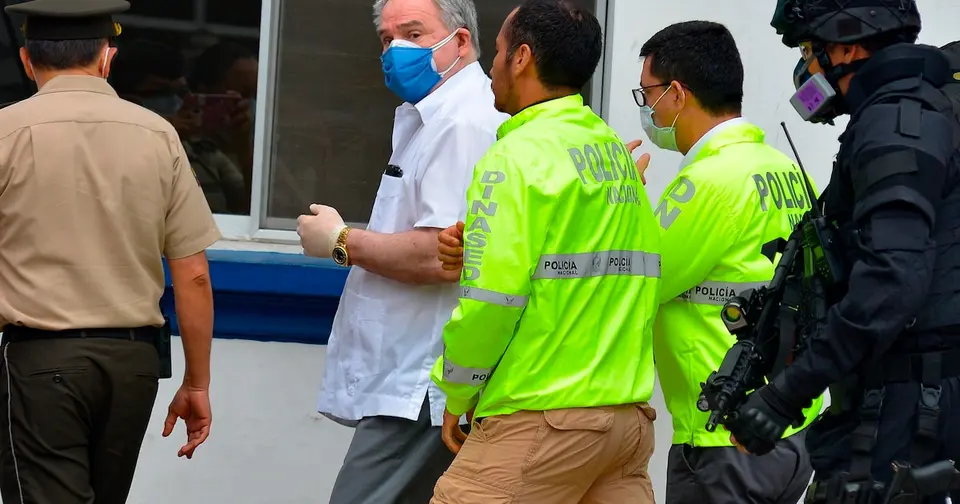
Ecuadorian court orders arrest of Bucaram to hear verdict pending since 2020
Ecuador's Criminal Guarantee Tribunal ordered the arrest of former president Abdalá Bucaram Ortiz once he receives medical discharge, after his absence prevented for the sixth consecutive time the reading of the verdict in the trial over the alleged irregular sale of tests to detect COVID-19. The measure was adopted on the evening of 3 September, according to infobae.com.
The judges also ordered the National Police's Search Block to maintain permanent surveillance at the Guayaquil clinic where, according to the family and lawyers of the former president, Bucaram remains hospitalised following a cardiac intervention carried out on 26 August.
The arrest order does not constitute a conviction and does not imply that Bucaram has been declared guilty. Its only purpose is to guarantee his appearance before the court to hear the first-instance ruling. As of 4 September, there was no official confirmation that the Police had executed the measure.
The accused and the charges
Bucaram, who governed Ecuador between August 1996 and February 1997, faces the proceedings alongside his son Jacobo Bucaram, Israeli citizen Oren Sheinman and former agent of the Metropolitan Traffic Agency of Quito Leandro Berrones. All four are accused of organised crime and maintain their presumption of innocence until a final verdict is issued.
The Prosecution maintains that the organisation obtained economic benefits through the commercialisation of 21,000 rapid tests, masks, lancets and other medical supplies during the health emergency of August 2020. According to the prosecution's theory, the structure used vehicles, servers and resources of the Metropolitan Traffic Agency to transport the merchandise across several provinces, and some of its members allegedly used uniforms and false identification documents to present themselves as members of the diplomatic corps or the United States Drug Enforcement Administration.
The charge identifies Berrones and Sheinman as direct participants, whilst Abdalá and Jacobo Bucaram are identified as collaborators. Part of the supplies was allegedly stored in the former president's residence in Guayaquil; his son allegedly delivered USD 321,600 in cash as payment for the merchandise. This latter assertion is supported, among other elements, by the testimony of Shy Dahan, an Israeli citizen killed in August 2020 in the Litoral Penitentiary.
Six failed attempts to read the ruling
The trial hearing was successfully convened on 11 April 2025 after more than ten previous postponements. The proceedings took place over approximately twenty non-consecutive days before the tribunal entered deliberations.
The first attempt to announce the ruling took place on 2 July 2026, but was postponed at the request of Bucaram's defence. The hearing on 3 August did not proceed due to the absence of the ponente judge, Gandhy Cervantes. Four days later, the lawyer of one of the accused and Sheinman's translator were absent, and were fined.
The convocations of 26 and 31 August failed again due to the hospitalisation of the former president. On the sixth attempt, on 3 September, the judges tightened the conditions to prevent another postponement.
Institutional pressure and risk of prescription
Prosecutor Lidia Sarabia questioned the reiteration of the suspensions and requested that the circumstances that have prevented the conclusion of the process be investigated. At the latest convocations, police officers attended the medical centre to verify Bucaram's condition, but reported that they did not obtain the necessary facilities to verify it directly.
The former president's family maintains that the hospitalisation is genuine. His wife, María Rosa Pulley, released photographs of the intervention and denounced what she considers persecution. One of his sons stated that he had provided an officer with the admission receipt and clinical documentation.
The accumulated delay led the Judicial Council to open a disciplinary inquiry against Judge Cervantes to determine whether he committed any infraction in the final phase of the proceedings. The Prosecution also warned of a possible risk of prescription, although that possibility must be evaluated and declared by the courts.
The tribunal will have to convene the defendants again to communicate its ruling. The verdict it adopts may be appealed by both the defence teams and the Prosecution.
Source: Google News EC — Crime