Alias 'Tuti' released: Police link his discharge to wave of violence in Machala
Human remains found in Machala in less than 48 hours alarm El Oro. Police cite the release of three alleged gang leaders as the trigger.
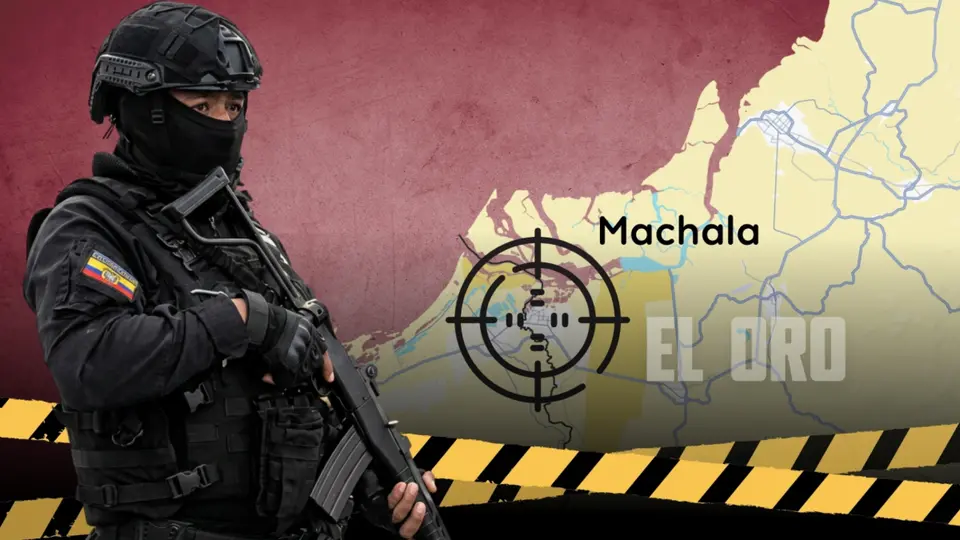
Body parts and alleged gang leaders at large: the surge in violence in Machala
In the early hours of Thursday, 3 September 2026, police officers found human remains inside an abandoned blue tank near a supermarket in Machala: arms, a leg, two ears and a heart, wrapped in a carpet. The victim has not been identified.
The discovery was not an isolated case. In less than 48 hours, similar situations were recorded at different points in the capital of El Oro province, including the exterior of a liquor store—where a pamphlet addressed to a criminal organisation also appeared—and a road interchange, according to expreso.ec.
767% increase in abandoned body parts
The appearance of dismembered bodies is not a new phenomenon in El Oro province, but its frequency has soared in 2026. Between January and 24 July of this year, authorities recorded 52 body parts abandoned in different sectors of the province, compared with six recorded in the same period of 2025.
The difference represents a 767% increase, according to an Intelligence report accessed by Ecuavisa. The document also sets out a dispute between criminal organisations over territorial control and illicit economies in several cantons. Machala has recorded 19 discoveries and Pasaje 18, whilst Huaquillas and Santa Rosa also concentrate documented cases.
Police cite three releases as turning point
A police officer consulted by Ecuavisa described Machala as an "extremely violent" city and linked the recent escalation to the release of three alleged gang leaders: individuals known by the aliases Tuti, Joker and Chema.
Alias Chema is identified as the alleged leader of Los Chemas, a structure said to maintain links with Los Lobos. He was arrested in June 2025 in Quevedo whilst travelling in an armoured vehicle in which substances subject to regulation were found. Transferred through different penitentiary centres to the Cárcel del Encuentro in Santa Elena, he subsequently received measures alternative to pre-trial detention. In June 2026, a judge declared his innocence after determining there were insufficient elements to prove that the drugs found were his property.
According to the officer consulted, his release coincided with an intensification of the dispute between Los Lobos and Los SaoBox, also known as Los Boxeadores. The Intelligence report indicates that Los Chemas would operate as the operational arm of Los Lobos and would exert influence in sectors such as Puerto Bolívar and La Barraca. The expansion of this structure into new territories would have provoked a reaction from Los SaoBox and contributed to the increase in selective killings and multiple attacks.
Who is alias Tuti
Tuti was apprehended on 15 January 2026 during an operation in the Rayito de Luz sector in Machala, directed against an organisation called Box, investigated for alleged illicit trafficking in arms, ammunition, explosives and substances subject to regulation. The authorities consider him a relevant individual of penal interest in El Oro.
On 28 May 2026, the commander of the National Police for Zone 7, colonel Renato González, publicly questioned the judicial decisions that permitted the release of three alleged gang leaders, including Tuti. According to González, the detainee obtained substitute measures to pre-trial detention after presenting a medical certificate for tuberculosis.
The commander also objected to the issuance of an abstention ruling within the process. Although he recognised that this decision falls within the legal powers of the Public Ministry, he expressed his disagreement with the result of the proceedings.
Illegal mining and criminal corridors: the other factors
Police have linked the releases to the reconfiguration of criminal disputes in El Oro, but the Intelligence reports themselves identify additional factors that help explain the escalation.
The document points to a connection between El Oro and Camilo Ponce Enríquez, in Azuay province, related to illegal mining and routes used by criminal structures. The geographical proximity between the two territories would have facilitated the creation of corridors to move explosives, gold material, arms and members of criminal organisations. To evade controls, these structures would mainly use secondary and tertiary roads.
According to the hypothesis contained in the report, interventions carried out by the Armed Forces and the National Police in camps linked to illegal mining in Ponce Enríquez during 2024 would have led criminal organisations to intensify their violent actions in El Oro, with the aim of forcing the relocation of state operational capacity towards El Oro province.
President Noboa recently renewed the state of exception in ten provinces of the country, among them El Oro, as part of the official response to the security crisis.
Source: Google News EC — Crime