Trial of 'Topillo' case suspended, the first case in which Mar Menor exercises its legal status: "The lagoon's ecological state is degraded"
The Court agreed to suspend the proceedings due to the justified absence of expert Luis Murillo, whose report is key to the case.
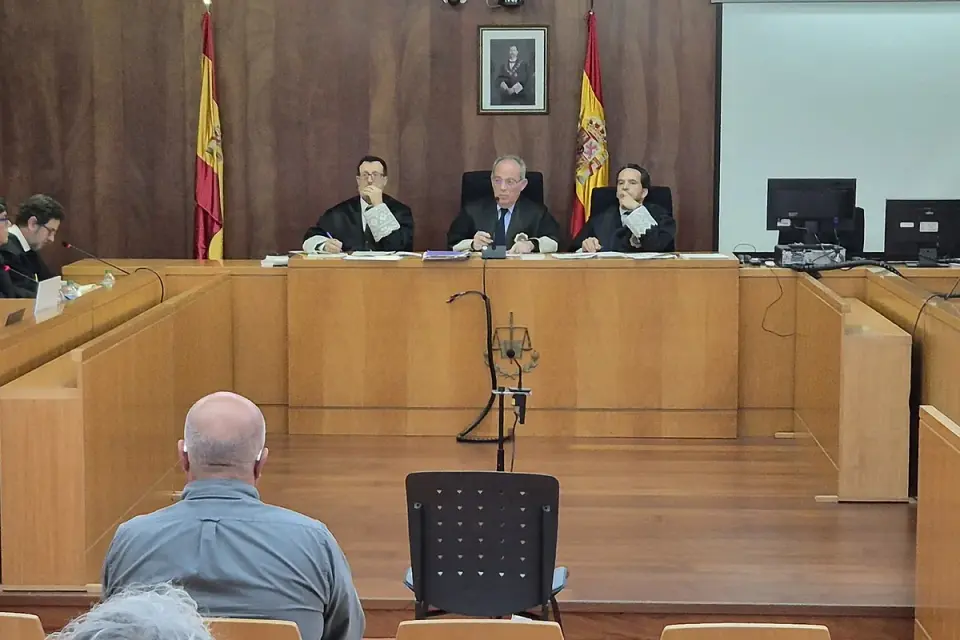
Mar Menor arrives at the courts as a private complainant, but the trial is postponed
The trial of the 'Topillo' case scheduled for Wednesday in the Fifth Section of the Provincial Court of Murcia has been suspended before it could take place. The Court agreed to postpone proceedings following the justified absence of judicial expert Luis Murillo, whose report is considered "fundamental" to the case, according to El Mundo.
The hearing had singular significance: it was the first time that Mar Menor, Europe's largest saltwater lagoon, was going to exercise its legal status as a private complainant and as the harmed party in a criminal proceeding.
Two companies and an administrator, accused of dumping between 2015 and 2017
The 'Topillo' case is a major prosecution investigating a series of pollutant discharges from various operations in the Campo de Cartagena. Expert reports suggest that these discharges may have caused "irreversible" damage to the lagoon. In this particular proceeding, two companies and an administrator are accused of an alleged crime against the environment committed between 2015 and 2017.
Expert Murillo was to establish in his report the damage suffered by the lagoon, its causes and an economic assessment of such damage. Given his absence, the prosecutor of the Cartagena Area requested the suspension in order to hold the trial as a single session with the expert present. The private complainants—comprised of four municipalities in the Region and groups such as Pact for Mar Menor, Ecologists in Action, Greenpeace Spain and Mar Menor Amarme Alliance—supported that request, which the judges ultimately accepted.
The origin: illegal boreholes and the "green soup" of 2016
Inés Díez, head of the legal department at Greenpeace, explained to El Mundo that the case began in 2018, when the Public Prosecutor's Office, based on investigations by Seprona, filed a complaint for alleged extraction of water from illegal boreholes. That water was desalinated through a reverse osmosis process which, according to the accusation, triggered the first "green soup" in 2016, a phenomenon that occurs when the lagoon "collapses" by being "unable to self-regulate because of the large quantity of nutrients it was receiving".
Three years later, on 12 October 2019, the DANA storm that hit the Region of Murcia caused a new collapse by dumping that same content into the lagoon's waters. "All these practices have meant that the ecological state of the sea is absolutely degraded," said Díez.
The sentences sought exceed half a million in compensation
The Public Prosecutor seeks in its charge document seven years' imprisonment for the administrator, a fine of 9,000 euros and compensation for public domain damage of 506,137.44 euros. The private complainants, for their part, are seeking a fine exceeding one million euros, suspension of business activities for three years and compensation also exceeding half a million euros.
A law that recognises the lagoon as a legal subject
The significance of the trial stems from Law 19/2022, of 30 September, by which the Spanish State recognises Mar Menor and its basin as an entity with its own legal status, with capacity to be represented in legal proceedings. It is the first time this mechanism has been activated in the Spanish and European legal system.
Díez noted, however, that the specific scope of this representation as the harmed party is still not entirely defined, given that the law has not been developed through regulation. The lawyer indicated that the representation could be exercised in any proceeding in which Mar Menor is affected, although the actual impact of this legal innovation will be determined by the regulation that develops the law and by the jurisprudence that is generated.
The Tajo-Segura transfer, backdrop to the deterioration
On the future of the lagoon, Díez was cautious. "The state of the sea is very damaged and beyond the specific facts that will be seen in the various proceedings, the underlying problem is the economic impact. Irrigation has grown considerably since the Tajo-Segura transfer began in 1979 and right now there is no water," she pointed out.
"As long as this system exists, the lagoon will probably continue to be harmed. Either you get water from the transfer or you extract water from boreholes that at this point are irregular and illegal and are not authorised by the Segura River Basin Authority," added Greenpeace's legal chief.
The trial will be held on a date yet to be determined, when the presence of expert Luis Murillo can be guaranteed and the proceeding can be held in a single session.
Source: El Mundo