TER derailment at Cléon: 44 injured, section of rail found on track
A TER train linking Rouen to Caen derailed on Friday evening near Cléon (Seine-Maritime), leaving 44 injured. Investigators are treating it as a criminal act.
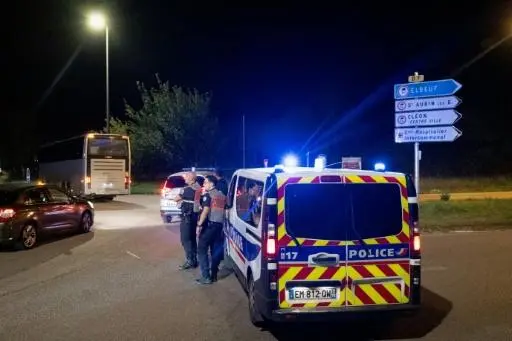
Derailment at Cléon: criminal act at the heart of investigation
A criminal act is the priority line of enquiry following the derailment, on Friday at around 19:45, of a TER train on the Rouen-Caen line at the level of the town of Cléon, in Seine-Maritime, according to afp.com. The accident left 44 injured, including an 18-year-old young woman who was in "absolute emergency" and whose life is now no longer in danger.
The convoy, made up of two trains and carrying 186 people, derailed between Tourville and Elbeuf-Saint-Aubin stations. One carriage overturned on its side; four others came off the rails.
Section of rail weighing 250 to 300 kilos on the track
"The main hypothesis is that of the presence, on one of the rails of the track, of a section of rail, which could be at the origin of this derailment," said the Rouen prosecutor, Sébastien Gallois, on Saturday in a statement. The causes of this presence "are unknown and will need to be identified by the investigation," he added, noting that the train's black box has been seized.
Hervé Morin, president of the Normandy region, was more categorical. This section of rail, "estimated at between 250 and 300 kilos," did not "just end up on the track like that, knowing that a train passed an hour before and there were no works in the meantime," he told AFP. He described the event not as an ordinary malicious act, but as "an act that could be described as criminal." The maximum authorised speed on this section is 120 km/h. The locomotive overturned from the violence of the impact, ending up facing towards Rouen when it was heading towards Caen.
Judicial police operations continue
The investigation has been entrusted to Rouen's judicial police. On Saturday early afternoon, around fifteen investigators were present at the scene, an AFP photographer observed. Investigations, notably technical police operations, continue "actively," according to prosecutor Gallois. Several interviews are planned and a judicial expert has been requested.
The derailment occurred in a narrow bend of the Seine, in the immediate vicinity of the Renault factory in Cléon.
130 firefighters and five medical teams deployed
Shortly after the accident, substantial emergency resources were deployed: 130 firefighters, five medical teams and 80 vehicles. Among the lightly injured, 26 were cared for in four healthcare facilities in Rouen. Twenty-one were able to return home during the night; five remained hospitalised on Saturday at mid-day, Transport Minister Philippe Tabarot specified on X.
"I am still trembling from it"
The violence of the impact deeply affected passengers. "Suddenly there were a few jolts, then after three seconds, it became stronger and stronger," testified Louis, 24, to ICI Normandie. "It was really shocking, I am still trembling from it."
The mayor of Cléon, Mélanie Delacour, whose municipality accommodated train passengers during the night following the accident, described victims "in a state of shock, because it was violent." She reported to AFP that stones had entered inside the trains when the windows gave way under the force. Some victims "say: I will never take the train again. It is a tragedy that could have been a disaster of very great magnitude," Mrs Delacour added.
Railway traffic disrupted
Railway traffic, interrupted on several lines in the area around the zone — notably Paris-Rouen and Rouen-Amiens — was restored on Saturday morning, according to an SNCF Réseau spokesperson. The Rouen-Caen line itself, however, remains interrupted. On this route, ten return journeys per day are operated during the week, six at the weekend.
For recovery of the train, SNCF Réseau teams must wait for the prosecutor to "release the zone" before they can inspect the location and organise operations. The timeframe remains undetermined at this stage.
Source: Google News LU FR