Former jihadist Othman Garrido sentenced to 30 years in prison in Paris
Paris's special assises court sentenced French national Othman Garrido to 30 years imprisonment on Tuesday for murders committed by an organised group in Syria.
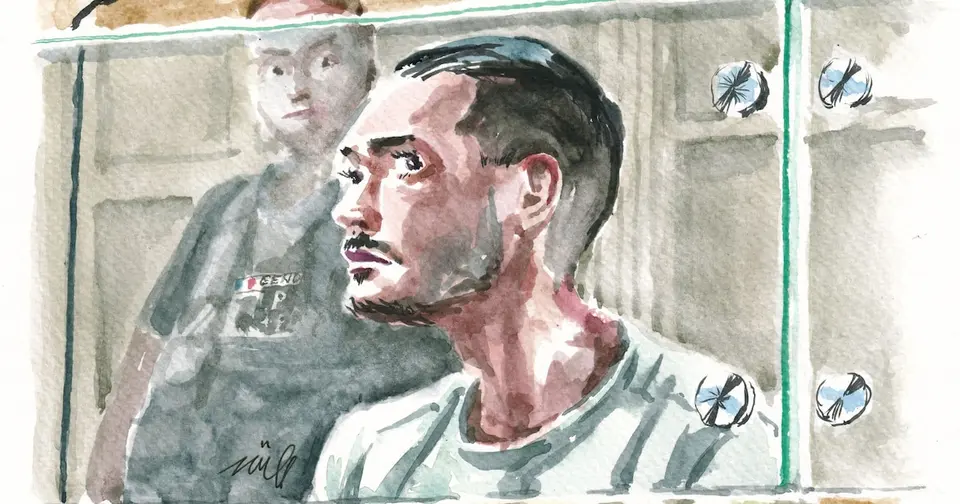
30 years in prison for former French jihadist Othman Garrido
Paris's special assises court sentenced Othman Garrido to 30 years imprisonment on Tuesday evening, with a mandatory minimum security period of two-thirds of the sentence. According to DHnet, the 32-year-old from Montpellier, a former member of the Islamic State (IS) organisation, was found guilty of murders committed by an organised group and of membership in a terrorist criminal association, but acquitted on a charge of assassination.
The prosecutor general had sought a life sentence with a mandatory minimum security period of 22 years. The court delivered a more measured decision, which the defence partly welcomed. "The court took account of his conduct whilst in custody and logically acquitted him of the charge of assassination," said Antoine Ory, Garrido's lawyer, speaking to AFP.
Acquittal on photograph, conviction on irrefutable images
The assassination charge rested on a poor-quality photograph, neither dated nor geolocated, showing a man with a partially masked face posing with a severed head. This image had been found in a mobile telephone attributed to Garrido's wife, recovered by Americans in Syria following IS's defeat in 2019. Experts never formally identified the individual in the image as being Garrido; the prosecution relied on clothing, posture and silhouette.
However, the court established his presence at a double public execution of two Iranians in September 2015 in al-Qaryatayn, Syria. Other photographs found in the same telephone show him in the pick-up truck transporting the condemned men, then with his hands on the shoulders of two executioners — the French jihadists Oumar Diaw and Yacine Rettoun, both since deceased — posing smiling in front of the two decapitated corpses.
An extraordinary family background
The trial, opened on 14 September, highlighted a singular trajectory among the approximately 1,500 French jihadists who left to join IS during the 2010s decade. Garrido described himself as "born radicalised" within an ultra-religious family, under the control of a father who had converted to Islam. The prosecutor general had acknowledged in his closing address the power of this paternal figure and described the Garrido family — three brothers and two sisters — as a cell that was "under wraps, withdrawn into itself and radicalised".
"It is a family of Islamist struggle. It is a family where the children do not draw faces, where they buy a television to smash it," he had stated.
After a childhood split between France and Morocco, Garrido attended school for only a few years during his teenage years before working with his father at La Paillade market in Montpellier, then reputed as a centre of Salafism. It was in his father's circle that he apparently found in Ahmed al-Mezgaldi a new figure of authority, presented at the hearing as the one who encouraged him to leave for Syria. He left France in 2012, at the age of 18, as a "pioneer", before being joined by the rest of his family.
The debate on free will
The prosecution emphasised the gradual emancipation of the Garrido brothers, arguing that they "had the choice to escape this indoctrination, not an easy one, but they had it". The defence contested this analysis, recalling that experts had highlighted "sectarian mechanisms" within the family and the impossibility for an 18-year-old to extricate himself from such an environment.
Over the course of the hearings, Garrido recounted a period in custody marked by study, psychological support and a displayed distancing from jihadist ideology. Experts acknowledged this evolution, but the prosecution judged it "suspect" and almost too smooth.
Louise el-Yafi, lawyer for the French Association of Victims of Terrorism (AFVT), a party to the proceedings, had summed up the difficulty of assessing the accused on Tuesday morning. "Neither a convinced jihadist nor a perfect penitent. What do we do with all this complexity?", she had asked, before addressing Garrido directly: "Is he dissembling, is he sincere? The truth is that I do not know."
Source: DHnet