Peru's Environment Ministry authorised retroactive shark fin quotas that benefited company under organised crime investigation
The Minam approved three retroactive opinions in 2025 that permitted the export of 60.5 tonnes of pelagic thresher shark fins, benefiting Inversiones Perú Flippers, whose representative faces charges for illegal wildlife trafficking.
Minam's retroactive quotas opened the door to further shark fin exports
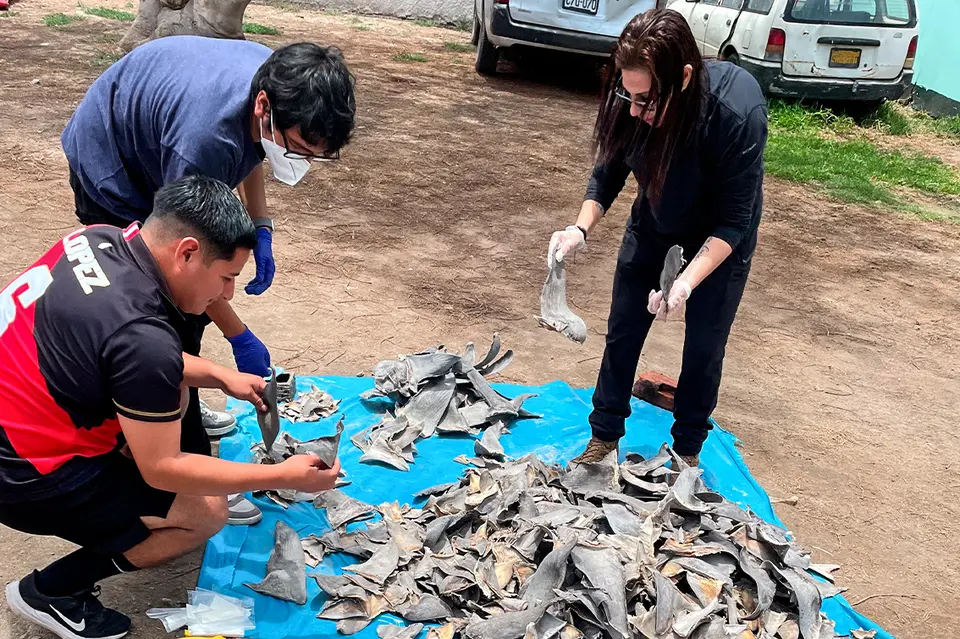
A shipment of 112 kilogrammes of shark fins concealed in a car boot exposed what is allegedly a criminal organisation dedicated to marine wildlife trafficking in Peru in November 2025. According to es.mongabay.com, Peruvian and United States authorities traced the driver to a warehouse at Callao port, where they found 9.3 tonnes of dried fins stored in 338 sacks with no documentation proving their legal origin. To complete that shipment, at least 9,000 sharks would have had to be killed. The product was valued at 11.2 million dollars on the black market.
The principal suspect is Juan Roberto Quispe Huamaní, the vehicle's driver and legal representative of Inversiones Perú Flippers E.I.R.L., the company that owned the merchandise. Quispe Huamaní was detained in flagrante delicto and identified as the alleged ringleader of the criminal network, although he currently faces a criminal proceeding.
Exports that continued despite judicial proceedings
Despite his detention, the company did not interrupt its commercial activity. Mongabay Latam revealed in July last year that the Ministry of Production (Produce) continued approving export applications for fins at least until June of this year. The highest fishing authority had warned of irregularities in certain applications from Inversiones Perú Flippers—including alleged falsification of documents, data manipulation and inability to demonstrate the legality of part of the product—but continued to grant permits for the volumes that did comply with regulations.
The public prosecutor for the Ministry of Production, Fernando Vidal Malca, justified the decision: "Produce evaluates each volume independently. For this reason, the permit is granted only for quantities in respect of which the legal origin, traceability and chain of custody required by regulations has been documented."
The Minam authorised retroactive opinions to release accumulated stock
The second part of the es.mongabay.com investigation now points to the Ministry of the Environment (Minam). Between September and October 2025, weeks before the seizure at Callao, the Minam issued three retroactive and exceptional Non-Detriment Findings (NDFs). These documents expanded the maximum export quotas for pelagic thresher shark (Alopias pelagicus) corresponding to 2022, 2023 and 2024, allowing the release of a stock of fins stored during that period.
The NDF is an annual scientific study that determines whether extraction of a protected species can be carried out in a sustainable manner. When the conclusion is favourable, the country's CITES scientific authority—in Peru, the Minam itself—sets the maximum quantity that can be exported so as not to compromise the species' survival.
In total, the three retroactive opinions authorised the additional marketing of 60.5 tonnes of dried fins of a species classified as Endangered by the International Union for the Conservation of Nature (IUCN). Among the companies that benefited is Inversiones Perú Flippers E.I.R.L. Thanks to that quota expansion, the company was able to export, following the November 2025 seizure, six additional shipments of fins that together exceeded 7.3 tonnes. The other two companies that benefited are Lamarqocha Inversiones S.A.C. and Full Moont S.A.C.
Specialists warn of risk of laundering illegal fins
For the experts consulted by Mongabay Latam, the permits granted contravene international recommendations to curb species trafficking and could be facilitating the laundering of fins of illegal origin.
"What we observe is that they simply wanted to release a stock of fins that these gentlemen supposedly had with traceability," said Juan Carlos Riveros, scientific director of the NGO Oceana. Riveros added that "it is very likely that they are fins from Ecuador," a country that since March 2024 has been prohibited from exporting sharks protected by CITES after a series of cases of illegal trafficking directed mainly towards Peru were confirmed.
The fins stored by Perú Flippers and those it has exported with authorisation from Produce are protected by the Convention on International Trade in Endangered Species of Wild Fauna and Flora (CITES). Their export is conditional on compliance with a series of obligations and the obtaining of specific permits.
Industry pressure preceded approval of the opinions
The Minam's decision to approve the three retroactive opinions came after intense pressure from the sector. In November 2024, the Federation of Maritime Artisanal Fishermen of Tacna (Feparmertac) sent a letter to the Ministry's General Directorate of Biological Diversity requesting the expansion of export quotas for accumulated stock from previous years.
The es.mongabay.com investigation into shark fin trafficking in Peru continues. The first part revealed that Quispe Huamaní, despite facing organised crime charges, remained active in the trade of fins of endangered species.
Source: Google News PE — Crime