US intensifies cooperation with Paraguay against transnational organised crime
A senior State Department official met with President Santiago Peña in Asunción to strengthen regional security collaboration.
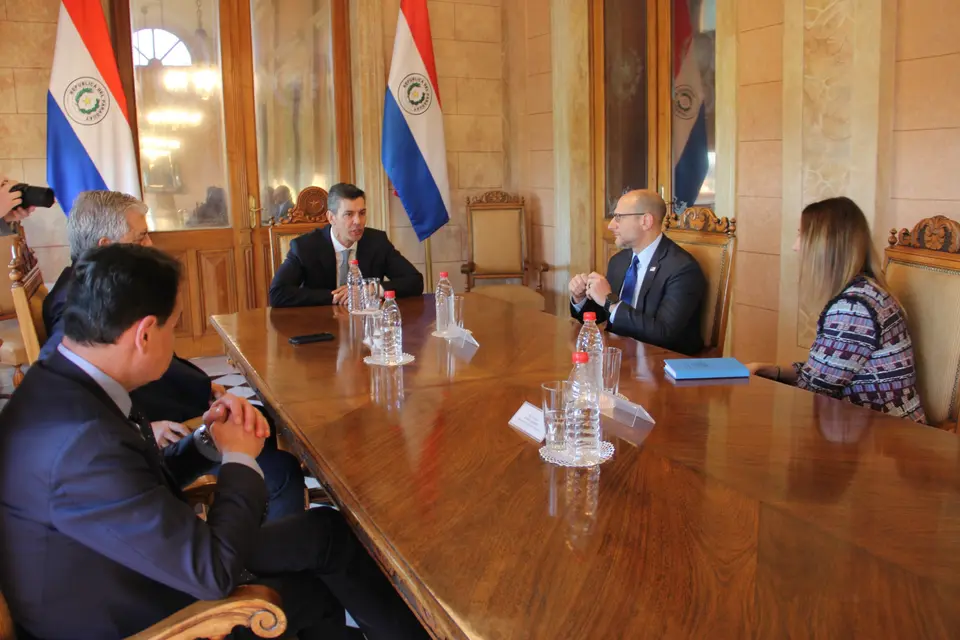
Washington reinforces its security strategy in Paraguay in response to advancing transnational crime
President Santiago Peña received on 16 September in Asunción Mónica Ager Jacobsen, Deputy Coordinator for National Security, Control and Terrorist Designation at the Counterterrorism Office of the US State Department, according to rcc.com.py. The meeting was also attended by the Interior Minister, the National Chancellor and the Chargé d'Affaires of the US Embassy, Robert Alter.
The meeting analysed threats linked to transnational organised crime in the region and the need to deepen cooperation between countries. The central point of agreement was that isolated actions prove insufficient against organisations that have international networks, financial resources and the ability to move between territories.
The Transnational Terrorism Forum as the setting for the meeting
Jacobsen travelled to Paraguay to participate in the sixth meeting of the Transnational Crime and Terrorism Forum (CTTF), held on 16 and 17 September in the capital. The forum includes an assessment of transnational crime threats, the financing of terrorist activities and the impact of new technologies on these networks.
The presence of an official of this rank in Asunción reflects the growing weight that Washington assigns to regional security and the fight against transnational organised criminal organisations.
A cooperation agenda taking shape
The visit is part of a series of initiatives showing the sustained interest of the United States in strengthening security cooperation with Paraguay.
In August, the Interior Ministry reported on Paraguayan participation in an initiative of the Americas Coalition Against Cartels (A3C), promoted with the participation of the US Southern Command. The stated objective is to expand information exchange and strengthen regional capacities to confront criminal organisations operating beyond national borders.
Paraguay has also signed a security cooperation agreement with the United States that includes joint actions against organised crime and drug trafficking, as well as training and technical assistance in various areas.
In June, the country acceded to the Santiago Regional Commitment, which establishes technical and operational coordination, information exchange, financial intelligence and border control among the signatory countries.
Paraguay, regional corridor at the centre of the strategy
The regional scenario explains much of this diplomatic and security offensive. Drug trafficking, arms trafficking, money laundering and other illicit activities are articulated through networks that take advantage of borders and differences between the control systems of each country.
Paraguay, due to its geographical location and its status as a regional corridor, is a central part of this discussion. The country has been deepening cooperation mechanisms with international organisations and neighbouring countries to improve intelligence exchange and the prosecution of criminal structures.
The challenge, as set out in the meeting, is not limited to increasing operations or seizures. Cooperation also aims to track money, share intelligence, control borders and dismantle the logistical and financial networks that sustain these organisations.
The agenda that the United States is currently developing in Paraguay places the country within a broader regional strategy, in which Washington seeks to strengthen coordination between governments to confront threats that, by their nature, do not respect territorial limits.
Source: Google News PY — Crime