Eleventh Court of Caracas assumes case of qualified homicide that occurred in 2013
The Supreme Court of Justice (TSJ) declared the Eleventh Court of First Instance in Trial Functions of Caracas Judicial Circuit competent to hear the case brought against Pedro Felipe Obregón Villamizar for the homicide of María Dolores Cañavete Zapata.
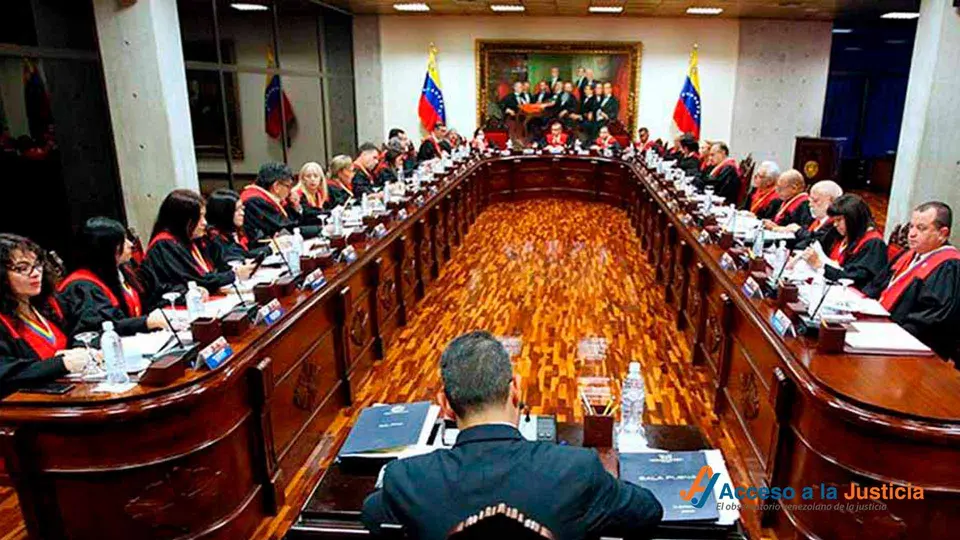
Jurisdictional conflict resolved by the TSJ in homicide case prior to the criminalisation of femicide
According to accesoalajusticia.org, the Criminal Cassation Chamber of the Supreme Court of Justice (TSJ) declared the Eleventh (11th) Court of First Instance in Trial Functions of the Criminal Judicial Circuit of the Metropolitan Area of Caracas competent to hear the criminal case brought against citizen Pedro Felipe Obregón Villamizar, holder of identity card number 5,313,673, for the alleged commission of the crime of qualified homicide against María Dolores Cañavete Zapata.
The decision, with Judge Carmen Marisela Castro Gilly as rapporteur, ended a jurisdictional conflict of no-jurisdiction that pitted two courts of the same judicial circuit in the capital against each other.
Events of 8 February 2013
The criminal investigation began on 8 February 2013, when Agent Rangel Yorkis of the Scientific, Criminal and Forensic Investigation Body (CICPC) reported by radio the discovery of a woman's body in the parking area of a building. Upon arriving at the scene, officers were approached by residents who expressed desperately that the citizen had fallen from her apartment.
Walter Rivero, an official assigned to the Bolivarian National Intelligence Service (SEBIN), indicated to the agents the exact location where the dying body of María Dolores Cañavete Zapata was found. The Fire Department of the Capital District attended the scene and transported her to Pérez Carreño Hospital. At the scene, several residents stated loudly: "He killed her", "He threw her from the apartment" and "He was beating her", which prompted the preventive detention of Pedro Felipe Obregón Villamizar.
Origin of the jurisdictional conflict
The Eleventh Court of First Instance in Trial Functions, when reviewing proceedings during the opening of the oral and public trial, found that Obregón Villamizar was accused of qualified homicide in accordance with article 406, numeral 3, literal a of the Penal Code. Because it involved the death of a woman, it declared itself incompetent and referred the file to the special courts for Violence against Women of the same circuit.
The Fifth (5th) Court of First Instance in Trial Functions with jurisdiction over Violence against Women matters received the proceedings and, in turn, declared itself incompetent. It based its decision on the fact that the referring tribunal failed to verify that Cañavete Zapata's death occurred on 8 February 2013, that is, before the amendment to the Organic Law on Women's Right to a Violence-Free Life, published in Official Gazette No. 40,548 of 25 November 2014—and reprinted in Official Gazette No. 40,551 of 28 November 2014—an amendment that incorporated the crime of femicide into the Venezuelan legal system for the first time.
The Fifth Court referred the file identified by the alphanumeric AP01-M.2022-865 to the Criminal Cassation Chamber of the TSJ by official letter No. 062-22, dated 27 June 2022, in accordance with article 82 of the Organic Code of Criminal Procedure, formally raising the jurisdictional conflict.
TSJ criterion: the law in force at the time of the events applies
In resolving the conflict, the Chamber verified the content of article 64 and the sole paragraph of article 65 of the Organic Law on Women's Right to a Violence-Free Life in force at the time of the events. The Chamber concluded that in cases of homicide in any of its forms committed against women before the criminalisation of femicide, jurisdiction over the case belongs to ordinary criminal courts, by express referral of that provision.
The decision was also based on articles 24 and 49, numeral 6, of the Constitution of the Bolivarian Republic of Venezuela—which establish the principle of non-retroactivity of criminal law and the right to a natural judge—as well as on article 1 of Resolution No. 2014-0040 of 10 December 2014, issued by the Full Chamber of the TSJ.
Decision
The TSJ declared the Eleventh (11th) Court of First Instance in Trial Functions of the Criminal Judicial Circuit of the Metropolitan Area of Caracas competent to continue hearing the case brought against Pedro Felipe Obregón Villamizar for the alleged commission of the crime of qualified homicide, provided for and punishable under article 406, numeral 3, literal a of the Penal Code, against María Dolores Cañavete Zapata.
The case establishes a relevant procedural criterion: homicides against women that occurred before femicide was criminalised in Venezuela must be processed before ordinary criminal justice, not before special courts for violence against women.
Source: Google News VE — Caracas