Brazilian Supreme Court adjourns trial of Alexandre de Moraes after heated session with accusations between judges
The Supreme Court began the trial that could open an investigation into Moraes, but the session ended with an adjournment following fierce confrontations between magistrates.
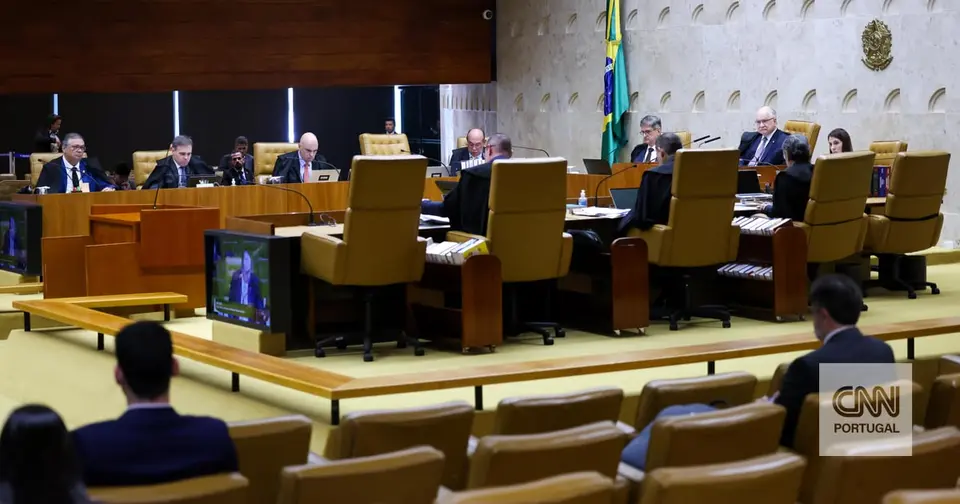
Supreme Court delays decision on Moraes after session marked by confrontations between magistrates
Brazil's Supreme Court met on Tuesday to judge the matter that could determine the opening of an investigation against judge Alexandre de Moraes, but the session ended without a substantive vote. According to CNN Portugal, the session began at 2 pm (Lisbon time) and continued for several hours, culminating in an adjournment after a provisional vote count of four against the adjournment and three in favour.
Judge Flávio Dino's vote was not counted, as the magistrate requested to examine the case documents. The case is thus suspended for a maximum period of 90 days, during which Dino may review the files.
Fachin appeals for calm but loses control of the session
The president of the Supreme Court, Edson Fachin, opened proceedings in a sombre tone. He recalled the trajectories of each of the magistrates — highlighting, among others, the academic careers of Moraes and Fux — and acknowledged the delicate moment being experienced by the institution. "This is not an ordinary day," Fachin said. "The moment demands from us what is expected of those who exercise the judicial function: good sense, decorum and serenity."
The president also read a report containing all documents received when he took charge of the case, previously under the responsibility of André Mendonça. Fachin explained that the Federal Police had produced a report indicating messages exchanged between banker Daniel Vorcaro — arrested for fraud and corruption — and Alexandre de Moraes. The content was made public by Mendonça, triggering the institutional crisis. The Attorney General's Office subsequently requested the annulment of the document, arguing that a Supreme Court judge cannot be investigated without the approval of the other members of the court.
Fachin lost control of the session when magistrates were called upon to state whether they had any grounds for disqualification from participating in the trial. From that point on, the president became a secondary figure in a plenary dominated by accusations and interventions spoken in raised voices.
Two judges declare themselves disqualified, a third remains
Kassio Nunes Marques was the first to speak. Federal Police investigations indicate that the judge's son may have received substantial payments linked to Banco Master. Nunes Marques denied any involvement by himself or his family with Vorcaro, but chose not to participate in the case. "This trial could eventually also impact the political-electoral scenario, so in my capacity as president of the Superior Electoral Court I do not feel comfortable," he said, then withdrawing from the plenary.
Dias Toffoli was the second to declare himself disqualified. Since February, the magistrate has abstained from all decisions related to the Master case. Toffoli sold his stake in a resort to a fund belonging to Fabiano Zettel — Vorcaro's brother-in-law, also detained — but denies any illegality. The magazine piauí also reported that the judge may be a beneficiary of a fund that received over 30 million reais from Banco Master, a fact that never prompted the opening of an investigation. Despite declaring himself disqualified, Toffoli assured that he would remain in the plenary to attend the session, but did not speak again before the adjournment at 5 pm (Lisbon time).
André Mendonça, vice-president of the Superior Electoral Court, opted for a stance opposite to that of his colleague Nunes Marques and remained in the trial.
Gilmar Mendes and Dino dominate the discussions
Gilmar Mendes and Flávio Dino were the protagonists of the most heated hours of the session. Mendes took the floor to raise a point of order, proposing the suspension of the trial and a joint trial of Moraes and Mendonça on 23 September, as well as the disclosure of all magistrates mentioned in investigations related to the Master case — a request that had previously been made and denied by Fachin.
The interventions of both went far beyond procedural matters. Dino directly confronted the court president: "Your honour's robe is the same as mine. Being equal, we must follow the rule that governs the relationship between equals. In no court can a president remove a rapporteur."
The judge was referring to the change of rapporteur for the case involving Moraes, previously handled by Mendonça. Fachin responded: "I never removed any rapporteur at any point. Your honour starts from the premise that I assumed the reporting of the Master and INSS cases, which did not occur." Dino did not relent and insisted on compliance with legal procedure: "Anxieties produce disasters."
Gilmar Mendes criticises removal of Federal Police director
The most direct attacks against Mendonça came from Gilmar Mendes, the court's senior judge. In a raised voice and with emphatic gestures, Mendes condemned Mendonça's decision to remove the Federal Police director-general, Andrei Rodrigues — a measure taken days after Dino had authorised Federal Police operations against members of the Brazilian far-right, including parliamentarians close to Mendonça.
"Any citizen who has the slightest notion of what the Federal Police means, which is an armed body subject to hierarchy, would not remove the police director. It is like removing the president of NASA or removing the commander of the army. You do not do it," Mendes said. "The person would need to be arrested before doing this kind of thing. When he has the temptation, he needs to ask God to intervene. And do not do it. Because, in fact, to submit an institution that already lives all the problems it has to this kind of humiliation is a lack of sense, of gravity."
The substantive trial, which will decide whether Moraes can or cannot be formally investigated, remains suspended while Dino examines the case — with the maximum period of 90 days running from Tuesday.
Source: CNN Portugal