General Cristancho identifies 24 criminal gangs in Bogotá and launches security plan
The commander of the Bogotá Metropolitan Police revealed that 24 criminal structures operate in the city. Theft from individuals is his priority in the first 90 days of the new government.
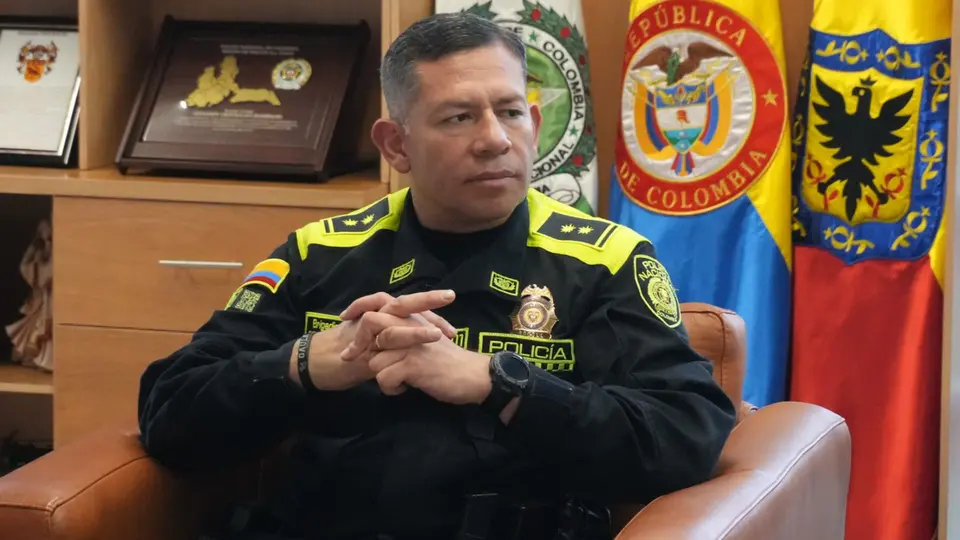
Bogotá in focus: 24 gangs, 90 days and a ratified general in command
The Bogotá Metropolitan Police has identified 24 criminal gangs responsible for theft, homicide and drug distribution in the capital, according to General Giovanny Cristancho in an exclusive interview with lafm.com.co. The officer was ratified as commander of the institution with the arrival of President Abelardo De la Espriella's government, in contrast to the command changes recorded in other military and police units in the country.
"It is a vote of confidence from the National Government, from our President, but also from the General Director of the Police, General Alejandro Barrera, who ratifies me," said Cristancho. "For me it is a new beginning, a break before 7 August. Everything must be done as if we were on the first day."
Theft from individuals, priority number one
The general stated that his main objective during the first 90 days of the new government is to reduce robbery of citizens in the street. "I have never wanted to normalise theft of mobile phones, I have never wanted to normalise the theft of a bicycle, but we know it happens on a daily basis," he affirmed. Cristancho indicated that he regularly attends community meetings and that the most frequent demand from residents is to be able to walk with peace of mind in a park.
The commander acknowledged that statistics show progress, but admitted that communities still perceive insecurity. "We are working to overcome these challenges. Theft for me is a priority: to seek out those criminal groups, attack them and bring them to justice," he said.
The revolving door of the criminal justice system
One of the most critical points in the interview was Cristancho's description of how the current judicial system functions. According to Cristancho, last year there were 29,000 arrests caught in the act for theft and drug trafficking, of which only 5% resulted in preventative measures. "That is a revolving door for criminals," the general stated.
The officer acknowledged the institutional strain generated by this dynamic: each arrest involves a hearing before a judge, which takes time away from the system to prioritise more complex cases. However, he maintained that the Police would continue to act. "We must arrest them as many times as necessary. I have said it many times: if we have to do it 20 times, we will arrest them 20 times."
Cristancho also noted that the theft of a mobile phone, although classified as a minor offence, has a profound impact on victims. "Your mobile is stolen and they take away half your office, matters of the house, family, photos of all your loved ones," he expressed. In his view, current legislation on minimum amounts needs review, and he was confident that the mayor would drive working groups to address the problem in the new legislative session.
Criminal structures in focus
Police intelligence has identified the localities with the highest crime rates and drawn up a differential strategy for each one. Among the organisations identified are the Tren de Aragua, Los Paisas and groups specialising in vehicle theft and armed robbery of financial entities. Also in the spotlight are freight handlers and drug distribution networks active in various parts of the capital.
The general explained that the work is not exclusive to the Police: "Here too are the Public Prosecutor's Office, the Mayor's Office and the secretariats. With them, we began to prioritise phenomena in some localities." Inter-institutional coordination is, according to Cristancho, the basis of the results achieved so far against these structures.
Over the next 90 days, focus will be on 24 criminal structures, with the aim of achieving arrests of high-value targets within the Tren de Aragua and groups dedicated to vehicle theft, among others.
A mandate that began with grenades
Cristancho recalled that his first day leading the Metropolitan Police was marked by a serious incident in the San Bernardo neighbourhood, where grenades were thrown. "That was my welcome, but we took on the challenge and from that moment onwards we managed to build a great working team," he said.
The general has high-impact operations in his track record: he participated in the takeover of the Bronx—the largest operation against micro-trafficking in central Bogotá—and in the processes that culminated in the capture of alias 'Otoniel', the top leader of the Gulf Clan. Now, with that accumulated experience, he faces the challenge of protecting a city that has the highest police density in the country.
Assessment at 90 days
President De la Espriella expects to receive a management report once the first three months of government have been completed. In that context, Cristancho took on the commitment to present concrete results in reducing crime.
The general warned, however, that urban security exceeds the Police's capabilities alone. "Where the Police have a presence, crimes are contained, but we cannot place a police officer on every corner, it is impossible," he stated. He also noted that weekends record deaths and injuries due to social intolerance, a phenomenon which, in his view, requires specific public policies beyond police action.
Source: Google News CO — Bogotá