Mazón denies before Catarroja court that Es-Alert delay caused deaths in the dana
The ex-Valencian president's lawyer presents a 66-page written submission that rules out the causal link between the late sending of the alert and the 231 deaths.
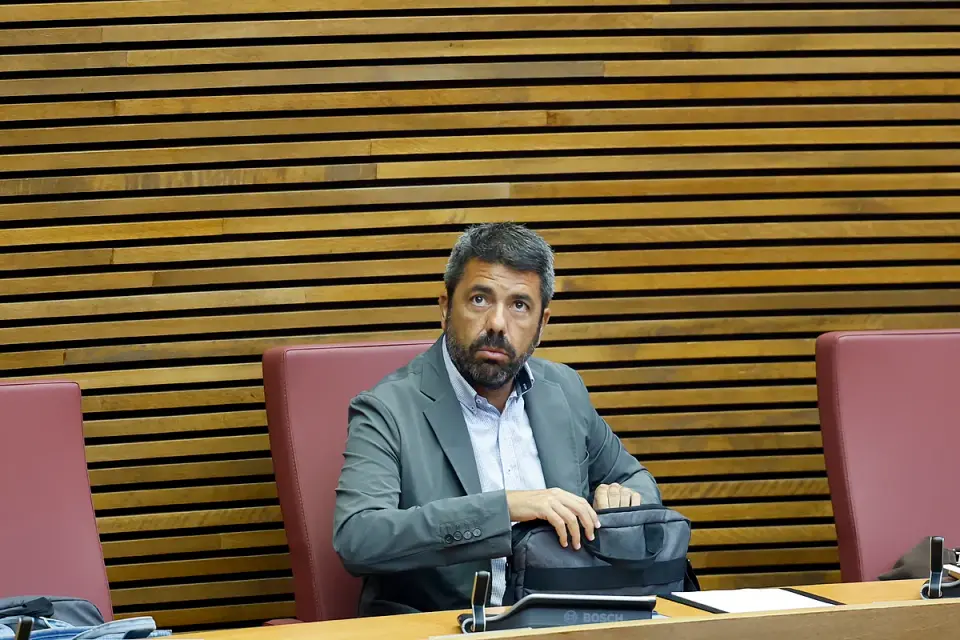
Mazón's defence rules out causal link between late alert and dana victims
Former president of the Valencian Generalitat Carlos Mazón has submitted his formal defence to the Catarroja court investigating the management of the dana of 29 October 2024, a catastrophe in which 231 people died. According to El Mundo, criminal law specialist Ignacio Gally has signed a 66-page written submission in which he counters the central thesis of both the prosecutors and the investigating judge: that the delay in sending the Es-Alert caused the deaths.
"To attribute the result [the death] to the delay, it would be necessary to prove that the difference between receiving the same warning around 20:00 hours or receiving it from 20:11 hours was precisely what determined that person's death. It must be proven what conduct could have been carried out during those 11 minutes, that would actually have been carried out and that its execution would have prevented the death with a degree of probability bordering on certainty," argues Gally in the document.
The defence goes further and maintains that it is impossible to determine, "with the degree of certainty required in criminal law", that each of the victims would not have died had they received the message sent at 20:11 hours a few minutes earlier, recommending avoiding travel. The written submission examines the evidence gathered in the case file corresponding to 42 of the 231 deaths and concludes that "this causal link does not exist".
Without guarantor status or evidence of direct involvement
The text recalls, in line with what the Valencian Superior Court of Justice already noted, that Mazón did not hold the position of guarantor of citizen safety. That responsibility fell, by competence, to regional minister Salomé Pradas. The defence argues that, consequently, Mazón could not have committed the crime of omission attributed to him by the investigating judge.
Gally further maintains that there is no evidence that the former president "issued instructions to determine or modify the content of the Es-Alert". According to the written submission, by 19:45 hours the "essential configuration of the two messages" was already "materialised" and the technical debate on whether to include indications relating to upper floors took place between those responsible present or connected to the CECOPI, "without the involvement of my client".
Cuenca's messages ruled out by chronology
The written submission also analyses the messages exchanged between Mazón's former Chief of Staff, José Manuel Cuenca, and regional minister Pradas. "Cuenca's messages begin at 19:54 hours. Consequently, those messages could not have caused a decision adopted nine minutes earlier. There is no record of his acting under instructions from Carlos Mazón when he sent his messages to Salomé Pradas," states Gally.
The lawyer adds that Pradas herself has denied that Cuenca's messages determined her actions, that there is no record of "an order from Carlos Mazón to stop any of the sendings" and that no technician who has testified before the court attributes to "an instruction from Carlos Mazón the time elapsed until the sending".
For the defence, the judge's two hypotheses about Mazón's involvement—direct or through Cuenca—are thus invalidated. The written submission recalls that the Superior Court of Justice itself had already warned of an "absence of supporting evidence" in the reasoning of the investigating judge, being based on contradictory hypotheses: on the one hand, that Mazón gave "direct and restrictive orders in an imperative manner through his chief of staff to obstruct or limit the taking of preventive decisions in the CECOPI" and, simultaneously, that "he was completely unaware and out of contact with the actual emergency situation".
Mazón asks the court to specify the indications against him
The defence asks the court to clarify whether, given the current state of the investigation, there remain "any positive fact or action specifically attributable to Mazón" or "any indication or line of investigation open or pending to be opened" regarding his potential criminal responsibility. It also asks to be informed whether there is "sufficient factual content to allow this defence to know it and to propose investigative measures and exculpatory evidence that it deems appropriate".
Mazón requested to be made a party to the case some months ago. Following the judge's initial refusal, the Provincial Court endorsed his participation. This status has allowed him to access the case file and gives him the possibility of requesting investigative measures or proceedings to be quashed at any time.
It is worth recalling that Mazón is not listed as an accused in the Catarroja court case. As a regional deputy with parliamentary privilege, the Civil and Criminal Division of the Valencian Superior Court of Justice rejected the reasoned disclosure submitted by investigating judge Ruiz Tobarra, considering that the steps taken until then had not produced sufficient reasoned indications against him.
Political reaction from the PSPV
PSPV general secretary Diana Morant responded to the written submission via X social network. "Almost two years later, they are still unable to acknowledge the obvious: they arrived late when it mattered most," she wrote. "An alert in time could have changed the fate of 231 people. Denying reality does not bring anyone back, but makes clear that there are those who still refuse to accept their responsibilities," Morant stated.
Source: El Mundo