Bishop Balog before the investigative committee: who will he point the finger at?
The pardon scandal is rooted in a web of personal connections and political interests. HVG has reconstructed how a fatal error could have slipped into the NER's otherwise disciplined system.
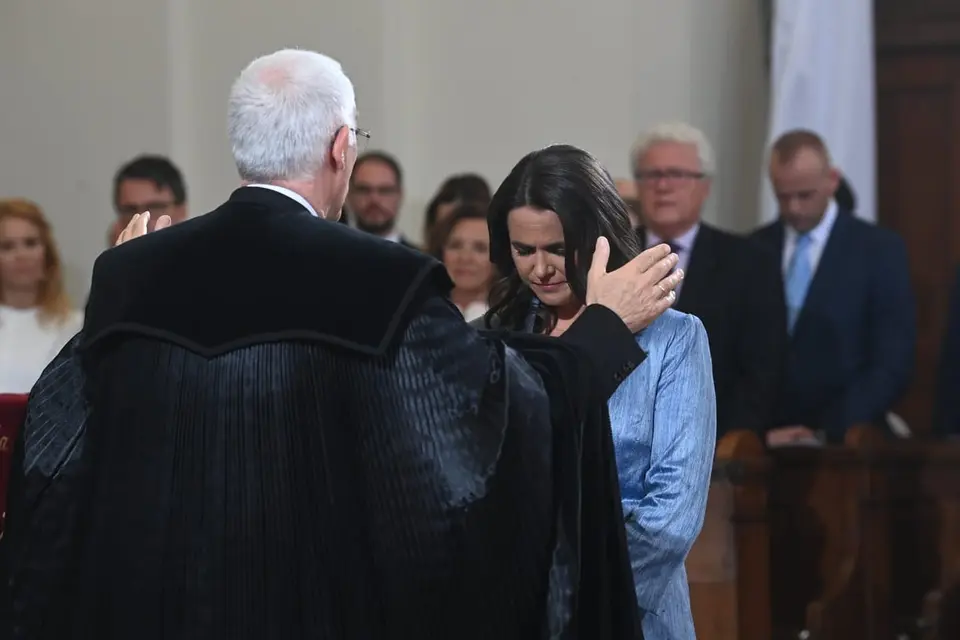
The background to the pardon scandal: decades-old alliances and political interests
Drawing on sources close to political and church inner circles, HVG has reconstructed the process whereby personal connections, political interests and the convergence of two separate cases introduced a fatal error into the otherwise disciplined system of the NER. The crux lies in communication details that are not documented – and by their very nature, cannot be.
"Viktor Orbán did not ask me to resign from the episcopate" – these were the words spoken by Zoltán Balog on 14 February 2024, a few days after the pardon scandal broke, at a meeting of the synodal council presidency of the Reformed Church. Ten people sat in the room: alongside Balog, the other three Reformed diocesan bishops and six council members, several of whom also held the position of chief warden. The agenda was whether Balog should resign after it became clear that he was deeply involved in the pardon scandal surrounding Endre Kónya, who had helped to cover up the affair of the paedophile headmaster in Bicske.
Those assembled quickly agreed that Balog's fate could not be decided by them – that was the task of a larger forum (which ultimately proved unnecessary, as Balog resigned from the leadership of the synod the next day, but retained his position as bishop). However, several were taken aback that the bishop had cited Orbán's position as an argument at all – particularly after the government chief had already once interfered in the internal life of the church, and it had not ended well.
From politics to church – Zoltán Balog's career path
The cooperation between Balog and Orbán spans decades. As a pastor at the Hold Street Reformed community and Orbán's spiritual guide, Balog initially sought to remain formally distant from direct politics, although in the 1990s he was already assisting from behind the scenes in the Fidesz's ideological transformation from the liberal camp to the conservative direction.
During the first Orbán government, in 1998, he received the title of adviser on church affairs, and then became director general of the Fidesz party foundation. In this capacity, he was able to lead the Prime Minister at the annual reviews year after year. By 2006, he held a position in the then opposition Fidesz parliamentary group.
After the 2010 government change, with the mid-cycle departure of Miklós Réthelyi, he took over the human resources portfolio in 2012. He sought to invest his ministerial role with moral weight through the statement that he wanted to be "the government's conscience".
Years as minister: loyalty and ecclesiasticisation
As Minister of Human Resources, Balog was involved in the termination of various benefits and the mass transfer of financially depleted state schools to ecclesiastical maintenance. He lent his name to making governmental loyalty the primary distribution criterion in state financing of culture. He blessed the expansion of the Hungarian Art Academy's power on the grounds that "we gave the artists the ability to decide things for themselves".
He was also a partner of Orbán in stripping ecclesiastical status from the Methodists led by Gábor Iványi, the MET, who had criticised him – despite the fact that in the period before the regime change, he had edited a newspaper jointly with Iványi, and they had fought alongside each other for religious freedom.
Orbán was not ungrateful: during Balog's tenure as minister, his church received state funding through unique government resolutions that was orders of magnitude greater than the actual provision of public services, in both money and property, with Balog having a decisive voice in the distribution. As one of the greatest achievements of his ministry, Balog himself mentioned the declaration of Good Friday as a public holiday.
Exit from politics – and return to the church
During his time as minister, there were repeated rumours that Balog aspired to a larger role – perhaps the post of head of state – and such speculations rarely arise without personal suggestion. After six years leading a portfolio, he left the government in 2018, and hinted that he had grown tired of political skirmishes, his "pastoral nature" struggling with the constraints. In an interview with Frankfurter Allgemeine Zeitung, he said what he did not dare to say at home: "not every migrant is a terrorist or a violent offender", and he said he would gladly have written this on anti-refugee posters.
His withdrawal from politics acquired new meaning roughly a year after his resignation, in 2019. At that time – as HVG first reported – the Reformed Church's synod amended the conditions for election as bishop: a single word was deleted from the previous regulation, which stated that only those who had completed at least ten years of "continuous" pastoral service could become bishop. This minor amendment removed every obstacle to the fulfilment of Balog's ecclesiastical career.
The two of them – Orbán and Balog – created circumstances that made it possible for Balog to first be elected bishop, and then leader of the synod's clergy.
Before the investigative committee
Now, as Balog faces the investigative committee, the stakes are not merely personal: the question is also at issue of how much the decades-old political and ecclesiastical alliances will withstand a formal accountability procedure. According to HVG's sources, the root of the scandal should not be sought in a single decision, but rather in the long, undocumentable system of communication networks that has been woven between people who have known each other well for decades and have mutually protected each other.
Source: HVG