Norwegian man threatening mass killing: eight years imprisonment upheld in Budapest
The Budapest Court of Appeal has upheld a sentence of eight years' imprisonment against D. Andre Brendjord for threatening to commit terrorist acts and for child pornography offences.
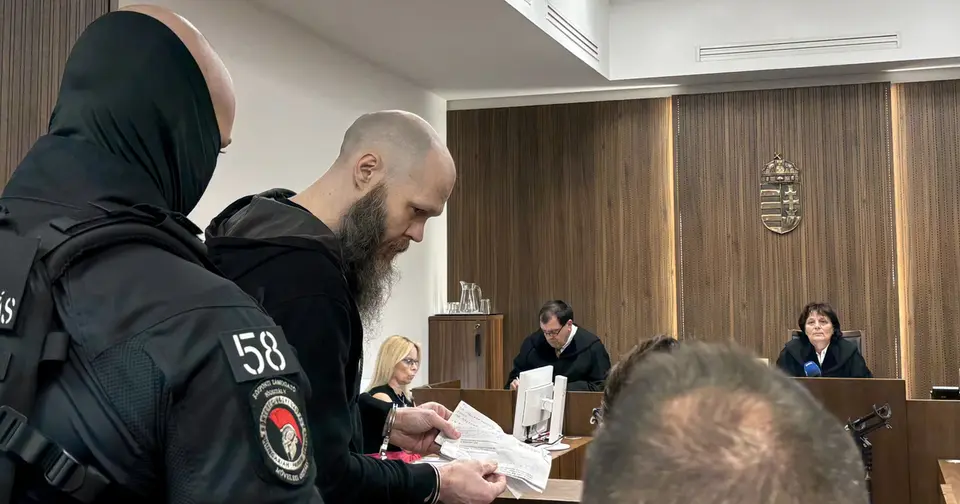
Final judgment in case of Norwegian man seeking to surpass Breivik
The Budapest Court of Appeal has upheld a decision reducing the prison sentence imposed on D. Andre Brendjord to eight years, according to Index. The first-instance court had imposed ten years' imprisonment on the 45-year-old Norwegian citizen in September last year for threatening to commit terrorist acts and for child pornography offences. The court also expelled him from Hungarian territory for ten years and ruled that he is ineligible for conditional release.
In its first-instance judgment, the Budapest District Court also ruled that D. Andre Brendjord is permanently barred from any occupation or activity that could bring him into contact with persons under the age of 18. The court also ordered that recordings of the defendant available on video-sharing platforms be rendered permanently inaccessible.
Seeking to surpass Breivik
According to the facts established in the first-instance judgment, the foreign citizen, who had psychopathic, dissocial and antisocial traits and did not speak Hungarian, created and published recordings on a video-sharing platform in which he threatened to kill multiple people with the aim of intimidating the population. The Counter-Terrorism Centre (TEK) informed the Police Rapid Response and National Investigation Office (KR NNI), whose staff immediately began analysing the recordings and identifying the man featured in them. Authorities eventually arrested the man at his flat in Ferencváros.
According to the content of the published videos, Brendjord intended to surpass the 2011 Norwegian terrorist attack – carried out by Anders Behring Breivik and claiming 77 lives. Statements heard in the recordings included: "I will take away everything that matters, everything that is valuable, I will destroy the country. Just watch! I can attack anywhere. Aeroplane, airport, railway station, nothing is a problem for me. I will destroy the innocent."
Court rejected the "creative dark humour" defence
The court rejected the defendant's contention that his videos fell into the category of "creative dark humour" and freedom of expression. The court found that the content of the recordings was clearly capable of causing serious fear, and the man's suggestive-aggressive style reinforced the reality of the threats. Although Article IX of Hungary's Fundamental Law guarantees freedom of expression, this does not mean unlimited hate speech – particularly not in the shadow of significant European terrorist attacks.
Regarding the child pornography count, Brendjord argued that the recordings on his device had been placed there accidentally or as a result of unauthorised external access. However, the forensic IT expert found no evidence of a hacker attack on the device. The court also took into account that the man had previously been convicted in Norway for sexual abuse against a minor under 16 years of age, and information had emerged suggesting he was interested in sexual relations with children aged 6–7 years old with others.
During the investigation, Hungarian authorities also contacted Norwegian police, from which it emerged that the man had previously been convicted on multiple occasions in his home country for various violent and sexual offences.
Second instance reduced the sentence
When the first-instance judgment was delivered, the prosecutor took it into account, whilst the defendant and his defence counsel appealed for acquittal. The Court of Appeal Prosecutor's Office deemed the defence appeals unfounded and moved for the first-instance judgment to be upheld.
The Budapest Court of Appeal, following a comprehensive review, established that the district court had conducted the proceedings in compliance with procedural rules. The facts of the first-instance judgment were in part unsubstantiated or unresolved; however, these gaps could be remedied on the basis of evidence presented at the closed hearing and the case file. The second-instance court likewise rejected both of Brendjord's defences.
The Court of Appeal reduced the duration of the prison sentence to eight years in accordance with judicial practice, taking into account the fact that the defendant, who did not speak Hungarian, had been subject to the strictest coercive measures for an extended period. The ten-year expulsion and the exclusion from conditional release, as well as the provisions on barring from occupational activity and rendering the videos inaccessible, remained unchanged.
Source: Index