Record cocaine seizure: 522 kg confiscated by KR NNI at Csepel port
Hungary's largest cocaine seizure has taken place at Csepel port, where 522 kg of narcotics were found among banana boxes. The black market value is 15 billion forints.
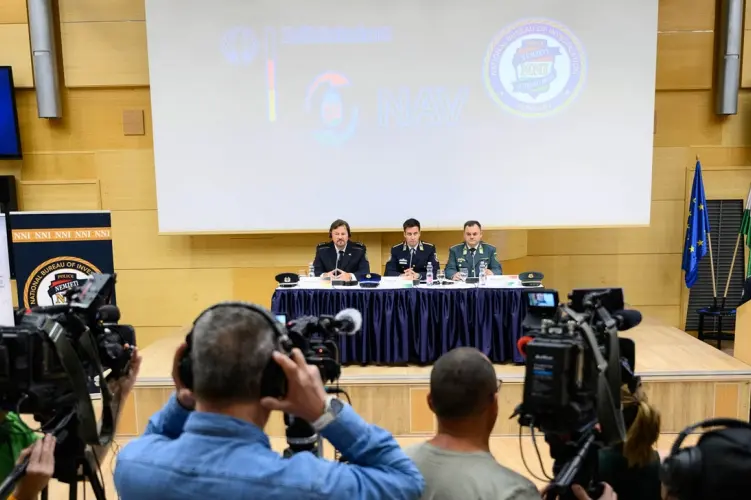
Record cocaine seizure at Csepel port – 522 kg confiscated
The Disaster Management Authority's National Investigation Office (KR NNI), the National Tax and Customs Administration (NAV), and the German Criminal Customs Service held a press conference this morning to detail Hungary's largest cocaine seizure to date. According to information from police.hu, a total of 522 kilogrammes of cocaine was confiscated at Csepel port, with a black market value of 15 billion forints.
At the press conference, Major Máté Csupor, head of department at the Drug Crime Prevention Office (KBEH), Major József Kalecz, deputy head of department at the NAV Central Management Police Department, and Thomas Rapp, liaison officer representing the German Criminal Customs Service, reported on the operation carried out within the framework of the DELTA Programme.
From Ecuador to Csepel – the shipment's route
The French Customs Authority notified the KR NNI on 24 November last year that a suspicious shipment was heading towards Hungary: based on operational information, narcotics were hidden in 20 containers of cargo. The goods left Ecuador on 18 October, waited in Panama between 23 and 28 October, and arrived at Bremen port on 17 November. From there, six containers headed to Hungary and 14 to Romania. German authorities X-rayed and scanned two of the six containers in Bremen with dogs, but the inspection yielded no results.
Despite the initial negative inspections, the KR NNI carried out a cross-border operation across the territories of the Czech Republic, Slovakia and Hungary in cooperation with the German Criminal Customs Service and the NAV. At Csepel port, 7,000 banana boxes were opened, among which 438 blocks of cocaine were found on a single pallet – a total of 522 kilogrammes.
Further seizure in spring
Over the past six months, the police, the KR NNI and the NAV established a joint working group to eliminate container drug smuggling. The authorities detected unusually large container movements from Romania towards Hungary in spring this year. On 30 April, the contents of a container that had returned from Arad were inspected at a Csepel site, from which a total of 72 kilogrammes of cocaine were confiscated. Its black market value is 2 billion forints.
Cocaine trafficking has doubled
It was stated at the press conference that international container cocaine trafficking has doubled in recent years. Shipments arriving from South America to Europe now target not only Rotterdam and Antwerp ports, but also Hamburg and Bremen ports – usually hidden among banana shipments, with transshipment typically taking place in Panama. Nearly 8,000 containers arrive in Hungary annually: approximately 2,000 by rail, nearly 6,000 by lorry.
The region's largest banana importer is a Polish company whose "banana trains" arrive in the country or pass through towards Romania weekly. Smuggled goods are typically not removed at the final destination but en route, or from an already emptied container on the return journey.
At Bremen ports in 2025, authorities have already confiscated more than 1.5 tonnes of cocaine – approaching the record amount from two years ago. In 2024, customs officials found 400 kilogrammes of narcotics at the same location. The Bremerhaven container terminal crossed the one-tonne threshold within a single year for the fifth time since 2017, and according to authorities, Germany and the EU have become a prime target for South American smuggling networks.
Background: previous seizures at Csepel
Three years ago, the police confiscated containers containing first 77 kilogrammes and then 155 kilogrammes of cocaine at Csepel Free Port. The criminal proceedings were also conducted by the KR NNI, and the Budapest Chief Prosecutor's Office brought charges last autumn against a 35-year-old Albanian man for drug trafficking.
Modern equipment and international cooperation
During inspections, NAV customs officers use cargo X-ray equipment, handheld X-ray devices operated with backscatter technology and cavity inspection endoscopes. The KR NNI has strengthened its links with the NAV, the German Criminal Customs Service, law enforcement bodies of neighbouring member states and Europol alike. According to authorities, Hungary has become one of the distribution hubs for narcotics shipments arriving from South America to Europe, from which drugs spread throughout the region – preventing this is only possible through coordinated action.
Source: Google News HU — Crime (hu)