Isabel dos Santos uses Lisbon Court of Appeal ruling to rebut accusations over Efacec purchase
The Lisbon Court of Appeal blocked an attempt by BCP and Novo Banco to use frozen funds to cover debts. Isabel dos Santos invoked the ruling to defend her integrity.
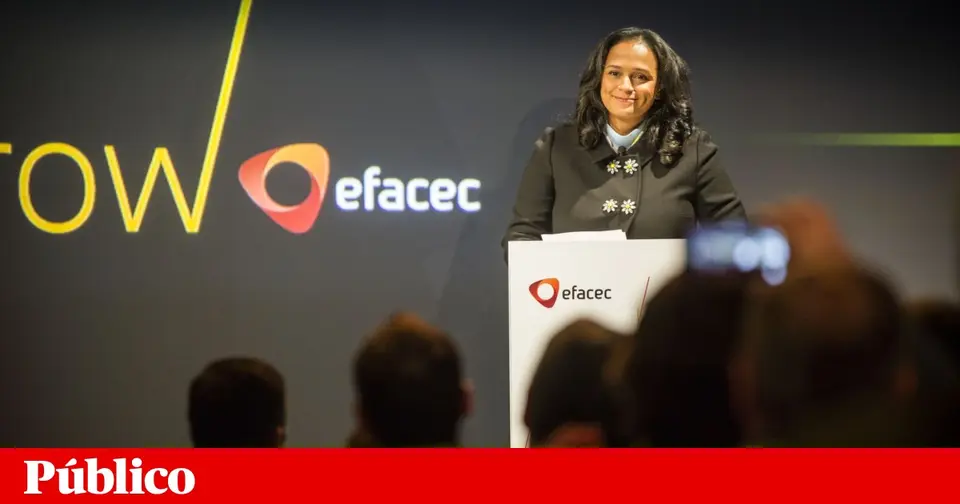
Isabel dos Santos invokes Court of Appeal ruling to defend herself against Efacec accusations
Days after the Lisbon Court of Appeal blocked one of the mechanisms used by BCP and Novo Banco to recover debts, Isabel dos Santos released a statement interpreting the ruling in her favour. According to publico.pt, the Angolan investor argues that the ruling, dated 12 May, proves that she acted with transparency in the purchase of Efacec in 2015 and that she did not resort to Angolan public funds to finance the operation.
"Today, the truth finally comes to light. After years of accusations and speculation, it is demonstrated that I have always acted with integrity, transparency and a sense of responsibility, placing the interests of companies and Angola above personal interests. This ruling confirms what I have always affirmed: I did not use public funds to finance my participation in Efacec," reads the statement released by her press office on Thursday, 4 June.
What the court decided
The case in question was brought by BCP and Novo Banco against the investor. The two banks sought that 17 million euros — part of the proceeds from the sale of Eurobic and frozen in two of Isabel dos Santos's companies — could be used to settle debts left by other companies belonging to the businesswoman. Those companies were used to acquire Efacec in 2015 and, after the scandal known as Luanda Leaks, lost that asset, which was nationalised.
The Court of Appeal, confirming the lower court, rejected the request. In the ruling, cited by PÚBLICO, it states that "there is thus no evidence from the facts proven of any conduct by the 1st Defendant [Isabel dos Santos] in abuse of rights, fraud against law or in violation of good faith rules and to the detriment of third parties". The court further added that the corporate structure of the companies was "abundantly known" at the time of the financing, and therefore could not on its own constitute fraud against law or violation of good faith rules.
Isabel dos Santos's interpretation
The daughter of the late Angolan President José Eduardo dos Santos uses the ruling to rebut the imputations that are at the heart of Luanda Leaks — the investigative journalism inquiry that points to the use of Angolan state funds for personal gain. Isabel dos Santos argues that the ruling describes "an operation financed through private bank credit", worth 160 million euros, and not through transfers of public origin.
"There is no judicial conclusion whatsoever that the acquisition of Efacec was financed by the Angolan state. On the contrary, the legal proceedings describe an operation financed through private bank credit," states the statement from her office. The note adds that "the facts recognised by the Lisbon Court of Appeal point to a reality distinct from the political narrative presented".
The statement does not clarify, however, whether Isabel dos Santos intends to use this ruling to demand any compensation or take new legal action.
The nationalisation of Efacec and the impasse with banking
The context of the dispute goes back to July 2020, when the Government of António Costa decided to nationalise Efacec to ensure the continuity of the company, whose assets had been blocked following judicial investigations in Angola and the freezing of Isabel dos Santos's funds. The Court of Audit subsequently criticised that nationalisation. No compensation was decided for the shareholders.
Isabel dos Santos invokes precisely the absence of compensation as justification for not settling her debts with Portuguese banks. "The companies holding shares in Efacec were thus left without the asset and without goods and, consequently, prevented from paying bank debts," the statement says, adding that "the assets that could serve to reimburse the financing ceased to be available to meet the credit".
The Court of Appeal itself acknowledges the impasse in which the banks find themselves: "It is true that the AA/Appellants [BCP and Novo Banco] hold a credit against the 1st Defendant [Isabel dos Santos], which requires reimbursement, and that they have resorted to all judicial means at their disposal to enforce it, without, to date, having succeeded."
Legal proceedings in several countries
The pursuit of debt repayment by Portuguese banks — BCP, Novo Banco and also Caixa Geral de Depósitos — has proved fruitless so far. The attempt to hold other companies belonging to the investor liable for the debts of the directly indebted companies, using a mechanism similar to the so-called piercing of the corporate veil, also failed at the Court of Appeal.
The banks maintain, however, various proceedings in parallel to enforce judgment against the investor and her business universe. In Angola, Isabel dos Santos was accused in court of embezzlement, qualified fraud, abuse of power, breach of trust, economic participation in a business, influence peddling, money laundering and qualified tax fraud. The investor currently resides in Dubai.
Source: Google News PT — Crime (pt)