Massive fraud in Argentine Navy: 10 military officers dismissed over $981 million salary diversion
The Argentine Navy leadership removed ten military officers from their posts due to a corruption network in the salary payment system that caused verified losses of nearly one billion pesos.
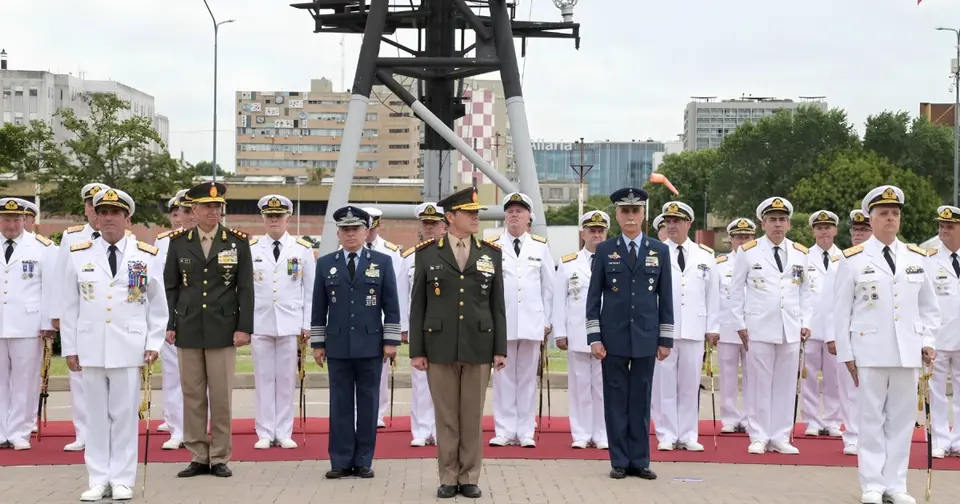
Ten naval officers dismissed over a fund diversion network in the salary system
The Argentine Navy leadership preventively removed ten military officers from their duties who were involved in a corruption scheme detected in the salary payment system, according to rionegro.com.ar. The measure was ordered by the Chief of the General Staff, Admiral Juan Carlos Romay, simultaneously with progress in a case at Federal Court No. 2, headed by Judge Sebastián Ramos, where an extensive network of public funds diverted to private accounts is being investigated.
Defence Minister Carlos Presti ordered the maximum possible sanction within the military regime to isolate the accused from the rest of the service. "I want to preserve the high prestige of the Navy. The Navy is not those four, five, twenty criminals," he stated publicly. He also explicitly instructed Romay that, through a Disciplinary Council, the officers be dismissed immediately and that, in the judicial sphere, "they return the money and go to prison."
Official documentation submitted to the courts records a verified diversion of nearly one billion pesos. However, internal estimates suggest the actual loss could be considerably higher.
How the scheme was detected
According to Infobae's reconstruction, the first alerts emerged in February 2026, when a review of January's salary liquidation detected five incorrect payments in the Revista Department. In March the administrative process was modified to separate salary liquidation, payment authorisation and bank control tasks. The turning point reportedly occurred in August, when retroactive audits detected unjustified payments to the wife of the then-head of the Revista Department, naval captain and accountant Ariel Baltasar Atanasoff, who was preventively relieved of his post.
In parallel, La Nación reported that the definitive collapse of the scheme came about through a female officer's refusal. A naval lieutenant—also a qualified accountant in the payment processing area—detected the fraud and refused to accept a "supplement" from which she was supposed to return half to her superiors. According to that source, the officer was offered money to keep silent, but she was a key piece in triggering the internal investigation.
The mechanics of the fraud
The corruption network combined computer manipulation with traditional diversion mechanisms. The main scheme involved exploiting the period that exists between the close of monthly salary liquidation and the final sending of the payment file to Banco Nación.
Those involved used salary funds that should have been blocked—due to discharge, retirement or death—and that were supposed to be returned to the Treasury. Before the money was returned, they modified the files to temporarily increase the amount for a specific person or add unjustified payments. After sending the file to the bank, they restored the records in the internal system to their original values, so that the transferred amounts did not match the official salary receipts.
Alongside that digital manipulation, a scheme of more direct frauds operated. The investigation detected the payment of false travel allowances in dollars for overseas missions that never took place, or that continued to be claimed after they had ended. A "supplement with return" scheme was also implemented: overtime hours or special allowances—such as diving—were paid to personnel who did not perform those duties, with the requirement for repayment of 50 per cent of the amount. In addition, the use of national identification numbers (CUIL) of retired or dismissed personnel to enable "phantom payments" is being investigated.
The figures and beneficiaries
Comprehensive analysis by Banco Nación and internal documentation made it possible to reconstruct 645 improper payments issued between July 2022 and January 2026, for a verified total amount of $981,148,567.88. Estimates derived from the continuation of the internal investigation, to which La Nación had access, suggest that the final loss could reach around $1,600 million.
The investigation identified 23 beneficiaries: the ten military officers dismissed and 13 people outside the service. Four of those civilians received 44.25 per cent of all the diverted money, more than $434 million. Captain Atanasoff himself stated internally that he defined the beneficiaries, set the amounts and manually executed the operations to favour third parties and naval personnel involved.
The largest individual beneficiary was Atanasoff's wife, María del Carmen Prieto, who, despite having no employment relationship with the Navy, received 46 payments totalling $152,259,495.86. The other three civilians who concentrated irregular payments were Damián Andrés Santana ($99.4 million), Amalia Cristina Díaz ($91.9 million) and Natalia Carolina Yahia ($90.4 million).
Additional irregularities within the service
Within the Navy, the investigation uncovered instances of double payment. Naval captain and accountant Roberto Eduardo Castro received salaries in Argentina at the same time as those he was drawing while assigned overseas—a double payment that requires bypassing the system's automatic block. Payments to his wife, Luana Magalí Piedigrossi, were also detected while she was on unpaid leave.
When exposed in September, several officers attempted to mitigate their situation by returning part of the funds. Among them were naval captains Ariel Vicente Gallo, Roberto Eduardo Castro and Cristian S., whose cases continue under judicial and disciplinary review.
Source: Google News AR — Crime