Trump maintains drug-decertification status for Colombia but promises review if progress demonstrated
The US keeps Colombia on the list of countries that have "failed significantly" in the fight against narcotics, but Trump points to possible lifting of status if the De La Espriella government demonstrates progress.
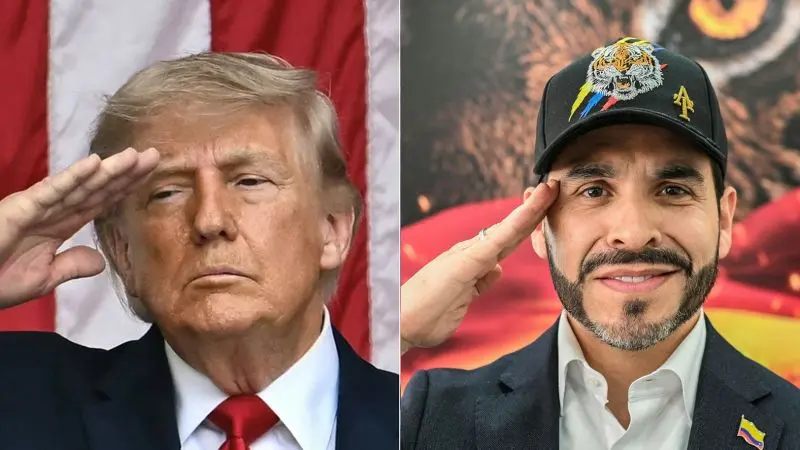
Colombia remains on US drug-decertification list, with possibility of removal
According to cnnespanol.cnn.com, US President Donald Trump confirmed on Wednesday that Colombia remains on the list of countries that Washington considers have "failed significantly" in combating drug trafficking. The South American nation was included in that category a year ago, amid diplomatic tensions with the then-government of Gustavo Petro.
At the same time, Trump opened a door: if the new government of President Abelardo de la Espriella makes progress in eradicating coca crops, cocaine production and "dismantling of narco-terrorist networks", the US president said he would "consider lifting" that status.
Praise for new Colombian government
Trump highlighted the relationship he maintains with De la Espriella, who took office in August, and praised the Colombian president's promise to launch an "aggressive campaign" against coca leaf crops. "Colombia is prepared to reclaim its position as our principal security partner in the hemisphere," Trump stated in a statement issued by the State Department.
The statement also included direct criticism of former president Petro's administration. "The Police, the Prosecutor's Office and the country's courts finally have a worthy defender in President De La Espriella," Trump said.
Colombian Foreign Ministry responds
Colombia's Foreign Ministry indicated that Washington's decision "reflects the marked deterioration in security and the fight against narcotics recorded over the past four years," in reference to the previous government.
The diplomatic ministry specified that the evaluation covers the period from September 2025 to September 2026, and highlighted that the De la Espriella government "has adopted concrete and decisive actions" from its first day in office to combat narcotics and transnational crime, with arrests and seizures recorded in the first month of his administration.
Secretary of State Marco Rubio, during his recent visit to Bogotá, had pointed out that Washington seeks to resume the "golden age" of bilateral relations, with security as the central pillar. De la Espriella for his part stated that the rapprochement represents "a new rebirth" for Colombia.
Other countries on the list
Along with Colombia, Afghanistan, Bolivia and Myanmar appear in the category of having "failed significantly". Although decertification can entail cuts or restrictions in US assistance, Trump included an exception on grounds of national interest to maintain the flow of aid.
At a lower tier—that of major producers or transit territories—are Bahamas, Belize, China, Costa Rica, Dominican Republic, Ecuador, El Salvador, Guatemala, Haiti, Honduras, India, Jamaica, Laos, Mexico, Nicaragua, Pakistan, Panama, Peru and Venezuela.
Venezuela exits non-compliance category
A relevant change in the list was Venezuela's exit from the non-compliance category. Trump attributed that decision to the "detention and removal" of President Nicolás Maduro in January and to "growing cooperation with the interim government" in drug control matters, which included, according to the statement, the elimination of the leader of Tren de Aragua, known as "Niño Guerrero".
"Given the positive steps taken under the interim presidency of Delcy Rodríguez, I have determined that Venezuela should no longer be designated as a country that has demonstrably failed to meet its drug control commitments," Trump indicated, although he clarified that he expects "continuous and measurable progress" in the dismantling of narco-terrorist groups.
The Mexico case
The statement also addressed Mexico's situation. Trump acknowledged advances under the government of President Claudia Sheinbaum: larger volumes of drugs seized, dismantling of clandestine laboratories and the deployment of security forces at the border, in addition to the capture of cartel leaders such as Nemesio "El Mencho" Oseguera Cervantes.
However, Trump warned that Mexico "must take additional measures" against narco-terrorist organisations operating in broad areas of national territory, and stated that current security investments "are insufficient" in the face of the power of criminal networks.
Source: Google News CO — Crime