Supreme Court upholds sentences of 8 to 14 years for drug trafficking based on EncroChat messages
The Supreme Court validates evidence from EncroChat and Sky ECC and confirms sentences of up to 14 years for five defendants convicted of drug trafficking.
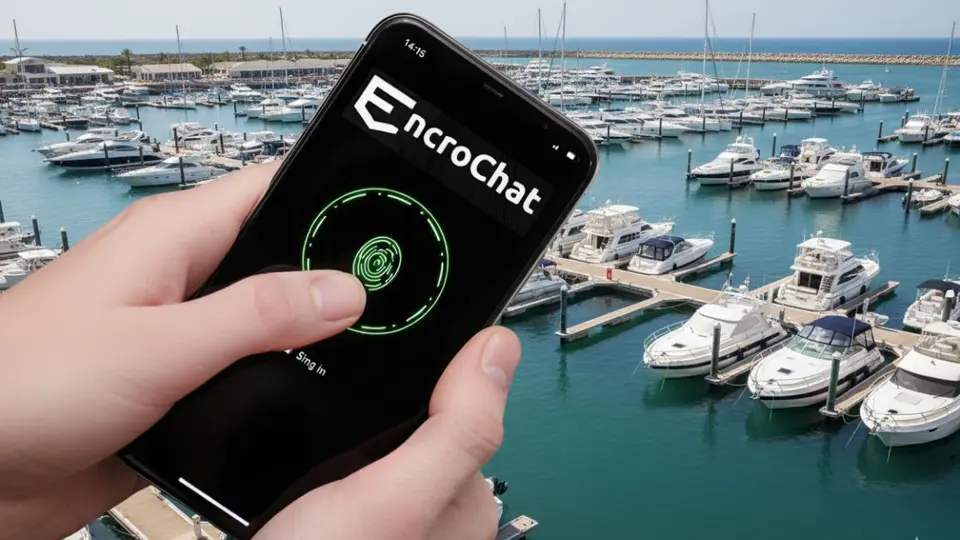
Final convictions for international drug trafficking following validation of encrypted EncroChat messages
The Supreme Court has ratified the validity of messages obtained through encrypted phones EncroChat and Sky ECC as evidence in Spanish criminal proceedings, according to Confilegal. The ruling, handed down by the Plenary Session of the Criminal Chamber on 16 October 2025 (no. 854/2025), with Magistrate Ana María Ferrer García as rapporteur, confirms the sentences imposed by the National Court for drug trafficking and membership of a criminal organisation.
The appeals for review filed by Jesús Salgueiro Roche, Germán Alonso Aguilar, Cornelis Johannes Boekholt, Marco Maijer and Marian Cojocauru were dismissed in their entirety.
Sentences of up to 14 years and million-euro fines
The sentences upheld range from 8 to 14 years in prison. Marco Maijer, considered the leader of the network, must serve 14 years in prison and pay a fine of 30 million euros. His collaborator and operations coordinator in the Netherlands, Cornelis Johannes Boekholt, was sentenced to 13 years and a fine of 25 million euros. Chemist Jesús Salgueiro Roche, responsible for laboratories located in Catalonia and Seville, received a sentence of 12 years. Germán Alonso Aguilar, in charge of industrial warehouses and transport, was convicted to 10 years, and Marian Cojocauru, a logistics collaborator, to 8 years in prison.
A network with branches in Catalonia, Málaga, Ibiza and Seville
The case is one of the main Spanish offshoots of the major European EncroChat operation. Its origins date to 2020, when French authorities dismantled the encrypted messaging platform used by criminal networks to coordinate international drug trafficking operations. The intercepted messages were shared with Spain through a European Investigation Order (OEI), which made it possible to identify members of an organisation with branches in Catalonia, Málaga, Ibiza and Seville.
The defendants operated through mobile phones encrypted with EncroChat technology and OneKey devices to coordinate shipments of synthetic drugs from the Netherlands and manage the profits from trafficking. Information intercepted by French authorities—between April and June 2020—revealed the aliases used by members of the group and made it possible to reconstruct their hierarchical structure.
Simultaneous searches with major drug seizures
The investigations culminated between October and November 2020 with a series of simultaneous searches in Barcelona, Málaga, Ibiza and Seville. At the premises on Pasatge Jardins de la Joana de Tomás (Barcelona), fitted out as a laboratory, 23.6 kilos of amphetamine, 42.2 kilos of MDMA and various chemical precursors were found. At the residence in Bigues i Riells, rented by Salgueiro, a further 2.1 kilos of amphetamine, 83 grams of MDMA and 242 grams of hashish were seized.
The most significant strike occurred on 17 November 2020, when the Guardia Civil intercepted a lorry in Irún coming from Alhaurín de la Torre (Málaga) that concealed 136 kilos of hashish and 81 kilos of marijuana in electrical transformers, destined for the Netherlands.
In subsequent searches of properties belonging to Maijer, Boekholt and the Toren sisters, more than 100 kilos of MDMA, 35 kilos of amphetamine, 180 kilos of liquid amphetamine, more than 100 kilos of GHB and GBL, several kilos of ketamine and LSD were found, along with money-counting machines, laboratory equipment, OneKey devices and accounting documentation of the illicit operations. The total of substances seized exceeded a market value of 14 million euros.
The incidental discovery doctrine, the key legal principle of the ruling
The central issue before the Supreme Court was not the authorship of the acts—which was established fully and in detail—but the lawfulness of the evidence. The defence argued that the EncroChat messages had been obtained irregularly and should be excluded from the proceedings.
The Supreme Court rejected that argument and supported the admission of the messages on the basis of the incidental discovery doctrine, regulated in articles 579 bis and 588 bis i of the Criminal Procedure Act. According to the ruling, the information sent by French authorities constitutes a legitimate incidental discovery within the framework of European judicial cooperation, and its use in Spain was authorised with full respect for procedural safeguards.
The court cited Directive 2014/41/EU and the judgment of the Court of Justice of the European Union (CJEU) of 30 April 2024 (case C-670/22, M.N.), which establish that the legal review of evidence obtained through an OEI is the responsibility of the state that decides to incorporate it, not the one that originally obtained it.
A precedent extending the Falciani doctrine to the European digital sphere
This interpretation connects with previous precedents of the Supreme Court. The Court had already applied the incidental discovery doctrine in the well-known Hervé Falciani case (STS 116/2016, of 16 February), where it declared valid banking information stolen from HSBC and sent by foreign authorities to Spain. In that ruling, the court held that the admissibility of the evidence depended on its reception and use in accordance with the law by Spanish authorities, regardless of the manner in which it was obtained abroad.
The ruling on EncroChat now extends this same reasoning to the European criminal sphere and to digital evidence obtained in transnational investigations, consolidating a coherent evolution of the doctrine. The Supreme Court affirms that information discovered incidentally in a foreign investigation may be validly used in Spain provided that its source is legitimate, its transmission occurred through formal judicial channels and its use respects the principle of proportionality.
Source: Confilegal