Third drug-trafficking tunnel suspected at Ceuta by Spanish investigators
Spanish investigators suspect the existence of a third clandestine tunnel linking Morocco to Ceuta to transport drugs to Europe. The matter is part of Operation "Ares".
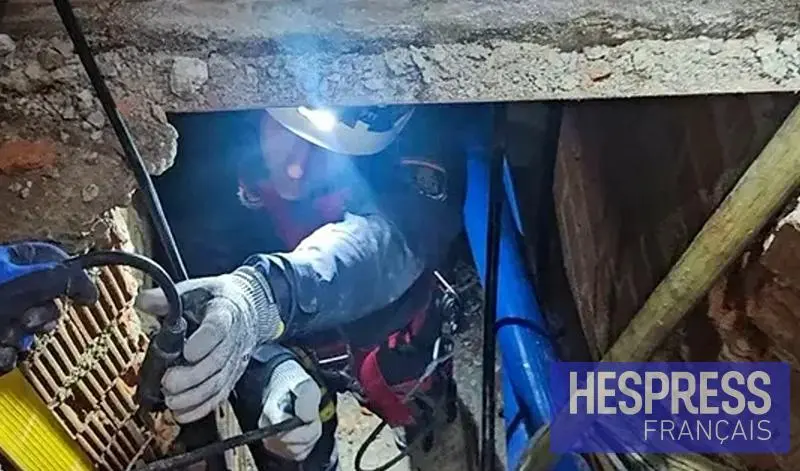
Ceuta: third smuggling tunnel in the sights of Spanish investigators
Spanish investigators suspect the existence of a new clandestine drug-trafficking tunnel between the outskirts of Ceuta and the enclave itself, according to Spanish media reported by fr.hespress.com. This hypothesis emerged following the interception of recordings and conversations attributed to a criminal network active in the region.
Initial investigative findings indicate that this tunnel would have been used, or was intended to be used, to transport shipments of narcotics as part of the activities of the network targeted by Spanish investigations.
Two tunnels already discovered in the Tarajal area
These suspicions follow the discovery of two clandestine tunnels in the Tarajal sector of Ceuta. One of these structures was described as particularly sophisticated: equipped with rails, trolleys and a lifting system, it allowed the transport of large quantities of hashish to Ceuta and then to Europe.
Investigators are now seeking to establish whether this third tunnel actually exists, to locate its position and to determine its links with the network dismantled during Operation "Ares", which resulted in the arrest of dozens of suspects.
An expert: each security reinforcement opens new routes
For Abdelhamid Bajouki, a specialist in Moroccan-Spanish relations, these successive discoveries reflect a new reality in the region. According to him, every reinforcement of security measures pushes international criminal organisations to search for new passage routes.
Bajouki believes that the successes of security cooperation gradually close certain trafficking routes, forcing networks to develop other means to circumvent controls. However, he questions the capacity of security services to identify all of these clandestine infrastructures and the possibility that other tunnels may be discovered in the coming months.
The expert also recalls that security cooperation between Morocco and Spain, as well as between Morocco and the European Union, constitutes one of the essential pillars of bilateral relations, and that this coordination has strengthened in recent years through numerous joint meetings and operations. Morocco's contribution to combating criminal networks operating in Spain is, according to him, regularly praised in Spanish official reports, with some Moroccan officials even being decorated for their cooperation. He estimates the number of visits by senior Spanish officials to Morocco since the beginning of the year at between three and four.
Increasingly technological mafias
Security expert Abderrahmane Mekkaoui for his part emphasises that mafia organisations have attempted in the past to establish themselves permanently in Morocco, without success. The authorities are today facing structured criminal networks, composed of organised crime professionals, alongside common delinquency which represents the majority of offences recorded in the country.
Having failed to establish themselves in Morocco, these organisations would have developed networks specialised in drug and irregular migrant trafficking, resorting to increasingly advanced technologies. They would first have used small Cessna-type aircraft before turning to the construction of tunnels crossing difficult-to-access mountainous areas.
Mekkaoui specifies that the border region between Ceuta and Morocco has a particularly difficult terrain, notably composed of very hard granite rock. Tunnelling through such an environment would, according to him, require very advanced drilling equipment equipped with heads capable of fracturing large rock masses.
The expert also mentions the growing use of various technological means by these networks: drones, remote-controlled vessels, drug-laden marine torpedoes or even submarines. He claims that Morocco is accelerating its acquisition of submarines from South Korea in order to strengthen its capacity to combat these new forms of trafficking.
Transcontinental alliances generating billions
Mekkaoui finally claims that Mexican and Brazilian mafias now maintain close ties with several European criminal organisations, notably Italian ones. This transcontinental alliance would be at the origin of large-scale logistics and technology projects in the region, generating profits of several billion dollars. The expert nevertheless emphasises that Moroccan authorities now have greater means than ever before to address these challenges.
Source: Google News MA