Andean Court admits claim against Peru over illegal mining in Nanay river
The TJCA opened proceedings against the Peruvian state for breaching Andean regulations on illegal mining. More than 100 dredgers are currently operating in the Nanay basin, the main water source for Iquitos.
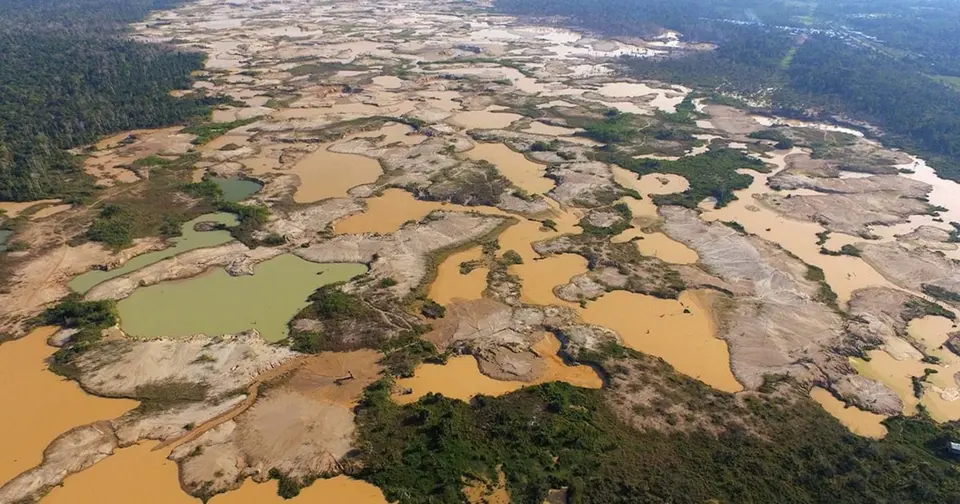
International proceedings question Reinfo and alert over dredgers in the Nanay basin
The Court of Justice of the Andean Community (TJCA) admitted for processing, by means of an order issued in July, a claim against the Peruvian state for alleged breaches in the fight against illegal mining. According to infobae.com, the proceedings—filed under case number 03-AI-2025—were brought by the Coordinator of Native and Peasant Communities of the Nanay Basin (Conaccunay) and residents of the Loreto region.
The plaintiff organisation brings together 33 communities settled around the Nanay river, which constitutes the main water supply source for Iquitos and a population exceeding half a million people. The claim alleges the breach of community regulations related to illegal mining, mercury control, customs cooperation and transnational organised crime.
General Secretariat had already found breaches
The path to the court began on 27 June 2025, when the claimants first approached the General Secretariat of the Andean Community, a compulsory administrative stage before submitting a non-compliance action to the TJCA. In October of that year, the Secretariat issued Opinion No. 007-2025, in which it concluded that Peru had failed to comply with two specific obligations.
On one hand, the Secretariat considered insufficient the measures adopted to strengthen the forfeiture of domain over instruments and products linked to illegal mining, money laundering and related offences. On the other, it determined that successive extensions of the mining formalisation process associated with the Comprehensive Mining Formalisation Register (Reinfo) hindered its effective implementation and breached article 4 of the Treaty establishing the Andean Court.
The ruling did not declare that all Reinfo provisions were contrary to Andean regulations, but questioned the reiteration of the extensions and recommended that Peru refrain from adopting measures that obstruct genuine formalisation.
Environmental lawyer describes Reinfo as "mechanism of impunity"
Environmental lawyer César Ipenza explained on RPP that, in his view, Reinfo ended up functioning as a "mechanism of impunity" that has allowed certain operations to remain for years under the umbrella of a formalisation process without completing it. Ipenza was more critical than the administrative opinion itself and pointed out that the underlying problem lies in the absence of effective oversight.
As regards the situation on the ground, the specialist stated that more than 100 dredgers would currently be operating in the Nanay basin despite operations carried out by the authorities. Official records gathered by the General Secretariat of the CAN show sustained expansion: between 2017 and 2025, 841 dredgers were identified in the Nanay river—a cumulative figure, not vessels operating simultaneously—of which 275 were detected only during 2025.
"We have more than 100 dredgers currently operating in the area," Ipenza stated, questioning whether operations continue to be isolated and are not accompanied by sustained monitoring of supply routes or intelligence work to identify those financing the operations.
The concern is not limited to the removal of river beds. Illegal gold mining uses mercury to separate gold, and operations also require large volumes of fuel and other materials that must be transported to remote areas.
The TJCA must still rule on the merits
Admission of the claim does not amount to a conviction. The TJCA, based in Quito, will need to hear the parties, evaluate evidence and determine whether the state breached community regulations that are binding on Peru, Colombia, Ecuador and Bolivia. Unlike the previous opinion from the General Secretariat, any eventual ruling from the court is binding: if a breach is found, the country is obliged to adopt the corresponding corrective measures. The Andean system provides for additional consequences if a state does not comply with a court ruling.
Government prepares new law to replace Reinfo
The controversy comes at a time when the Government is working on a new regulatory framework to replace the current formalisation scheme. Minister of Energy and Mines Guillermo Shinno announced that the Executive expects to have ready in November a new Law on Small-Scale and Artisanal Mining (MAPE) and stated that Reinfo "must reach an end point". The current validity of the register expires on 31 December 2026.
Ipenza warned, however, that changing the regulation will not resolve the problem by itself. For the specialist, any new system must be accompanied by effective oversight, monitoring of processing plants, tracking of materials used by illegal mining and greater capacity to dismantle the organisations operating behind gold extraction.
Source: Google News PE — Crime