Six convicted to up to nine years in prison for cocaine trafficking in frozen squid from Ecuador
The Leiria Court convicted six men for trafficking more than one tonne of cocaine hidden in frozen squid imported from Ecuador. The sentences range between eight and nine years in prison.
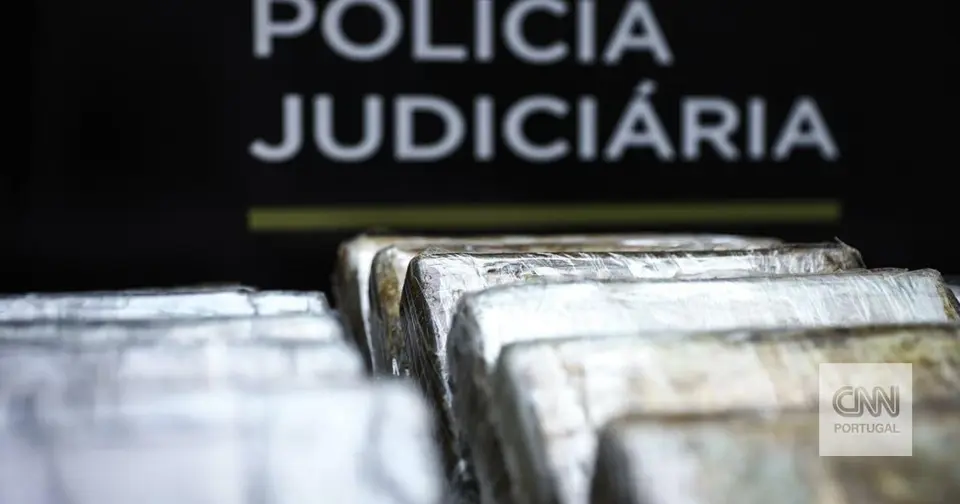
Over one tonne of cocaine seized in squid containers: six men convicted in Leiria
The Judicial Court of the Leiria District convicted six men to prison sentences of between eight and nine years for aggravated cocaine trafficking hidden in frozen squid imported from Ecuador. The decision, reported by the Lusa news agency and confirmed by CNN Portugal — which had access to the ruling — allows for a detailed reconstruction of an international operation that culminated in the seizure of 1,144.8 kilogrammes of cocaine hydrochloride at the end of February 2024.
From Colombia to Ecuador: how the scheme began
According to the court, the cocaine entered Portugal through shipping containers from South America, using apparently legitimate commercial documentation and the structure of a Portuguese company. The panel of judges found it proven that, in an initial phase, those involved had considered the importation of bananas and pineapples from Colombia and Panama, but this business never came to fruition. The solution found was to send the drug mixed with frozen fish, "concealed in squid and not in fruit", as was proven in court.
On 19 December 2023, Fábio Cândido went to the facilities of the company Os Linos Comércio de Produtos Agrícolas, based in Torres Vedras, to propose the business. Ten days later, the company expanded its Economic Activity Code to the sale of meat and fish. On 8 January 2024, Cândido received an image on his mobile phone showing the loading of the boxes of squid — already with cocaine — still in Ecuador.
The role of the company and financial transfers
The court concluded that Os Linos was used by its administrators, Lino Santos and Nuno Santos, "with the objective of importing, transporting, storing and transferring cocaine", at the request of Fábio Cândido and Luís Mayer da Silva. The judges found it proven that father and son had knowledge of the illicit purpose of the operation.
Contacts were established with customs brokers, bills of lading were reviewed and customs expenses were paid. The company transferred €11,756.99 to the customs broker responsible for the process, after Fábio Cândido had delivered €11,000 to Lino and Nuno Santos through Luís Mayer da Silva — a delivery that took place in the car park of a commercial centre in Montijo. As Os Linos did not have the necessary refrigeration facilities, space was rented at Frutifrio, in Usseira, in the municipality of Óbidos, to receive and store the containers.
Detention and seizure in Óbidos
The criminal operation ended on 28 February 2024. Several of the defendants went to the Frutifrio warehouses, where the merchandise was being unloaded. The Judicial Police intercepted the suspects and carried out formal detentions after the discovery of the first blocks of cocaine. In an initial inspection, 15 slabs were found hidden inside cardboard boxes, between layers of frozen squid wrapped in plastic.
For security reasons, the containers were transferred to PJ facilities. The thorough inspection carried out the following day revealed a further 1,124 slabs. In total, 1,139 slabs of cocaine hydrochloride were seized, with a net weight of 1,144.828 kilogrammes, purity levels of between 72.4% and 81.2%, and sufficient to produce 4,564,023 individual doses. The ruling estimates the value of the drug at between €25.8 million and €47.8 million.
The sentences imposed
Fábio Cândido received the heaviest sentence: nine years in prison for aggravated trafficking. The court considered that the defendant had "essential participation" in the importation, acting as the "sole intermediary for the drug owners", and that he would receive €400,000 for the delivery of the cocaine.
Luís Mayer da Silva was convicted of eight years and six months for aggravated trafficking and two years for possession of prohibited weapons and ammunition; under cumulative sentencing, a single sentence of nine years was imposed on him, and he was also prohibited from possessing, using or transporting weapons for five years.
Mohammed Ismail, Leonardo Fábio Mosquera Castro, Lino Manuel Leal Henrique dos Santos and Nuno José Fernandes dos Santos were each convicted to eight years in prison for aggravated trafficking.
The company Os Linos Comércio de Produtos Agrícolas was convicted of the same crime to a fine of 750 days, at a daily rate of €250, totalling €187,500. The court took into account the company's share capital of one million euros and the role it played in the operation.
The ruling also determined the forfeiture to the State of €2,014,365.85 relating to Fábio Cândido and €780,069 relating to Luís Mayer da Silva, in addition to various items, sums and vehicles seized during the investigation.
Three acquittals and connection to alleged corruption at the Tax Authority
Bruno Vilhena, Manuel Ângelo Martins and Amílcar Zabala were acquitted: the judges considered it not proven that they knew that the cargo they were helping to unload contained cocaine.
The case also intersected with a parallel investigation into the alleged involvement of inspectors from the Tax Authority in a corruption scheme intended to facilitate the passage of drug shipments through Portuguese ports. The court emphasises the scale of the shipment and notes that the requirements for general prevention are high, "particularly when more than one tonne of cocaine with a high degree of purity is involved".
Source: CNN Portugal