Drug smuggling via bag tag swaps at Pearson Airport: Canadian acquitted, another jailed in New Zealand
A CTV News investigation has linked dozens of drug cases worldwide to bag tag swapping at Toronto's Pearson Airport. One Canadian was acquitted; another remains imprisoned in New Zealand.
Pearson Airport bag tag scheme links drug cases across the globe
A CTV News investigation has connected more than two dozen drug smuggling cases around the world to a single point of origin: Toronto's Pearson International Airport. The scheme, known as tag-switching, has seen innocent travellers face criminal charges after organized criminals swapped luggage tags to redirect drug-filled bags onto unsuspecting passengers' names.
The mechanism is straightforward. A corrupt airport employee removes the tag from a legitimate passenger's luggage and attaches it to a bag packed with drugs. An accomplice waits at the destination to collect it. If customs intercepts the bag, the innocent passenger — whose name is on the handle — is left to explain why they appear to be carrying narcotics across international borders.
W5, CTV News' investigative program, first exposed the scheme last May in a documentary titled Trafficked: The Airport Conspiracy. Since then, the investigation has expanded to identify more than two dozen cases, almost all originating at Pearson.
RCMP officers confirm tag-switching is an ongoing trend
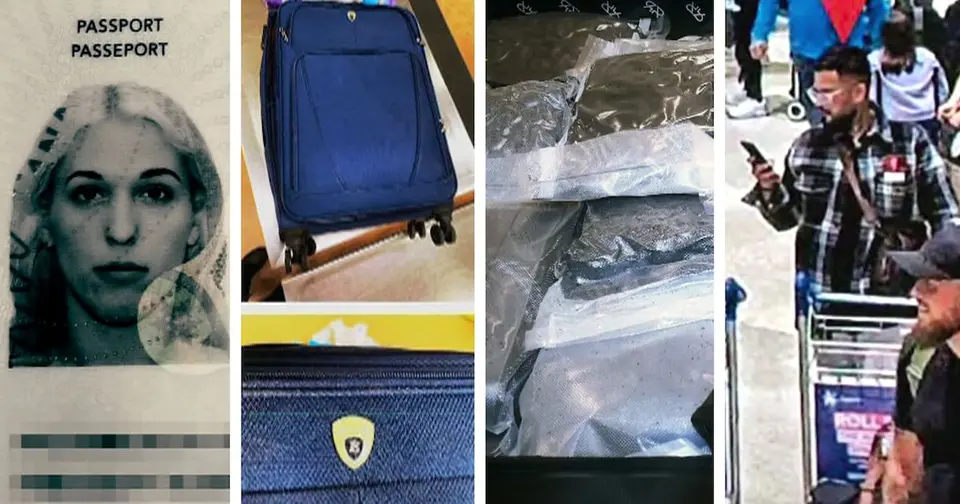
One of those cases belongs to Megan Maurer, a 30-year-old Canadian who was travelling from Calgary to Düsseldorf, Germany, two years ago, with a layover at Pearson. Customs officers found two suitcases containing 24.5 kilograms of vacuum-sealed cannabis — valued at up to $170,000 — bearing tags with her name on the handles.
The Crown argued at her Brampton, Ontario trial that Maurer being a drug smuggler was "the only reasonable inference" from the evidence. But her defence lawyer, Jessica Zita, had seen CTV News' early coverage of the bag tag scheme shortly before the trial began in early April.
Zita cross-examined two RCMP officers and a Canada Border Services Agency agent who had been involved in Maurer's arrest. All three acknowledged that tag-switching occurs at Pearson Airport and described it as a known and ongoing "trend," according to the written ruling by Justice Robert Tomovski of the Brampton Court of Justice. The two RCMP officers went further, telling the court they had personally investigated "multiple such incidents" at Pearson.
The Crown's own witnesses had handed the defence a reasonable explanation for why Maurer's name was on the drug bags. Justice Tomovski cited the testimony about tag-switching when delivering a not-guilty verdict, stating it gave him "reasonable doubt."
Zita said the case creates a new resource for defence lawyers going forward. "I wouldn't go so far to say precedent — but it does make the argument more palatable and more available for use," she told W5.
Canadian convicted in New Zealand hopes the ruling helps his appeal
Two months after Maurer's arrest in late 2024, Tawheed-Ul Moyeen — known as Tommy — flew from Toronto to Auckland, New Zealand, and checked a red suitcase at Pearson. It never arrived at the carousel. New Zealand authorities were waiting for him instead, presenting a blue suitcase they said was his. His tag was on the handle. Inside: 23 kilograms of methamphetamine at 80 per cent purity.
"I'm like, 'That's not my bag,'" Moyeen told W5 in a phone interview from prison. "My bag is red. That's a blue bag."
A second man, Le Tan Pham of Vancouver, had also checked an identical blue suitcase on the same flight — containing only six white towels, he claimed. At the Auckland carousel, Pham picked up the blue bag bearing Moyeen's tag: the drug bag.
Both men had layovers in Dubai en route to Auckland. It remains unclear whether the tag swap occurred in Dubai or at Pearson. Both were arrested. No evidence was presented at trial that the two men knew each other or had communicated.
The trial judge was unsparing in his assessment of Pham, whose defence — that he travelled with only towels because he distrusted hotel ones — "clearly did not wash with the jury," the judge wrote. He ruled that Pham's role was that of the "catcher": tasked with retrieving the drugs and exiting the airport with them.
Moyeen's role, the judge found "difficult to assess." His only direct link to the drug bag was his tag. The Crown never established that he touched it or had any contact with Pham. Nevertheless, several factors counted against him. Both men booked their flights just days before departure — flagged by authorities as suspicious. Despite sitting more than 30 rows apart on the aircraft, Moyeen disembarked immediately after Pham.
Moyeen was convicted and sentenced to nearly 10 years in prison. He is now banking on the precedent set by Maurer's acquittal to support his case.
A systemic problem at Pearson
The cases of Maurer and Moyeen sit at opposite ends of the same investigation, illustrating how the same scheme can produce radically different legal outcomes depending on jurisdiction, available testimony, and the state of public knowledge at the time of trial.
Zita, the defence lawyer who secured Maurer's acquittal, reflected on the broader implications of what the police officers admitted in court. "This must be more than a trend. This must be an ongoing problem, if not maybe a crisis, that Pearson is facing," she told W5.
As ctvnews.ca continues to report, the scheme's reach extends well beyond Canada's borders — with cases now documented across Europe and the Pacific — while its apparent source remains a single terminal in Toronto.
Source: Google News CA — Crime (EN)