Demonstrations in Brussels: 26 complaints against police, over 250 arrests
Over 250 people were arrested during youth demonstrations in Brussels. The Committee P has received 26 complaints relating to police operations.
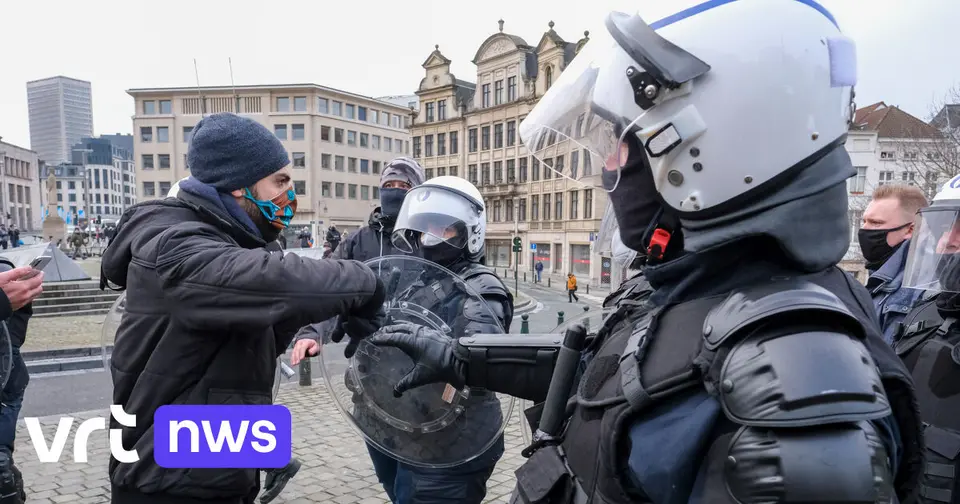
Brussels: violence, arrests and accusations against police after three weeks of demonstrations
Over 250 people were arrested during youth demonstrations that shook Brussels over the past two weeks, according to vrt.be. Police operations are also the subject of fierce criticism: the Committee P, the body responsible for oversight of police services, has received 26 complaints so far.
It all began on Friday 9 October, during a national action day organised by the socialist ABVV (FGTB) and Christian ACV (CSC) unions to protest against the federal government's austerity measures. Several student movements and antifascist groups had joined the mobilisation, in particular to denounce cuts to French-language education.
Union actions were disrupted by vandals, estimated at around one thousand according to police. STIB buses, shared cars and street furniture were severely damaged. Projectiles — bricks and pyrotechnic material — were thrown at police forces.
110 arrests on 9 October, 150 on 17th
On that day, police made 110 arrests, including 30 judicial arrests. Of the 21 people brought before prosecutors, only four were adults. They are suspected of carrying weapons, violence and vandalism.
On Saturday 12 October, young people took to the streets again. Events deteriorated once more: police officers targeted by projectiles, shared cars and street furniture damaged. Police arrested 150 individuals, of whom 19 were subject to judicial arrest — eight of them were minors. Five police officers from the Brussels-Capital/Ixelles zone were slightly injured.
26 complaints to Committee P
The Committee P registered 20 complaints relating to the events of 9 October and six others concerning the demonstration of 17 October. No complaints have yet been filed regarding 12 October. "It is possible that further complaints will reach us in the coming days or weeks," the oversight body indicated, which does not communicate on the nature of complaints received.
Testimonies denouncing police operations deemed disproportionate are also circulating on social media. Pierre-Yves Rosset, director of the Youth Rights Service (SDJ), an organisation offering free legal advice to young Bruxellois, has collected several of them.
"We have ourselves collected testimony from a minor who received baton blows to the head. Another minor had to be hospitalised with a fractured clavicle after receiving a baton blow," Rosset states.
The SDJ also received testimony concerning the events of 9 and 12 October. For the 17 October demonstration, reports are progressively beginning to pour in. "By way of comparison, during similar demonstrations in June, we collected around thirty testimonies indicating possible police violence," Rosset specifies.
Encirclement and tear gas: two practices under scrutiny
The SDJ and the French-speaking Human Rights League (LDH) identify several problems in police management of student demonstrations. Rosset notably cites the use of encirclement technique. "Brussels police have already been convicted for using this technique, but they continue to apply it. We have also seen several images showing officers impossible to identify, which also poses a problem."
Both organisations consider that tear gas is used too quickly and in too large quantities, including in the presence of young children. "However, children are more vulnerable to the effects of the chemical components of these gases," Rosset emphasises.
The SDJ director nevertheless wishes to nuance his organisation's position: "We condemn looting and all forms of violence. We are not saying either that police cannot resort to force, but we sometimes question whether its use is proportionate."
Source: Google News BE FR