Bolivia approves extradition to US of Evo Morales's former anti-drug chief
Bolivia's Supreme Court of Justice approved the extradition of Colonel Maximiliano Dávila to the United States, accused of conspiracy to produce and traffic cocaine. It is the first extradition of a Bolivian to the US in two decades of MAS governments.
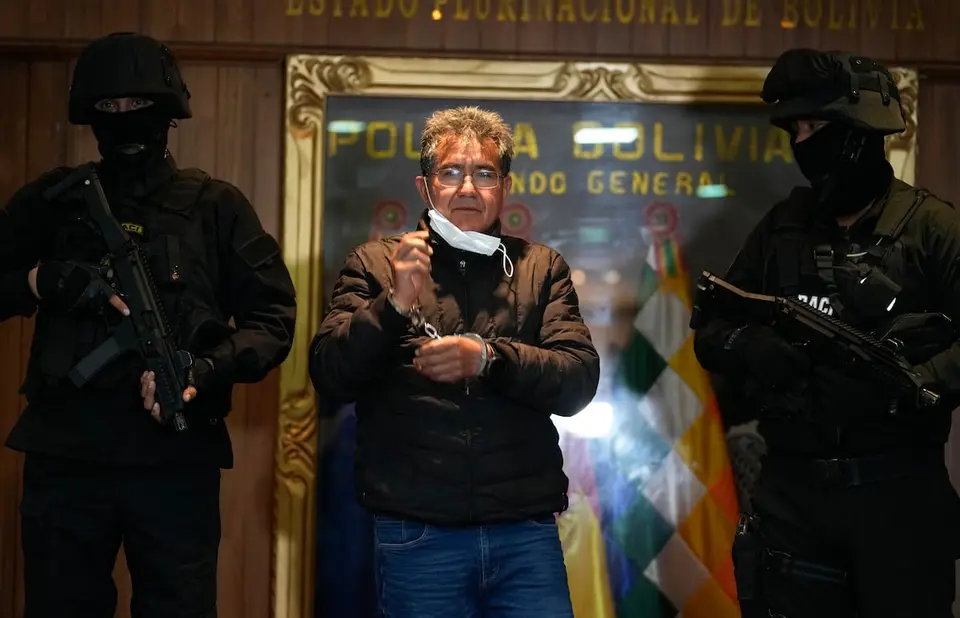
Extradition approved after political battle between Arce and Morales
Bolivia's Supreme Court of Justice (TSJ) authorised the extradition of Colonel Maximiliano Dávila to the United States on Wednesday. According to elpais.com, Dávila, who commanded the Special Anti-Narcotics Force between 2018 and 2019, is accused of "conspiracy to manufacture and introduce cocaine into the United States" by a court in the Southern District of New York. The decision marks the first extradition of a Bolivian to the US in two decades of governments by the Movement Towards Socialism (MAS).
Background to detention and charges
Dávila has been held since 22 January 2022 following an order from Government Minister Eduardo del Castillo, who prevented his flight to Argentina. The initial detention was based on accusations of "illicit enrichment", as Bolivia then lacked concrete evidence of links between Dávila and drug trafficking. The US Drug Enforcement Administration (DEA) accused him of being part of a protection network for drug traffickers led by former Police Major Omar Rojas, who was himself awaiting extradition in a Colombian prison.
According to an undercover DEA agent, both police officers "used their official positions and connections to gain access to Bolivian airfields" in order to facilitate shipments of cocaine and "organise protection by law enforcement". A subsequent report by the Bolivian Police accused Dávila of having thwarted, in his capacity as anti-drug chief, a raid at a rural airfield near Santa Cruz de la Sierra in July 2019.
Shift in relations with Washington
Approval of the extradition represents a marked change in the MAS's foreign policy towards Bolivia. Since 2008, when the US ambassador was expelled under Evo Morales's presidency, the Movement Towards Socialism's authorities maintained sparse and difficult relations with the United States. Morales expelled the DEA from the country and promised to give a national character to the anti-drug fight.
The extradition request was formalised in October after receiving the directive from the New York court. It was approved by the Attorney General's Office and now by the TSJ, indicating that there is political backing. Dávila's defence attempted to prevent the extradition until the last moment, arguing that legal procedures had not been followed.
Political conflict between Arce and Morales
The detention and extradition generated a confrontation between Minister del Castillo, a close collaborator of President Luis Arce, and sectors close to Morales. The latter questioned whether the minister was following the "DEA agenda". In August 2024, Morales publicly declared that there was "an order from above" to link him with Dávila and subsequently to extradite him as well.
When the extradition process was already underway, Morales claimed that in September or October 2021 the charge d'affaires of the US Embassy, Charisse Phillips, had requested Dávila's detention from Del Castillo because he was about to leave Bolivia.
Denial of links and mutual accusations
Following his arrest, Dávila told the press: "I am innocent, I am a victim of that petty bourgeois who is the Government Minister". He suggested that Del Castillo sought to link Morales with drug trafficking. The "evist" wing of the MAS, then incipient and still part of Arce's Government, attempted to censure the minister in Parliament.
Two former officials from Morales's administrations rejected any possibility that the MAS leader was aware of Dávila's illegal activities during his term. Morales stated that he never had direct contact with Dávila and that he was nominated by his ministers. At the same time, he denounced that people were approaching the colonel in prison to offer him: "Speak out against Morales and you will be freed".
This confrontation accelerated the estrangement between Morales and Arce. After his extradition, Dávila could still play a role in the internal tensions of Bolivia's left.
Source: Google News ES — Crime (es)