Suitcase case: former judicial official reveals Saucedo's confession at Mexico dinner
Aldo Quezada declared that Rómer Saucedo revealed to him at a dinner in Mexico that the 32 suitcases with alleged marijuana were his. He also implicated Mariaca and Rojas.
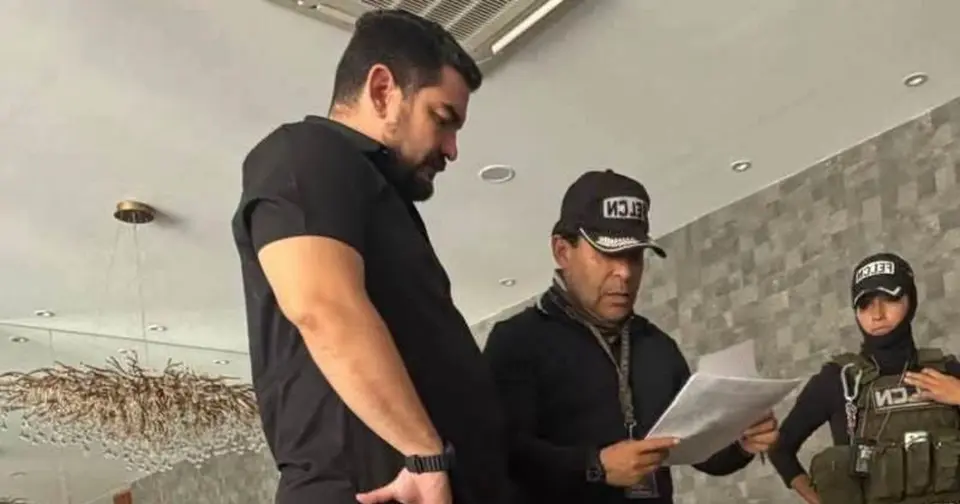
Former judge links Saucedo, Mariaca and Rojas in the case of 32 suitcases at Viru Viru
A dinner in Mexico was the setting in which the then president of the Supreme Court of Justice (TSJ), Rómer Saucedo, admitted to a colleague that the 32 suitcases investigated for alleged links to drug trafficking were his property. So declared Aldo Quezada, former president of the Departmental Court of Justice (TDJ) of Santa Cruz, before a commission of prosecutors, according to El Deber.
Quezada — arrested last Wednesday — initially testified in the capacity of a witness. He recounted that both officials had travelled to Mexico to receive an honorary distinction. Following the ceremony, they shared a dinner in which alcoholic beverages were consumed and Saucedo began to speak of his business dealings.
"Once the event was over we shared alcoholic beverages," declared Quezada, before describing the conversation. According to his testimony, Saucedo detailed to him the arrival of 32 suitcases at Viru Viru international airport in Santa Cruz de la Sierra, which allegedly contained marijuana and which he himself identified as his property.
Private plane from California and the participation of Laura Rojas
According to Quezada, the cargo was transported in a private plane that departed from California, United States, bound for Santa Cruz de la Sierra. The person in charge of accompanying the suitcases on that journey would have been former deputy Laura Rojas.
The former official also involved the former Attorney General of the State, Róger Mariaca, whom he identified with the nickname "el Chino". According to his statement, Saucedo assured him that Mariaca supervised and supported the removal of the suitcases from the air terminal.
Alleged business processing marijuana for electronic cigarettes
The testimony incorporates an additional revelation that investigators will need to verify. Quezada stated that Saucedo described to him an alleged business aimed at processing marijuana through an industrial cold system, with the objective of obtaining a liquid product that would later be commercialised in electronic cigarettes.
According to that version, the suitcases contained genetically modified marijuana and processing would allow profits to be maximised through sales in Brazil and other markets. The former official mentioned former judge Hebert Zeballos as responsible for installing an ice factory in his company, allegedly as a cover for that activity.
The statements about the contents of the suitcases, their ownership and the alleged drug processing form part exclusively of Quezada's testimony and do not constitute, by themselves, conclusive proof.
Travel permits for Laura Rojas's daughters: calls from home
In another part of his statement, Quezada explained how authorisations for travel for Laura Rojas's minor daughters were managed. He assured that he had received direct instructions from Saucedo to expedite the procedure, at a time when he was no longer at the Palace of Justice but at his home.
"I was at my house, I only received the calls. Rómer Saucedo calls me and orders me to process it for him," he declared to the prosecutors.
Quezada added that he subsequently contacted Laura Rojas to inform her that the authorisation would be ready the following day, and that he received a message of thanks from the father of the minors. The former official emphasised that the procedure was carried out outside the usual hours of judicial attention.
"Rómer Saucedo calls me and tells me that this permit has to go out, so I called Dr Evelin Pai, the judge for minors, and asked her to sign the permit," he stated.
That sequence opens a parallel line of investigation into the circumstances in which the authorisations were processed and the possible irregular intervention of judicial authorities.
The Prosecutor's Office concludes that Quezada had knowledge since August
Based on these statements, the Prosecutor's Office for Controlled Substances considers that Quezada had knowledge of information related to the 32 suitcases at least since August. Among the elements noted is the alleged ownership of the cargo attributed to Saucedo, as well as the participation of other people investigated in the case.
The testimony is incorporated into ongoing investigations into the so-called suitcase case, which involves, among other investigated parties, former deputy Laura Rojas and former judge Hebert Zeballos.
Source: El Deber