President of Bolivia's Supreme Court flees into exile and denounces persecution
Romer Saucedo, president of Bolivia's highest court of justice, left the country with his family and denounced political persecution by the government of Rodrigo Paz.
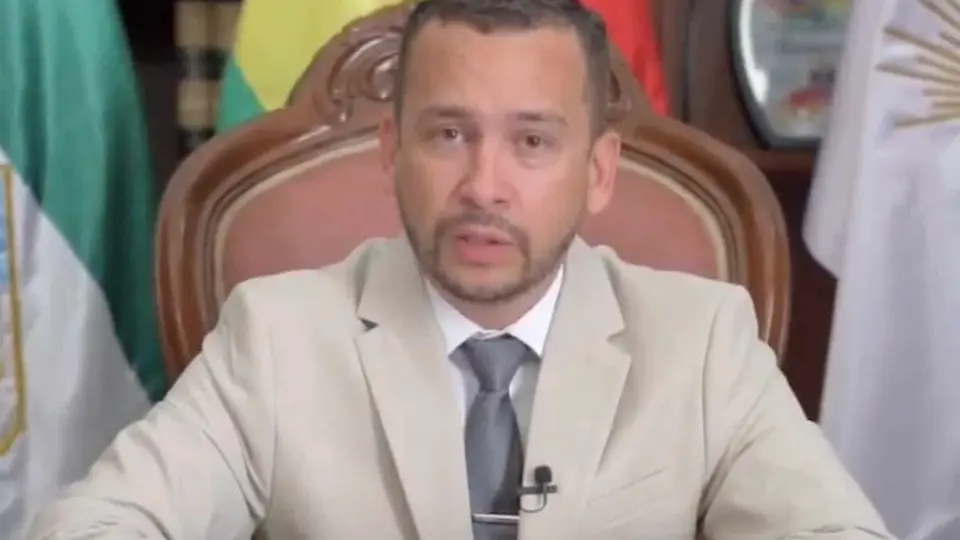
President of Bolivia's Supreme Court abandons the country and accuses the government of fabricating a case against him
Romer Saucedo, president of Bolivia's Supreme Court of Justice (TSJ), announced on Wednesday that he had left the country with his family. According to diariolibre.com, Saucedo made the announcement through the social network X, where he denounced "attempts at persecution and intimidation" by the government of centre-right president Rodrigo Paz.
"I have left the country, I am with my entire family in exile," wrote the magistrate, without specifying from which country he was publishing the message. Saucedo claimed that his life and that of his family "are in danger" and accused the government of allegedly fabricating a case against him to "discredit him". "I have left without having any open proceedings, but I know they will start soon," he added, asserting that he is being "persecuted" for "questioning political power".
At the time of publication, no formal investigations against him were known to be open. As president of the supreme court, Saucedo enjoys political immunity according to Bolivian legislation and cannot be investigated without authorisation from the legislative body.
Judicial detentions since October
Saucedo's departure comes in a context of growing pressure on Bolivia's judicial system. Since October, several high-ranking judicial officials have been detained for alleged links to drug trafficking. Among them is former prosecutor general Roger Mariaca, arrested days after the United States cancelled his visa and that of several officials and businessmen from Bolivia, Colombia, Peru and Ecuador. Mariaca was jailed and dismissed in early October, accused of criminal organisation, drug trafficking and money laundering, in two cases opened by the Public Prosecutor's Office.
Vice minister of Internal Affairs and Police Peter Maldonado told the media that Saucedo's "flight" "also has a connection" to Mariaca and "narco-terrorism" organisations. "Many of Mariaca's accomplices and of criminality are escaping and putting themselves out of harm's way," Maldonado declared. Government minister Marco Antonio Oviedo noted that Mariaca and Saucedo "were very close friends" and had even shared a residence in Sucre, the constitutional capital and seat of the judicial body, where both carried out their functions.
Interim prosecutor general Armando Urioste indicated that there are "open proceedings" against Saucedo in the eastern city of Santa Cruz, without specifying their nature, and urged the magistrate to return to appear before the Public Prosecutor's Office.
Government reaction from Madrid
President Paz was in Spain during Saucedo's announcement, participating in the XVI Ibero-American Business Meeting, prior to the Ibero-American Summit. From there he described the news as "regrettable, but encouraging for the future". Saucedo "is leaving the country because there is a series of accusations or investigations into our judicial system model," added the president without offering further details.
Paz also linked the situation to the need for judicial reform. "If we do not change justice, if I do not give you better justice, I do not have good democracy," he said at the business meeting held in Madrid.
Government spokesperson José Luis Gálvez told Radio Fides that "the news has taken us by surprise and there would be no reason to be investigating the departures" from the country of the president of the court.
Emergency session at the Supreme Court and Saucedo's position
The judges of the court began a session to appoint a temporary supreme authority. Saucedo, however, stated that he will not resign from his position as magistrate. In July he had already announced that he would step down from the TSJ presidency amid a dispute with Paz's government over greater funding for the judicial branch, a threat that included a possible strike by the body. On 15 October he formally submitted his resignation from the presidency of the court, to take effect in January 2027, although his position as magistrate would remain in place.
Saucedo was elected magistrate of the TSJ by popular vote in the 2024 judicial elections, representing the department of Santa Cruz, with more than 700,000 votes, for a term of six years. A month after his election, he was selected by his peers to preside over the court. In Bolivia, since 2011, high judicial authorities have been elected through popular vote.
Bolivia, the Shield of the Americas and Washington
The Paz government, close to completing its first year in power, has sought closer ties with Washington. In March, Bolivia joined the Shield of the Americas, a regional alliance of right-wing governments to combat transnational organised crime led by the Trump administration, which has expressed its support for the recent detentions of high judicial authorities in the country.
Source: Google News BO — La Paz