Basel Police acted partially unlawfully in rubber-bullet deployment in 2023
The administrative court of Basel-Stadt classified the rubber-bullet deployment of 8 March 2023 as partly disproportionate. The judgment comprises 64 pages.
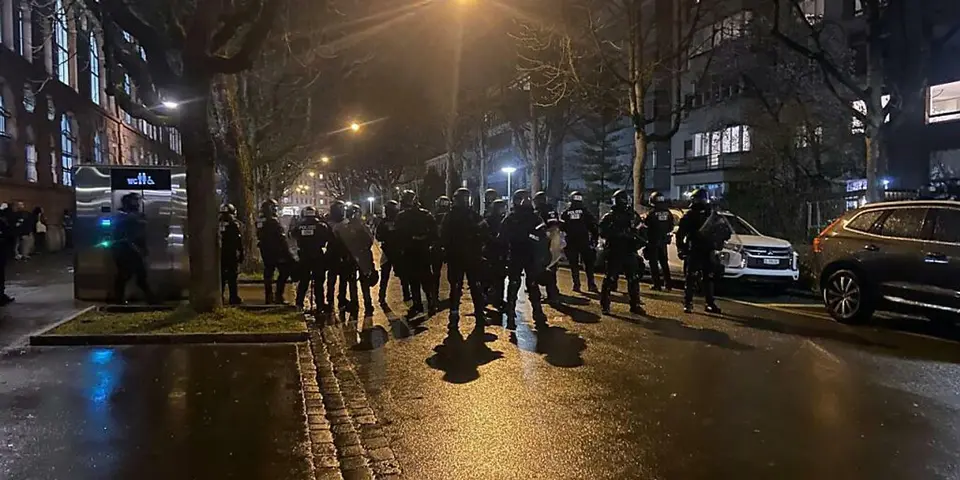
Administrative court censures Basel police over rubber-bullet deployment at 2023 demonstration
As reported by Google News CH — Crime (de), the court of appeal of Basel-Stadt, acting in its capacity as an administrative court, has established that the deployment of rubber bullets by the cantonal police on 8 March 2023 was partly unlawful. The court assessed parts of the police action as disproportionate.
The deployment occurred during the encirclement of a demonstration on Bernouillistrasse. Previously, groups had called for an unauthorised assembly on Barfüsserplatz to mark International Women's Day. Police cordoned off the square and conducted personal identity checks. Meanwhile, a demonstration march of around 200 people had formed on Petersplatz, which moved into Bernouillistrasse and was encircled there.
On the western side, the march moved towards the police line. The front rows were protected by reinforced banners carried by people wearing safety goggles and gloves. The police then fired rubber bullets multiple times. The demonstrators initially stopped and subsequently retreated.
Shortly afterwards, members of the evidence and arrest unit (BFE) advanced, seized the banner carried at the front from the demonstrators, and fired rubber bullets again together with regular operational personnel.
First shots proportionate — follow-up shots not
The court established that the demonstration march had posed a concrete threat to public order and safety. The initial shots had been an appropriate and necessary measure to prevent further advancement. The police could not reasonably have been expected to wait for a direct confrontation with the police line.
However, according to the judgment, the demonstrators came to a halt after the first three shots. The remaining of roughly ten shots fired in total were disproportionate as they were no longer necessary. The court found that sufficient time would have remained to intervene in the event of renewed forward movement.
Second deployment: minimum distance fell short
In the second rubber-bullet deployment after the banner was seized, the prescribed minimum safety distance of five metres was partly fallen short of. According to the judgment, this is only permissible in cases of self-defence or assistance in self-defence. However, no concrete danger that BFE members would have been physically attacked at that time was "ascertainable".
Furthermore, the BFE had created the spatial proximity itself by running towards the demonstrators. As these were no longer protected without the banner, the second deployment carried greater weight — according to the court, it would have been unlawful even if the minimum distance had been observed.
Deletion of recordings ordered
The court obliged the police to delete all photographic and video recordings of the appellants who were subject to identity checks, as soon as all proceedings related to the demonstration are concluded.
The judgment is dated 5 August and comprises 64 pages. In anonymised form, it was sent to media outlets on Thursday by the legal representative of the demonstrators, including the news agency Keystone-SDA. The weekly newspaper "Wochenzeitung" (WOZ) first reported on it.
The legal proceedings originated when a number of demonstrators appealed against a determination notice from the Justice and Security Department (JSD). The JSD had assessed the police action as lawful and proportionate and rejected the appeals, whereupon an appeal was filed in the second instance. The court dismissed further applications by the appellants — including a complaint about the encirclement. The judgment is not yet final.
Source: Google News CH — Crime (de)