General Mejía charged with ordering release of man carrying cocaine in Cauca; Defence and Prosecution seek victim status
Brigadier General Federico Mejía was charged with four offences after ordering the release of a detained man carrying more than four kilos of cocaine paste in Cauca.
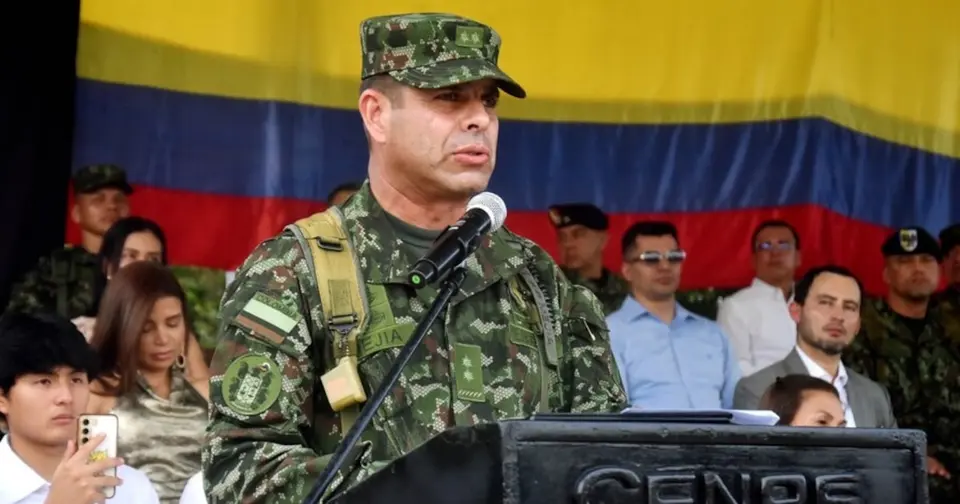
General Mejía before tribunal for ordering return of detainee with cocaine in El Plateado
Brigadier General Federico Mejía was charged before the Criminal Chamber of the Superior Court of Bogotá with four offences related to the release of a man detained with more than four kilos of cocaine paste in El Plateado, Cauca, on 31 January 2024. According to infobae.com, both the Ministry of Defence and the Office of the Attorney General requested to participate in the proceedings as victims.
Formal recognition of that status is not automatic. "The participation of the Ministry of Defence, which has made that request, will be allowed in the capacity of victims, and also the Office of the Attorney General. However, formal recognition will take place before the respective trial judge at the hearing for the formulation of charges, in the event that stage is reached," explained the magistrate presiding over the case.
The background: Operation Perseo and the arrest in El Diamante
The events date back to 8:30 a.m. on 31 January 2024, during Operation Perseo, the military plan directed against illicit economies in the Micay canyon, an area of Cauca with the presence of illegal armed groups. Soldier Jonathan Caicedo Gómez stopped a man in El Diamante, a rural area of El Plateado, who was driving a green motorcycle without licence plates. The detainee identified himself as Melsiades Guaca Armero and was carrying a black bag containing a brown substance.
Guaca Armero admitted to military personnel that he was transporting cocaine paste in a quantity exceeding four kilos, according to the charge filed by prosecutor Claudia Maritza Vega Merchán. The uniformed officers reported the discovery to Colonel Iván Darío Castillo, who had set up the checkpoint on the instructions of Mejía himself.
The chain of command and the order for return
Intelligence sergeant José David Díaz informed agent of the Technical Investigation Body Fernando Mera of what had occurred. The matter escalated through the chain of command to Colonel Asdrúbal Herrera Cepeda, commander of the anti-narcotics brigade, who in turn notified Mejía. The Prosecution maintains that the general responded that he did not have flying hours available to transport the detainee to Popayán.
Despite that initial refusal, Herrera proceeded with arrangements to place the detainee at the disposal of judicial authorities. Army Aviation Brigade 33 provided air support and the man was transferred to the capital of Cauca. It was then that, according to the accusation, Mejía intervened directly.
"The general issued directly and by telephone an order to Colonel Herrera for the detainee and the narcotic substance to be returned immediately to the place where the arrest had been made," recounted prosecutor Vega Merchán. The order was carried out in the afternoon with the support of two aircraft that were in Cali. Guaca Armero was returned to El Plateado and handed over to his wife and a councillor of Argelia, Cauca.
The charges and possible sentence
The Prosecution attributes to Mejía the offences of abuse of authority by action, abetting, falsification of public documents and procedural fraud. The prosecution argues that the arrest took place in flagrante delicto and that, for that reason, ordering the detainee's return lacked legal basis. It also questions the contradiction between the alleged lack of aircraft to transport him to Popayán and the subsequent availability of the same aircraft to return him to the place of arrest.
Actions following the incident also form part of the investigation. When administrative and disciplinary proceedings were initiated within the Military Forces, the officer allegedly incorporated in public documents information that did not correspond to the facts examined, conduct that supports the charges of falsification of public documents and procedural fraud. The Prosecution estimates that Mejía could be sentenced to a term of up to 18 years' imprisonment.
Mejía rejects the charges
During the hearing, the general denied any responsibility. The magistrate explained to him that accepting the charge would automatically result in conviction and asked if he accepted the charges. "Honourable magistrate, no, I do not accept any of the charges that have been brought against me," Mejía replied.
The officer maintained that the return of the detainee took place in a scenario of tension, in the face of the risk of a possible reaction from the community in El Plateado.
Pending procedural stages
The general's defence will be able to challenge the evidence and present its arguments in the following stages. Charging does not amount to conviction: justice must determine whether the decisions attributed to the officer constituted crimes and whether criminal liability exists.
By virtue of his rank, the case is handled under the jurisdiction applicable to generals of the Republic. The Prosecution presented the case before the Superior Court of Bogotá, which will determine the procedural course of the case. Formal recognition of the Ministry of Defence and the Prosecution as victims will be the responsibility of the trial judge, should the case reach the hearing for the formulation of charges.
Source: Google News CO — Crime