Security guard killed on Transmilenio in Soacha: more than 230 agents attacked in 2026
Cristian Garzón, a 27-year-old security guard, died after being stabbed on Transmilenio whilst defending a colleague from a fare-dodging couple. Bogotá city council debates new safety measures.
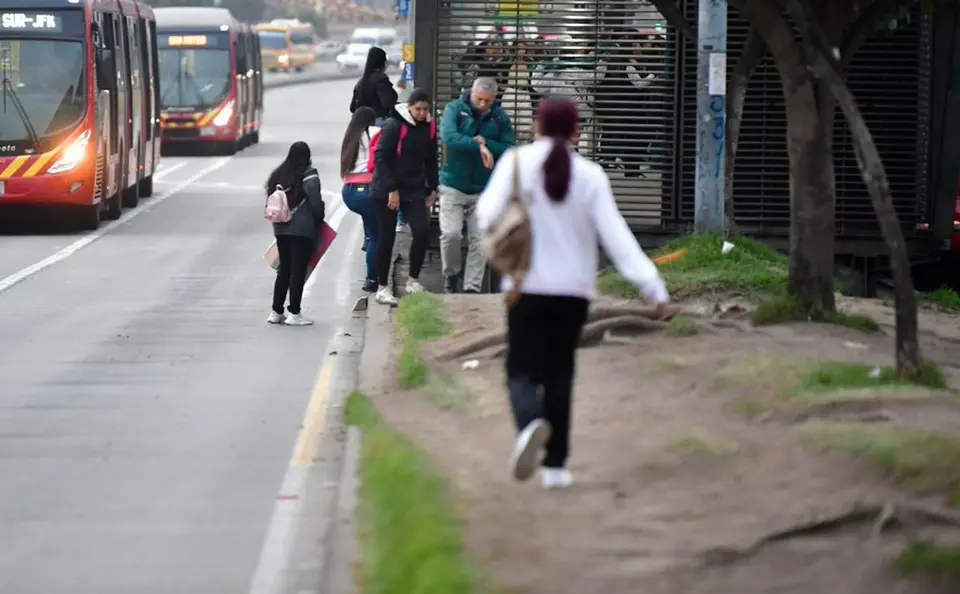
Guard fatally stabbed on Transmilenio whilst defending colleague in Soacha
Cristian Garzón, a 27-year-old security guard, died on Tuesday after sustaining two stab wounds to the chest inside the Transmilenio system in Soacha, according to pulzo.com. The attack occurred at around 9:30 a.m., when a couple attempted to board without paying and was confronted by a female guard of the system. When the man drew a knife to intimidate his colleague, Garzón intervened and was mortally wounded.
The attackers fled after the incident, but police arrested them later on streets in the Terreros neighbourhood. Garzón was immediately transferred to a healthcare facility in Soacha, where he did not survive the severity of his injuries.
A system under siege: 8,260 thefts in one year
Garzón's killing comes amid a sustained escalation of violence within the transport system. According to figures presented by city councillor Juan David Quintero to the district council, 8,260 thefts were recorded on Transmilenio in the past year, with a 45 per cent increase in robberies. More than 230 security guards have been assaulted during 2026 so far, the majority during fare-evasion checks.
A previous incident, which occurred in June, illustrates the magnitude of the risk: a guard was struck on the head with a hammer during an attempted fare evasion. Only the protective helmet he was wearing prevented the incident from becoming fatal.
Proposal for elite inter-institutional unit
In response to deteriorating security conditions, Quintero proposed the creation of the "Urban Squad for Authority, Coexistence and Justice in Public Transport" (EMAC), a specialised unit that would bring together the National Police, Judicial Police, the Fiscal Investigation Technical Corps (CTI) and local authorities.
According to Quintero, EMAC would be tasked with acting immediately in response to crimes such as theft, assault, vandalism, threats and blockades within the system. Its functions would include evidence collection, preservation of video records and receipt of complaints, with the objective of reducing impunity. The councillor did not specify whether the proposal includes additional weapons allocation for guards or how it would alter the current operational dynamics of the system.
Opposing stance: reducing fares as a solution
Councillor Heidy Sánchez took a different position. In her view, tightening controls and resorting to force has proved ineffective at containing fare evasion. Sánchez argued that measures such as reinforcing turnstiles or increasing the number of guards end up increasing evasion and reducing user flow, which worsens the system's financial crisis.
For Sánchez, the solution lies in freezing or reducing the cost of fares and recognising public transport as a right, not as a service conditioned on payment. Her proposal has not yet been put to a vote in the council.
Open debate in district council
Garzón's murder has reignited a debate that district authorities have been postponing for months. The two positions that have emerged from the council point in opposite directions: greater institutional presence and coercive capacity, on one hand; more affordable fares to discourage evasion, on the other.
Neither of the two proposals has been approved or has a defined implementation timeline. Meanwhile, Transmilenio guards continue to operate under conditions that, according to the data cited by Quintero, expose them to assaults systematically during their control operations.
Source: Google News CO — Bogotá