Operation KRATOS in Bogotá: 172 arrested and 10 criminal bands dismantled
President De la Espriella led a police operation in Bogotá in the early hours of Wednesday that resulted in 172 arrests and the dismantling of 10 criminal organisations.
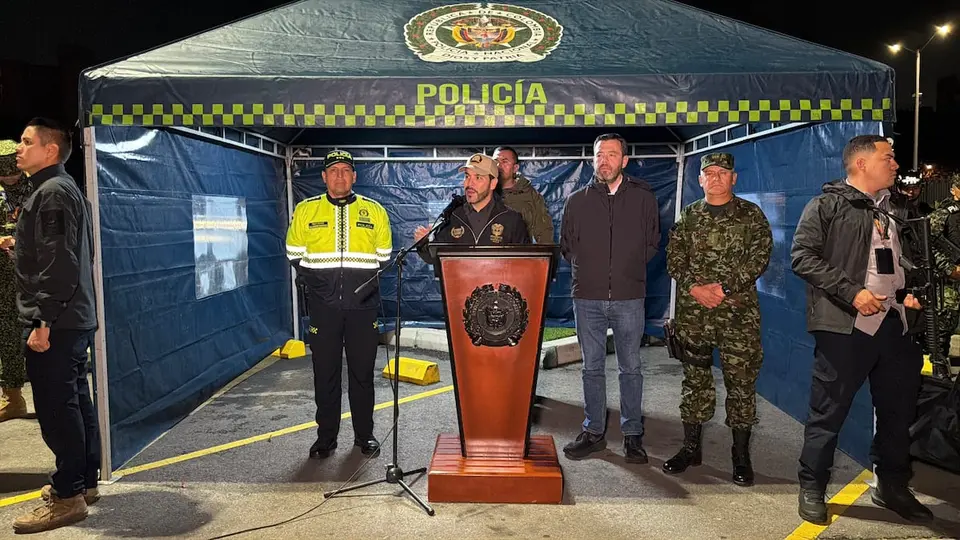
Operation KRATOS rocks Bogotá: 172 arrested in one night
Colombia's president, Abelardo de la Espriella, led a large-scale police operation in Bogotá in the early hours of Wednesday under the name Operation KRATOS, according to reports by elpais.com. The result: 172 arrests, 114 raids and the dismantling of ten criminal gangs accused of at least 350 homicides.
The president transmitted the action through a video recorded in the south of the capital, set to epic music and sequences of officers breaking down doors. "One ten in the morning. I am here in Bogotá, a city to which I owe much, and to which Colombia owes much," he declared in the recording. "We are going to feel proud of this great city again," he added.
Face to face with a suspected criminal
In one of the most widely circulated moments of the video, De la Espriella directly confronted a detainee identified as alias Mailo, accused of throwing a grenade in January that caused the death of a civilian. "Where is the bandit Mailo?" the president asked as he descended from his vehicle. When the detainee tried to respond, the president raised his tone: "What? Are you going to throw a line here, clown? What you are is a murderer, wretch. You are going to see how hard the tiger bites."
De la Espriella promised to send Mailo to a maximum security prison and to shave his head, in explicit allusion to the prison model applied by Salvadoran president Nayib Bukele. "Let's see if you're as handsome there," he concluded.
Seizures and operation figures
Authorities seized 11 firearms, three grenades, 72 rounds of ammunition and 34 mobile phones during the operation. In terms of drugs, 2,270 grams of marijuana, 130 grams of cocaine, 2,250 grams of crack cocaine and 250 tablets of tusi were confiscated. The value of cash seized amounted to 10 million pesos, equivalent to approximately 3,100 dollars.
"Let this be clear to you: there will be no hiding place or dawn that will save you from the weight of the law! We are going after your leaders, your structures and your finances. Bogotá cannot continue at the mercy of criminals," the president wrote on his X account when concluding the action.
Galán backs the operation but keeps his distance
The mayor of Bogotá, Carlos Fernando Galán, accompanied the operation and described it as the largest of its kind in the city's history. "There had never been an operation of these dimensions in Bogotá and it is thanks to an articulation that is being made between the Nation and the District," he stated in his own video. Galán highlighted the capture of alias Mailo and noted that the result "is the fruit of several months of investigation."
Despite not having supported De la Espriella in the elections, the mayor has maintained a relationship of public cooperation with the national government. However, according to elpais.com, Galán distinguishes himself from other local officials in symbolism: when alongside the president, he avoids seconding the military salute and remains silent when De la Espriella pronounces his motto "Firm for the Homeland!"
Framework of the BODSU programme
The operation in Bogotá is part of the Urban Security Defence Blocs (BODSU), a programme promoted by De la Espriella to tackle organised crime in the country's main cities. In previous days, the president had already led similar actions in Medellín and Barranquilla.
Since taking office in August, De la Espriella has systematically resorted to large audiovisual displays to demonstrate his hardline stance. In September he generated controversy with a video in which he appeared armed with a pistol during an operation in Santa Marta, wearing a green uniform and bulletproof vest. He has also circulated images of himself walking alongside the bodies of criminal leaders killed in police operations.
Criticism from the Ombudsman's Office
The Ombudsman, Iris Marín, has questioned this type of communication. "A war made for the cameras rather than to protect people," she stated in remarks reported by elpais.com. "It may bear fruit in the media. But, will it transform people's realities in the medium and long term?" she asked in an interview with that outlet.
Source: Google News CO — Crime