Mysterious seal deaths off Rügen: fishermen appear in court in Bergen
Two fishermen from Thiessow are on trial for the deaths of at least 19 grey seals. The animals are said to have drowned in a large trap net.
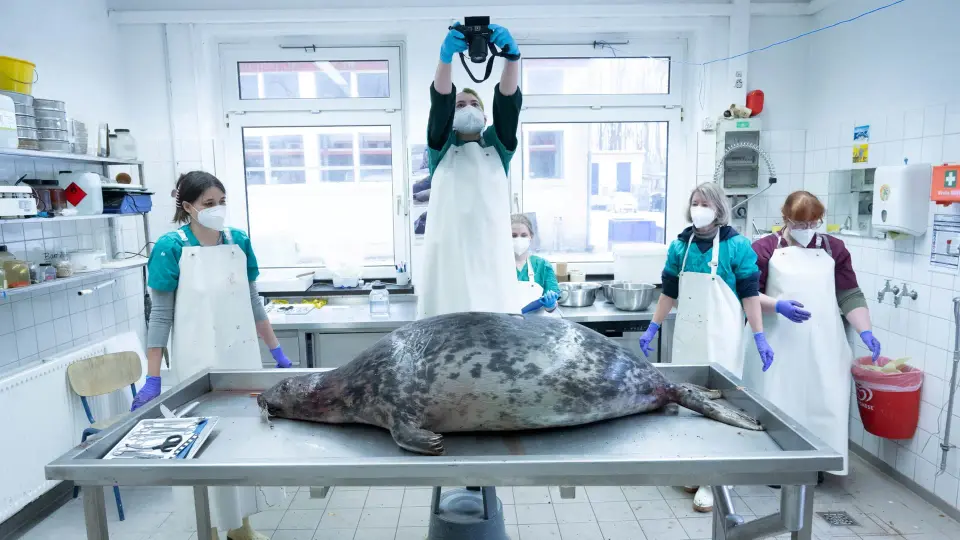
Fishermen in court after mass seal deaths on Rügen's coast
Nearly two years after a mysterious death series among grey seals off the east coast of Rügen, a fisherman and his father must answer to the regional court in Bergen today. According to ndr.de, the 44-year-old fisherman P. from Thiessow deployed a large trap net approximately 670 metres long in the Baltic Sea in mid-September 2024 — shortly afterwards, the deaths began.
Almost daily, in the weeks that followed, seal carcasses drifted onto the beaches of Rügen and the Greifswald Bodden. By 12 October, a total of 19 dead specimens of the strictly protected species had been recovered. According to the subsequent penalty order, some of the animals bore rope marks on their bodies — as if they had been dragged away to be disposed of elsewhere.
Five carcasses found directly at the trap
Staff from the German Maritime Museum and the South-East Rügen Biosphere Reserve noticed the increase in deaths. On 15 October, the authorities sent divers to the trap — and found five more dead seals directly at the catching equipment. All carcasses were recovered and autopsied.
According to the autopsy report, most of the animals are said to have suffocated. In the lungs of one animal, staff from the German Maritime Museum diagnosed "alveoli with foamy, reddish fluid", the windpipe of another was "moderately filled with food bolus". Museum director Burkard Baschek interpreted this as clear evidence of death by asphyxiation. Autopsy photographs also showed animals with bulging eyes and extensive haematomas — in Baschek's assessment, the result of blunt force trauma. Baschek subsequently filed a report with the Stralsund public prosecutor's office. Of the ten seals examined, four showed signs of possible human interference.
Public prosecutor's office: fishermen should have acted
The public prosecutor's office is convinced that the fishermen failed to take protective measures despite knowing of the ongoing seal deaths and the known risk that seals can swim into traps. Moreover, they failed to inform the competent veterinary authority. The two men are accused of violating animal welfare and nature conservation legislation — punishable by fine or imprisonment of up to three or five years respectively.
Against the original penalty order, which obliged both men to pay 90 daily rates, the fishermen lodged an objection — which is why the case is now being heard in open court. They have not commented on the accusations so far; their lawyer refused to make a statement to NDR before the proceedings.
The death series ended after the fishermen removed the trap from the water. Within a total of two months, more than 40 grey seals died.
A heavy loss for an already small population
For marine scientists and conservationists, the loss weighs heavily. "This meant that around 30 to 40 per cent of the autumn population of the stock perished," estimates marine biologist Henning von Nordheim, honorary professor at the University of Rostock. Grey seals are considered the largest predators in the Baltic Sea; around 1920, they were completely exterminated on the German Baltic coast. Since the early 2000s, they have been resettling the area; on average, around 170 animals now live here — in spring the number can rise to 400, in autumn the stock is particularly low.
Already investigated in 2017 — without result
This is not the first time the public prosecutor's office has investigated the fishermen. In 2017, they were blamed for the deaths of 23 grey seals in the adjacent Greifswald Bodden. The autopsy results from that time were similar to those from 2024 — the investigation was nevertheless discontinued because the offences could not be proven.
Following the 2017 incidents, the state environmental ministry tightened the trap net regulation for the Greifswald Bodden: trap nets have since had to be equipped with an entry barrier that keeps animals of 75 centimetres in length away.
New regulations after the mass deaths — conservationists demand more
Following the mass deaths in autumn 2024, the ministry extended the regulation to the entire coastal area of Mecklenburg-Vorpommern. Trap nets must now be equipped with an entry barrier against marine mammals everywhere.
For conservationists such as Corinna Cwielag from the BUND, this came too late. The seals' deaths could have been prevented with more consistent action, she said. The BUND also demands that the barrier device be reduced to 60 centimetres to protect juveniles as well.
A ministry spokesman explained that, to his knowledge, no further deaths of grey seals in connection with such trap nets had been reported following the extension of the regulation: "The current standardisation of the traps therefore appears to be effective with regard to seal protection."
Not all carcasses from the death series have been examined so far. A DNA sample from a fishing trap in the Greifswald Bodden yielded no evidence of seal DNA; further witnesses are to be questioned.
Source: Google News CH — Crime (de)