RAF terror chief Siegfried Haag arrested on A5 motorway – the Opel Admiral gave him away
On 30 November 1976, police stopped a stolen Opel Admiral on the A5 motorway near Butzbach and arrested RAF leader Siegfried Haag.
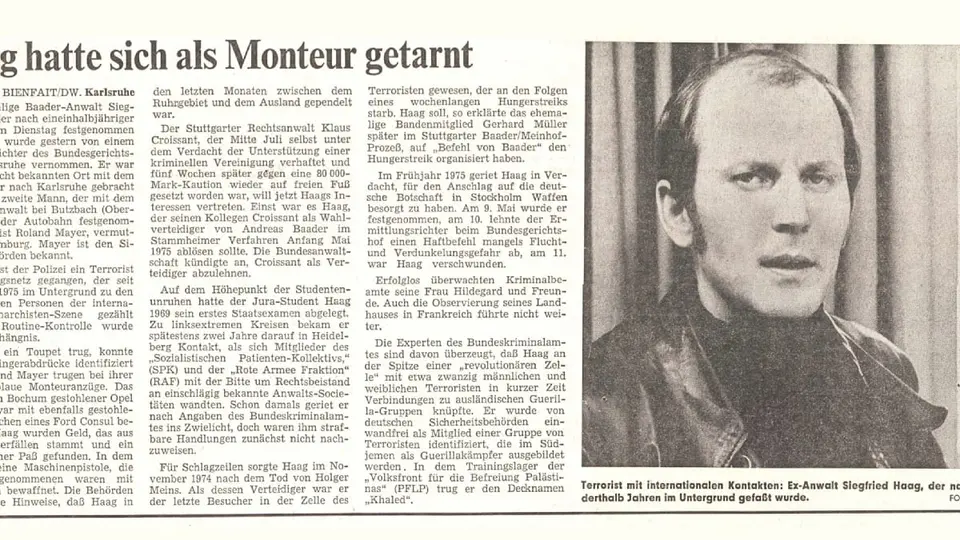
Arrest on the motorway: how Siegfried Haag fell into police hands
On 30 November 1976, police stopped a stolen Opel Admiral on the A5 motorway near Butzbach in Hesse's Wetterau district – and apprehended one of West Germany's most wanted men. According to welt.de, the former solicitor and RAF leading figure Siegfried Haag, 31 years old, was at the wheel, disguised in a blue overall suit.
Whether by chance or as a planned trap – conflicting accounts circulated in various German media immediately after the arrest.
A stolen car becomes his downfall
In the second half of November, an Opel Admiral bearing the registration plate BO-ZZ 418 had been stolen from an underground garage in Bochum. The BKA (Federal Criminal Police Office) quickly suspected that it was not ordinary car thieves but the RAF behind it. The reason: the Opel Admiral – an upper-class saloon from Rüsselsheim, priced just below the Mercedes S-Class and BMW E3 – was comparatively rare on German roads. The BKA thus knew the model and colour of the sought-after vehicle; the RAF had most probably exchanged the registration plate, and the group only rarely had a stolen car resprayeds.
In fact, on the morning of 30 November the Admiral bore a false number plate – H-SC 234, belonging to an Audi 80 or a Ford Consul, but certainly not to an Opel. The Montana grey colour remained unchanged.
Two versions of the arrest
Regional newspapers reported on 1 December 1976 that the BKA had already received a tip "some days earlier" from the anarchist scene, which investigators had initially not taken seriously. According to this account, a targeted vehicle check had been set up at motorway kilometre 444; the Opel was stopped and surrounded by officers with submachine guns. Both occupants had surrendered without resistance.
Welt, the Frankfurter Allgemeine and shortly afterwards Der Spiegel described the sequence differently: the grey Admiral had encountered a routine check, but the driver had ignored the police baton signal. Whereupon a radio patrol car pulled the vehicle across the roadway and forced the saloon to a stop on the hard shoulder.
Weapons, bundles of banknotes and a poorly-fitting toupee
As they got out, one officer noticed that the driver was carrying a gun under his jacket. His passenger wore a noticeably ill-fitting toupee that was meant to hide pronounced baldness. In the boot, investigators found weapons and extensive ammunition supplies. At the older of the two – the driver – banknotes were also confiscated that had been stolen during bank robberies in Cologne on 20 September and in Hamburg on 15 November 1976. The forged papers of both arrested men came from Austria; the blank identity documents had been stolen during a burglary.
One officer recognised a resemblance to a wanted poster in the toupee-wearer. Both men were handcuffed and taken to Giessen police headquarters. Through liaison officers there to the RAF special task force of the BKA in Bad Godesberg near Bonn, fingerprints quickly established: the older man was Siegfried Haag. Identification of his companion took longer – he was 22-year-old Roland Mayer, who had already gone underground and was being treated as a suspected RAF member.
More than 120 encrypted pages
Haag carried with him more than 120 sheets of notes – encrypted, as was customary in the RAF. Criminal chief superintendent Alfred Klaus, for years the leading RAF expert of the BKA, analysed the so-called "Haag-Mayer papers". According to the documents, Haag's group had at least eleven members and was currently preparing five operations with codenames.
Among these was the plan "Margarine", which was to take place in the northern Black Forest – possibly in Karlsruhe, seat of the Federal Prosecutor's Office and Federal Court of Justice. The first generation of the RAF had already carried out a bombing attack there on investigating judge Wolfgang Buddenberg, in which his wife had been seriously injured.
Another plan was called "Big Money". In two robberies – on 20 September 1976 at a Commerzbank branch in Cologne and on 15 November at a branch of Vereins- und Westbank in Hamburg – the RAF had together stolen approximately 251,800 marks: some 225,400 marks in Deutsche Mark notes and roughly 26,400 marks in foreign currency. For an extended series of attacks this was hardly sufficient: following its commencement, one had to reckon with increased security measures and reduced cash stocks at financial institutions.
The image on the A5
For the officers, the scene on the motorway must nevertheless have had a certain comic aspect: the driver and passenger of the comparatively expensive upper-class saloon were wearing blue overall suits with dungarees – a disguise that raised more questions than it answered. Who drives an upper-class limousine in work clothes anyway?
Haag had been wanted across Europe since May 1975 – for support of a criminal association. His arrest on 30 November 1976 remained one of the most significant investigative successes against the second generation of the RAF.
Source: Google News AT — Crime (de)