Saxony strengthens fight against Syrian clans: police monitor four families in Leipzig
Saxony's criminal police special unit "Taskforce Clan" is monitoring four large Syrian families in Leipzig that are allegedly linked to drug trafficking and human smuggling.
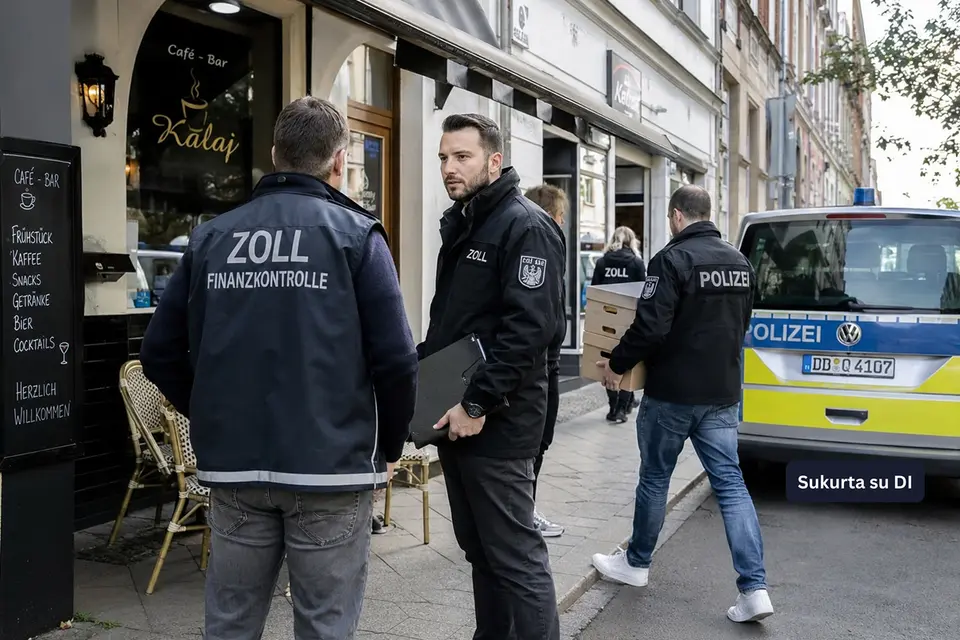
Saxony police intensify surveillance: four Syrian families in Leipzig under investigation
As reported by "Google News LT — Crime (lt)", Germany's Saxony state criminal police (LKA) are increasingly investigating criminal networks based on family ties that have formed in Leipzig. According to current data, between 700 and 1,000 people are associated with Syrian clan environments in Saxony – the vast majority of them live in Leipzig and its surroundings.
However, this figure cannot be equated with the number of criminals. According to police data, around 130 people associated with this environment are linked to criminal activity. Belonging to a large family or kinship ties are not in themselves crimes – investigators emphasise this particularly strongly.
Four families, more than 60 members each
Raiko Märtins, head of the LKA's organised crime department and the special unit "Taskforce Clan", notes that the main focus is on four large Syrian families. Some of them have more than 60 members, but even within these families, some people, as Märtins himself emphasises, live lawfully and do not participate in criminal activity.
The investigation has identified a wide range of criminal acts: violence, drug trafficking, money laundering, tax crimes, illegal human smuggling, document forgery, unlawful financial transactions and various fraud schemes. Firearms have been confiscated during some operations.
50 premises searched in Leipzig – document usage scheme
One of the largest investigations in recent times was conducted in April 2026. According to German media reports, officials searched approximately 50 residential premises and business facilities in Leipzig and surrounding areas.
The focus of the investigation is an alleged illegal human smuggling scheme. Officials suspect that around 50 Syrian citizens may have handed over their identity documents to people in Syria who were sufficiently similar in appearance and attempted to enter Germany with these documents while posing as different persons. While the investigation continues, these accusations have not yet been definitively proven in court.
Structure – not just individual crimes
Saxony investigators regard the structure that facilitates or complicates individual offences as the biggest problem, not the offences themselves. Family members can register cars, bank accounts, real estate or businesses in their names, which are actually used by other relatives.
Märtins contends that some family members register bars, late-night shops and other businesses, and behind the façade of legitimate business, unlawful activity can take place. Investigators also mention the use of so-called nominees – a business or asset formally belongs to one person, but is actually controlled by another.
Strong family ties also create a witness problem: relatives often refuse to cooperate, provide incomplete statements or help conceal assets. German authorities view this as one of the main characteristics of clan criminality.
32 children, 25 grandchildren – an example of one family
As one illustration, Märtins described a Syrian family in the Leipzig region with more than 60 members. According to him, one man with at least three women has 32 children, some of whom are already adults, and at least 25 of his grandchildren live in Saxony. According to police data, almost two-thirds of the closest family members have come to the attention of law enforcement in the past. Nevertheless, Märtins deliberately did not publicise the family name, emphasising that some of its members do not commit crimes.
"Taskforce Clan" – since October 2023
Saxony established the special unit on 1 October 2023, when officials began to notice signs that long-term criminal structures based on family ties were forming in Leipzig. Police forces alone are insufficient in such a model – the unit cooperates with the LKA, federal police, customs authorities, tax investigators, riot police and other state and municipal institutions.
Since the unit's establishment, approximately 40 major operations have been conducted in Saxony. Some suspects have been arrested, some have been charged, and some have already been convicted to prison sentences. Similar specialised structures operate in Berlin, North Rhine-Westphalia and Lower Saxony.
Federal context and inter-group conflicts
The problem is not limited to Saxony. In the German Federal Criminal Police Office's 2024 report on illegal human smuggling, 58 organised crime groups whose primary activity was human smuggling were identified. Fifteen of them were led by people with Syrian citizenship – this was the largest separate group by the citizenship of its leaders.
Political scientist and scholar of clan structures Mahmoud Jaraba claims to have observed a tendency of new criminal networks forming within parts of the Syrian community. Due to competition for the drug market, business or territorial influence between older and newly formed groups, conflicts can arise. One of the most striking episodes occurred in June 2023 in Essen, where individuals linked to a family of Lebanese origin got into a fight outside a Syrian restaurant – chairs were thrown, windows smashed, and police had to intervene in the incident.
However, Jaraba emphasises that it would be wrong to attribute such conflicts to all people of Syrian origin or even to all members of large families. The vast majority of Syrians living in Germany are not involved in such activity.
Source: Google News LT — Crime (lt)