Gender violence in DR: 86 femicides in 2026 and over 75,000 complaints in 2025
66 years after the murder of the Mirabal sisters, male violence continues to claim lives in the Dominican Republic, with 86 women murdered by their partners so far in 2026.
Femicides and gender violence persist in DR six decades after the Mirabal crime
66 years after the murder of sisters Patria, Minerva and María Teresa Mirabal—executed during Rafael Leónidas Trujillo's dictatorship in 1960—male violence continues to be an active crisis in the Dominican Republic, according to eldia.com.do reporting on this 25 November, International Day for the Elimination of Violence Against Women.
A recent study cited by the outlet indicates that 86 women have been murdered by their partners or ex-partners so far in 2026. Projections from the Public Prosecutor's Office show no signs of reduction in reports of gender-based, domestic and sexual violence compared to the previous year.
During 2025, the Office of the Attorney General received over 75,000 complaints about these aggressions. Attorney General Yeni Berenice Reynoso provided that figure when presenting the first Compendium for the Judicial Investigation of Violence Against Women.
"The goal is not just to reduce, the goal is to eradicate all forms of gender-based violence," Reynoso stated.
New tool for prosecutors and experts
The Public Prosecutor's Office presented the compendium as an instrument to improve investigation processes and victim care. The document unifies protocols, standards and procedures, and is directed at prosecutors, medical examiners, forensic psychologists, social workers and lawyers representing victims.
Its development responds to amendments to the Dominican legal framework, including the new Criminal Code and the reform of the Criminal Procedure Code, which incorporates a catalogue of 25 rights for victims.
Reynoso emphasised that investigations cannot be limited to examination of an isolated assault, but must consider the history of violence and power relations between victim and perpetrator. Spanish expert in legal medicine and femicides Juan Manuel Cartagena Pastor noted that the tool seeks to guarantee specialised investigations, reduce re-victimisation and preserve the dignity and integrity of women.
Regional panorama: 3,386 victims in Latin America and the Caribbean
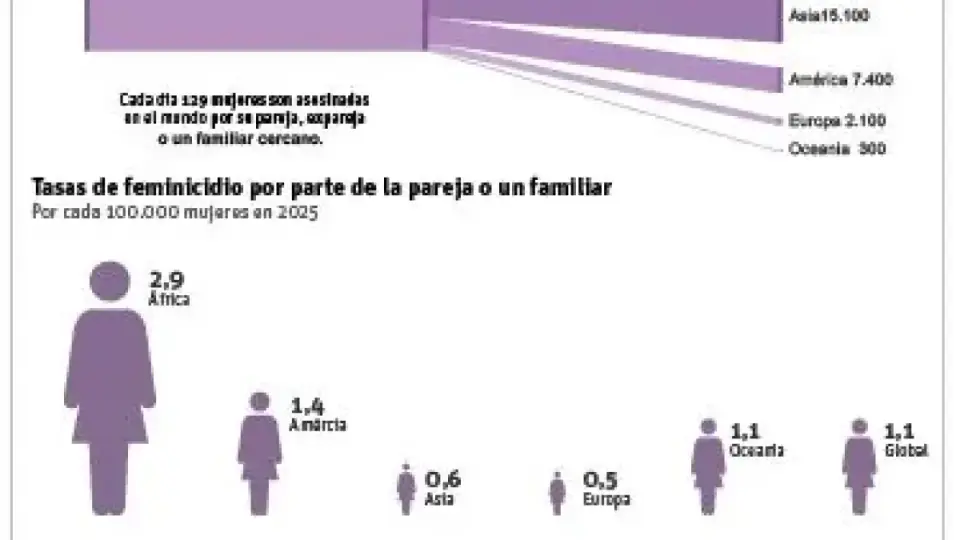
The Dominican situation reflects a regional trend. During 2025, at least 24 women suffered femicidal violence daily in Latin America and the Caribbean, according to data released by the Economic Commission for Latin America and the Caribbean (Cepal).
The body recorded 3,386 victims of femicides or violent deaths due to gender-based reasons in 27 countries, as well as 5,327 attempted femicides in ten nations. In most cases, the main perpetrators were the victims' partners or ex-partners.
Comparable data from seven nations indicates that 72.9 per cent of murdered women were between 15 and 44 years old. Between 11.9 per cent and 33.3 per cent of victims had filed a prior complaint, and in six countries with available information 15 per cent had protective measures in place at the time of the crime.
The home, principal site of aggression
In the Dominican Republic, the family environment accounts for the majority of violent deaths of women. According to the National Statistics Office (ONE), of the 150 violent deaths recorded during 2025, 79 occurred within the victims' own homes.
Violence also reached the child population. During that period, eleven girls under 14 years of age lost their lives violently, the highest figure of the past five years. Five were victims of femicides committed by family members, among whose perpetrators were three biological fathers and one stepfather.
New digital forms of violence
Male violence has also found expression in digital environments. On the eve of the commemoration, the European Commission warned about growing online harassment and the use of technology to amplify misogyny and normalise aggression.
The European body recalled that one in three women worldwide faces gender-based violence, a situation that worsens in contexts of conflict, displacement and humanitarian crises.
State response: "Life Initiative"
Manuel Alba Cano, general coordinator of the Spanish Agency for International Development Cooperation (Aecid) in the Dominican Republic, noted that the response must involve sectors of justice, security, health, education, social protection and civil society.
"Violence against women is not a private matter, but a human rights issue and fundamentally a State responsibility," he stated.
The ministries of Women's Affairs and Interior and Police, together with the Office of the Attorney General, presented the "Life Initiative" on Tuesday in an act headed by the Republic's Vice-President, Raquel Peña.
On 17 December 1999, the United Nations General Assembly, through Resolution 54-134, officially declared 25 November as the International Day for the Elimination of Violence Against Women, in memory of the Mirabal sisters. Six and a half decades after that crime, the challenge remains to convert institutional commitments into effective guarantees of protection for women.
Source: Google News DO — Crime