The Herradura crime: murder in Santiago de Compostela in 1901 that shook the Apostle festivities
A Galician émigré returned from Uruguay was stabbed and robbed on the Herradura promenade during the Holy Year of 1901. The case resulted in two death sentences, a prison escape, and decades of judicial consequences.
Ángel María Lorenzo Ozores, murdered at the Herradura during the Apostle festivities of 1901
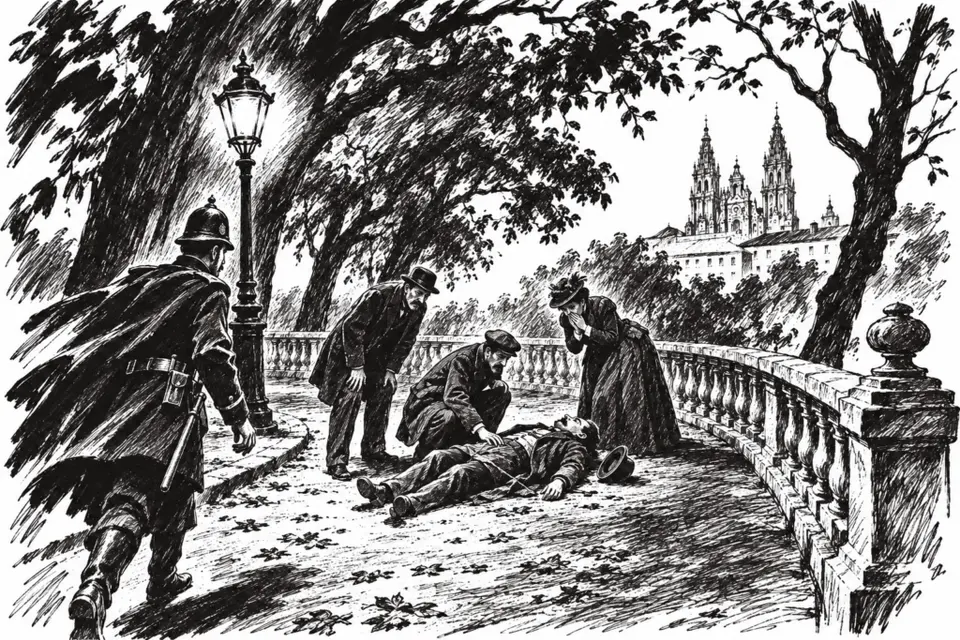
On the night of 25 July 1901, Santiago de Compostela was celebrating the festivities of the Apostle during the Holy Year. According to diariodesantiago.es, among those attending the celebrations at the Alameda was Ángel María Lorenzo Ozores, a Galician émigré who had made his fortune in Uruguay and was visiting Galicia. The following morning, his body was found lifeless in a remote area of the Herradura promenade: he had been stabbed and robbed of his belongings.
The case, known from then on as the Herradura crime, triggered one of the most discussed judicial proceedings in Compostela's history. Its consequences lasted for more than thirty years and included two death sentences, a municipal intervention to request clemency, a prison escape, and the return to court of one of the accused when he seemed to have left his past behind.
The victim: an Indian from the Padrón region
Lorenzo Ozores was just over fifty years old and was from the Padrón region. He had lived for years in Mercedes, a city in Uruguay, where he developed businesses linked to cattle trading. His stay in Galicia included a visit to the Cuntis spa before passing through Santiago coinciding with the Apostle celebrations. The wallet he was carrying contained about 3,000 pesetas, a considerable sum for the time.
The meeting at the Herradura and the reconstruction of events
According to the reconstruction elaborated during the judicial process, Lorenzo Ozores met during the festivities María Manuela Carreira Corredoira, a 28-year-old woman known as la Peizoca. Both headed towards a remote sector of the promenade, far from the main concentration of people.
The prosecution argued that this meeting was part of a premeditated plan to rob the Indian. While Manuela entertained Lorenzo Ozores, her companion, Celestino Rodríguez—nicknamed el Vimianzo—remained hidden in the vicinity. When the victim discovered the attempted robbery, a confrontation ensued: Celestino intervened and stabbed him fatally.
Celestino Rodríguez had been born in Vimianzo on 2 November 1876 and had previously worked in hospitality establishments in A Coruña. The police identified both suspects by tracing the victim's movements during his final hours. Both were arrested two days after the crime.
A ten-day trial with Civil Guard reinforcements
The proceedings lasted almost two years before reaching the oral hearing, held between 20 and 30 April 1903. Expectations were so high that the authorities requested reinforcements from the Civil Guard from different points in the province to control access to the sessions. The newspapers followed in detail the interrogations, expert statements, and the interventions of lawyers.
One of the central elements of the trial was the analysis of stains found on the clothing of the accused. Narciso Carrero Goyanes, professor of Forensic Medicine in Santiago, declared that they were human blood. Celestino Rodríguez, for his part, maintained that they came from his own nosebleeds.
Disagreements also arose regarding the weapon. Some experts considered that the wounds to Lorenzo Ozores' body did not correspond to the knife seized from the accused. The defence argued that the available evidence did not allow for a certain reconstruction of what had occurred and that there was insufficient evidence to attribute the murder to their clients. The accused initially denied their involvement.
Despite these objections, the court considered the responsibility of both defendants established and sentenced them to death.
The city council requests a pardon and sentences are commuted
The sentence provoked a new mobilisation in Santiago. On 30 April 1903, the city council agreed, at the proposal of councillor Máximo de la Riva, to request the pardon of the condemned. The doubts that had surrounded the trial and social opposition to an execution added support for commutation.
The request succeeded. The death sentences were replaced by life imprisonment sentences: Manuela Carreira was sent to the prison in Alcalá de Henares and Celestino Rodríguez to the penal facility in Melilla. For the majority, this seemed to be the final denouement of a case that had kept Compostela society in suspense for years.
The Vimianzo's escape and a new life under a false identity
However, Celestino Rodríguez managed to escape from the penitentiary establishment in Melilla and left Spanish territory. Historical reconstructions of the event do not entirely coincide on the date, although they place the escape in the early years of the twentieth century. For a time he remained in North Africa and subsequently managed to reach America, where he lived under various identities.
As the years passed he returned to Spain and settled in different cities. He used documentation with false names and developed commercial activities that allowed him to build a new life. In Lugo he came to participate in business related to merchandise trading and hospitality. Those who dealt with him under his adopted identity were completely unaware of his judicial past.
The Herradura crime would thus remain one of the longest-lasting and most complex episodes in Santiago de Compostela's crime chronicle: a murder committed during a festive night which, far from closing with the 1903 sentence, continued to have consequences for decades.
Source: Google News CL — Santiago