Roissy: customs face explosion in wildlife trafficking
Seventeen people convicted of smuggling glass eels, rhinoceros horns seized on export: RFI assesses the state of trafficking at Charles de Gaulle Airport.
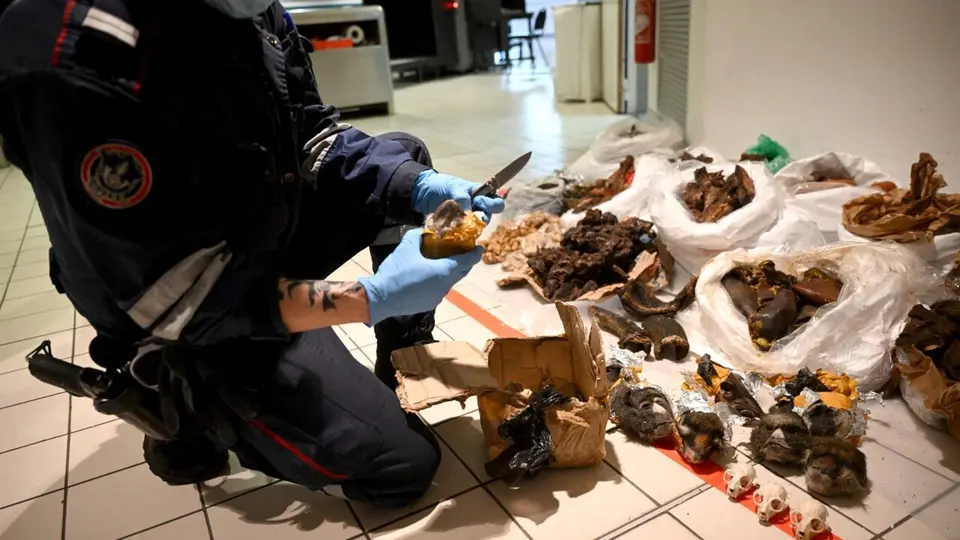
Rhinoceros horns, pythons and glass eels: Roissy cargo faces protected species trafficking
Seventeen people have been convicted of sentences of up to five years' imprisonment for organising the smuggling of glass eels — young eels — destined for Asia. Bags filled with these young eels were intercepted at Paris-Charles de Gaulle Airport. As RFI reports, this case illustrates the scale of a global trafficking operation estimated at 20 billion dollars per year according to the United Nations.
In Roissy's cargo hangar, more than two million tonnes of goods pass through each year. Every day, customs officers conduct random searches of packages there — drugs, cigarettes, but also animal or plant species whose trade is regulated or prohibited by the CITES convention on protected species.
Bear bile, powdered horn and caiman skins
Valérie Besson, head of the Roissy customs office, supervises these inspections. In front of a table covered with recent seizures, she describes the diversity of products intercepted: "There are many medicines that contain species of either flora or fauna protected by CITES. You have for example in medicines bear bile that is extracted from live bears. You have dried seahorse, species of flora as well, that go into the manufacture of Asian medicines for their supposedly therapeutic properties, for strength, for virility."
Among the items on display that day: two caiman skins from the United States, orchids and agaves imported for French collectors, bone fragments, pieces of limbs, tails or animal hair. Besson also mentions "the small hairs from elephant tails" and two rhinoceros horns, one small and one large, seized during an export inspection to Asia. "They bear traces proving that they were attached to trophies, so they were certainly stolen," she specifies. An investigation is to determine their origin. A kilogramme of rhinoceros horn sells for more than 40,000 euros.
Live animals slipped into postal packages
Trafficking sometimes extends to the shipment of live animals. "People sometimes put live animals in postal parcels," Besson continues. "It is very rare, but it can still happen. Through the Post, we have already found notably snakes, a royal python." Once seized, these animals are sent to approved shelters or aquariums to receive appropriate care.
Trafficking is not limited to cargo: it is also detected in passengers' luggage during random inspections.
Fourth global trafficking, behind drugs and weapons
Laurent Authier, deputy head of cargo at Roissy, places these seizures in an international context: "At the global level, trafficking in protected species is the fourth most lucrative, most profitable trafficking operation after that related to drugs, human trafficking and that related to the arms trade."
Interpol data confirm this trend. Last year, wildlife trafficking reached record levels globally, with 30,000 seizures recorded — including more than 6,000 birds, turtles, reptiles, primates and pangolins. This rising figure is notably driven by growing demand for exotic pets.
Administrative and criminal penalties
On the judicial front, customs officers rely on two mechanisms. For small quantities, the seizure of goods can be accompanied by an administrative fine. When criminal proceedings are initiated, sentences can range up to imprisonment — as illustrated by the five years handed down in the glass eel case. "The primary aim is still to try to ensure that criminal proceedings are pursued on the basis of our findings," Authier emphasises.
The conviction of the seventeen members of the glass eel smuggling network constitutes, according to the authorities, a strong signal to organised networks that exploit air cargo flows to transport protected species to Asian markets.
Source: RFI