Multimillion-euro fraud at OPEKEPE: Fictitious cattle, ghost passports and political connections
The European Public Prosecutor's Office is investigating illegal subsidies worth 5 million euros channelled through fictitious cattle in Trikala, with the network extending to Western Greece.
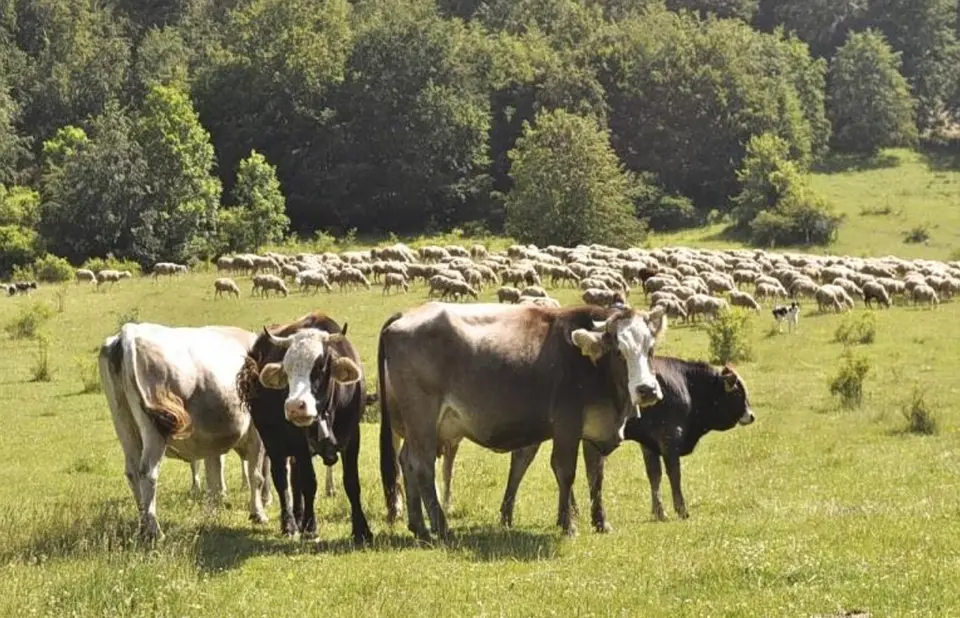
Network of fictitious subsidies at OPEKEPE: Trikala, Western Greece and political connections
In.gr reveals that the network of illegal subsidies through fictitious cattle at OPEKEPE continues to operate and expand, whilst the European Public Prosecutor's Office is already in full investigative action. According to Thoma Moschos, technical adviser to the Union of Greek Livestock Breeding and sectoral chief of Agricultural Development at ELAS, the phenomenon has now spread throughout the entire Greek region, through successive ministerial decisions.
The OPEN channel had previously revealed that a network of illegal subsidies with fictitious animals and non-existent land had been set up in Trikala during the period 2019-2021. Villas with swimming pools were registered as pastureland, whilst luxury residences were declared as stables. The scale of the fraud reaches approximately 5 million euros.
Surprise raids on Friday
On 6 November, the European Public Prosecutor's Office carried out surprise raids at the Veterinary Service of the region, at the OPEKEPE office in Larissa and at the Veterinary Clinic in Kalambaka. According to Thoma Moschos, further raids are expected in the immediate future.
In the Trikala case, says Mr Moschos, a high-ranking political figure's family is leading. "Nine out of the 19 persons who, according to information, are involved in the Trikala case, belong to the family of that particular politician," he points out. Only one person had declared, he says, "around 2,000 to 2,500 cattle".
The method: ghost passports and fictitious births
Dimitris Moschos, president of the Union of Greek Livestock Breeders and father of Thoma Moschos, explained the fraud mechanism to in. For someone to receive a subsidy for cattle, there had to be a recorded birth within the year. To declare a birth, the issuance of an animal identity document — a "passport", as livestock breeders call it — was required, a procedure that took place at the veterinary clinic.
"Livestock breeders were receiving subsidies for births that had never taken place, knowing that no one actually checks in the field what is happening," explains Dimitris Moschos. After securing the fictitious passport, the perpetrators would later declare that the "animal" had died — to avoid any checks. Subsequently, they would take 3-4 calves to the private slaughterhouse but declare 5, using the fictitious passport.
At the same time, the perpetrators "split" the slaughter weights: instead of declaring 350 kilograms for one animal, they would categorise them into 4 batches of 100 kilograms, thus converting 3 real calves into 4 subsidised ones.
Numbers that reveal the scale
"They declared nearly 261,500 calf births. And in the end, when they slaughtered, the picture we saw for that year is that ultimately approximately 70,000 cattle were slaughtered and subsidised," explains Thoma Moschos. "For the public to understand, from the 261,500 births there should have been close to 200,000 cattle slaughtered".
Additionally, the average weight at Greek slaughterhouses appears very low — around 260 kilograms — whereas in practice calves going for slaughter are usually 350 kilograms and over.
Many involved — and a new area in the spotlight
According to Thoma Moschos, the mechanisms involve veterinarians, slaughterhouses and the Centres for Reception of Declarations (KYD), which were uncritically registering the fictitious declarations.
Beyond Thessaly, Mr Moschos points out that an even larger problem is detected around a major city in Western Greece, whilst "scattered across the country are still 6 to 7 regions where the same thing happened". The analysis that revealed the discrepancies was conducted using ELGO DIMITRA data for 2024.
The detailed memorandum drawn up by Thoma Moschos was sent to the European Public Prosecutor's Office with the signature of the Agricultural Association of Kastoria, which he chairs. He says he was called to give a deposition. "I believe the European Public Prosecutor's Office had understood this beforehand, because both last year and the year before there had been public complaints about this issue," he says.
New Joint Ministerial Decision by Schinas: an "open window" for continuation
Mr Moschos points out that the irregular subsidies were not stopped. On the contrary, a recent Joint Ministerial Decision issued at the end of October by the Minister of Agricultural Development and Food Margaritis Schinas leaves, in his view, an open window for further wastage of public money.
According to the Joint Ministerial Decision, it is sufficient for someone to have agricultural income — in form E3, agricultural income means: subsidy. "This means that someone who has never proved they have production, if they have received a subsidy once, that is considered agricultural income, and they can receive a subsidy again," explains Mr Moschos. The relevant article 6 of the Joint Ministerial Decision states: "In cases of zero income or zero value of rights, for reasons of administrative futility and avoidance of extreme values, the index takes the value 1".
"This is mad what has happened," comments Thoma Moschos. "From now on, anyone who applies for a subsidy for agricultural production will be able to receive it".
Source: In.gr