54 gang members killed in Martissant during police offensive in Port-au-Prince
Haitian police killed 54 suspected gang members during a 48-hour operation in Martissant. The objective: to reopen national highway no. 2 and prepare for elections.
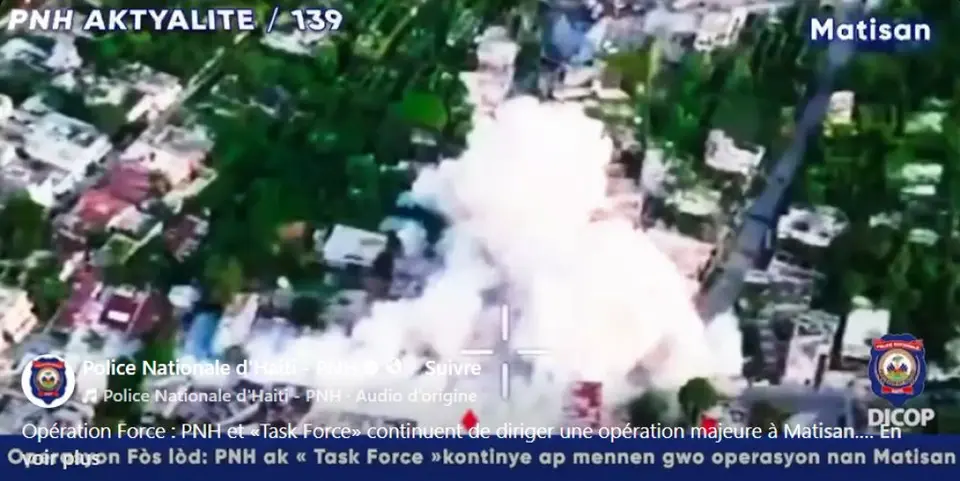
Offensive in Martissant: PNH strikes hard at the southern entrance to Port-au-Prince
On 19 and 20 November 2026, elite units of the Haitian National Police (PNH) launched a large-scale offensive in Martissant, a strategic neighbourhood at the southern entrance to Port-au-Prince. According to guadeloupe.franceantilles.fr, the toll announced on Monday 24 November by the PNH indicates at least 54 suspected members of armed groups shot during the firefights: 34 on the first day, 20 on the second.
Specialist units — SWAT, UTAG and UDMO — intervened in the sectors of Martissant 2, 4 and 23, strongholds of the Village de Dieu and Grand Ravine gangs. They deployed a dozen armoured vehicles, one heavy armoured vehicle and drones loaded with explosives, alongside the government Task Force. International contingents, including Salvadoran forces, also participated in the operation. The PNH reported no losses in its ranks, without specifying which areas were finally secured.
Reopening national highway no. 2
The immediate objective of this offensive is the reopening of national highway no. 2, which connects Port-au-Prince to cities in the south of the country, notably Miragoâne and Les Cayes. For several years, armed groups stationed in Martissant and the neighbouring commune of Carrefour have blocked access, carrying out kidnappings, extortion and cargo diversions.
Security pressure is being applied simultaneously on other fronts in the departments of the West and Artibonite:
- In Tabarre: on 22 November, the Gang Suppression Force (GSF), supported by the UN, announced it had killed six suspected gang members and seized five firearms near the Marassa bridge.
- In Cité Soleil: in the Boston neighbourhood, law enforcement set fire to the house of gang leader Mathias Saintil, who was himself killed on 6 November.
- In Gros-Morne: in Artibonite, clashes left three bodies attributed to the Kokorat San Ras group, according to municipal magistrate Hubert Cénéac, whilst the GSF seized ten weapons and located approximately ten vehicles used by armed groups.
Tragedy in Salvadoran ranks
This escalation follows the deployment in October 2026 of more than 2,000 Salvadoran military personnel to Haiti, decided after the disappearance of four Salvadoran aeronautical technicians engaged within the GSF. The engagement was however marked by tragedy: on 20 November, three Salvadoran soldiers were killed and a fourth wounded in the accidental explosion of explosives at a Haitian military camp.
On Sunday 22 November, Haitian Prime Minister Alix Didier Fils-Aimé visited their base to pay tribute to the fallen soldiers and affirm that "gangs will have no peace". That same day, Salvadoran President Nayib Bukele released a fund of one million dollars in support to the families of the three deceased military personnel, comprising an initial payment of 200,000 dollars per household, supplemented by a monthly allowance.
Bilateral cooperation and electoral horizon
Beyond the military response, the Haitian executive intends to establish this cooperation on a long-term basis. Following approval of a bilateral agreement between Haiti and El Salvador in the Council of Ministers on 17 November 2026, the Minister of Planning and External Cooperation, Sandra Paulemon, met Salvadoran Vice-President Félix Ulloa on 21 November, during the World Summit of Governments for Latin America and the Caribbean.
After a minute's silence in tribute to the killed soldiers and four missing persons, the two officials discussed the training of Haitian forces and the management of high-security prisons — a matter already explored by Justice Minister Patrick Pélissier in El Salvador. Félix Ulloa emphasised the necessity of accompanying repression with measures for education and social reintegration. Sandra Paulemon highlighted Haitian employment creation and demobilisation programmes, with a specific political objective: to restore the authority of the State to allow citizens to return to the polls, ten years after the last elections.
Source: Google News HT — Crime