Georgescu, judicial supervision transformed into political platform, warns political scientist Țăranu
Political scientist Andrei Țăranu warns that the court's decision in the Georgescu case offers the former candidate a new political platform. Police appearances could become meetings with supporters.
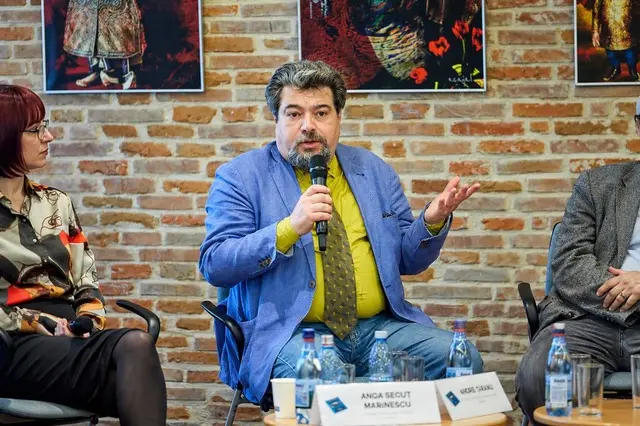
Georgescu's judicial supervision, opportunity to reconnect with supporters, says political scientist Andrei Țăranu
The court's decision to impose judicial supervision instead of preventive arrest in the case of Călin Georgescu could produce significant political effects, warns political scientist Andrei Țăranu, professor at SNSPA. According to News.ro, Țăranu believes that the former presidential candidate will once again transform his mandatory appearances before institutions into political platforms.
"I know that the effects, from my point of view, will be dramatic," the political scientist declares.
Georgescu was detained for 24 hours by DIICOT prosecutors in a case in which he is being investigated for fraud with particularly serious consequences and the establishment of an organised criminal group. He was removed from DIICOT headquarters in handcuffs, presented to the court with a proposal for preventive arrest, and then released under judicial supervision.
Police appearances, replicated according to an already-tested model
Țăranu points out that the mechanism is not new. In previous legal episodes related to accusations concerning a coup, Georgescu attracted tens and hundreds of supporters around his visits to institutions.
"As we saw with the previous accusation, the one related to the coup, Călin Georgescu transformed his police appearances into platforms," Țăranu states.
Supporters repeatedly gathered to see him, shouting his name and seeking ways to make direct contact with him.
"And for weeks on end, tens, hundreds of citizens came just to see him and to shout at him and to find ways through which to get in touch with him," says Andrei Țăranu.
Now, judicial supervision provides a predictable schedule of movements, which, in the political scientist's view, gives these meetings a visible rationale.
"Until now he travelled around the country without having any particular programme, that is, you did not know why he was travelling around the country. Now, when he goes to the Police and meets with his supporters, it is supposed that there is a rationale," explains Țăranu.
The effect, according to the analyst, could be a partial recovery of public sympathy.
"And that will probably bring him again, part of the sympathy that perhaps was lost before," says Andrei Țăranu.
The court's decision, viewed from two angles
The political scientist analyses the judges' decision from two perspectives. The first concerns the degree to which the case has been investigated.
"Namely the fact that the case was not fully investigated," states Țăranu, adding that he cannot know whether "the judges believe that what we see, or what the prosecutors presented to us, is not actually so serious".
The second perspective is purely political: judicial supervision puts Georgescu back in the public eye as a visible person, not merely as a defendant.
"On the other hand, the fact that it will again allow Călin Georgescu to become a public person, not defendant or anything, in relation with institutions," says Țăranu.
The case, damages of 1.1 million euro and a connection to the elections
Officially, the DIICOT case in which Georgescu is being investigated concerns fraud with particularly serious consequences and the establishment of an organised criminal group, with damages estimated at approximately 1.1 million euro. Prosecutors argue that the investigation is separate from the electoral one.
However, Țăranu questions this distinction, proceeding from the public statements made by prosecutors.
"Well, it seems to me that it has a connection to the elections. At least from what the prosecutor was saying," the political scientist states.
He refers in particular to the sum of 100,000 euro which investigators claim was directed towards the 2024 electoral campaign.
"Namely the fact that the 100,000 euro that he took from that person were allocated to be spent on the 2024 electoral campaign. I don't know, more explicit than that, I don't see it," says Țăranu.
The electoral future, open or closed?
Asked whether Georgescu could ever run again, Țăranu rejects any premature conclusion.
"Until now, whether he cannot run, we do not know. Perhaps later, perhaps it has a connection, perhaps he can run until 2030. There is still a long time."
The political scientist emphasises that any analysis concerning the impact on elections in the long term must be approached with caution, so long as the judicial process is ongoing.
"We do not know whether he can or cannot run," he says.
The effect on public opinion, measurable only through polls
Regarding the impact among the wider public, Țăranu believes that the episode of arrest and release will leave marks, but that their extent cannot be estimated without dedicated opinion research.
"I do not know how such a case will be reflected — I have no way of knowing, as serious polls need to be conducted again," says Țăranu.
When asked whether the event could nevertheless influence public opinion, his answer is firm: "Certainly, certainly."
The Georgescu case, more powerful than other political subjects
A distinct element of Țăranu's analysis concerns the ability of the Georgescu subject to capture public attention even when the political scene is crowded.
The political scientist observes that, unlike other important political figures, the Georgescu case has managed to dominate public discourse in parallel with them.
"Important figures, such as Mureșan or Grindeanu or even Nicușor Dan, were not overshadowed by the subject of Călin Georgescu," says Țăranu.
He describes the mechanism through which the case generates interest: the combination of emotion, politics and the element of surprise.
Țăranu finally places Georgescu's strategy in a broader historical context: "The fashion of transforming the courtroom into a platform is a very old fashion, dating back to the Roman Empire."
Source: News.ro