Purge Case: Criminal Group Controlled Police, Court Restarts Trial
The indictment in the Purge case is set to be read on 8 June — the trial stalled on its first day. Eleven people are on the defendant's bench, including Gašpar and Bödör.
Purge Before Court: Instructions from the Sixth Floor, Bribes and Surveillance of Politicians
The indictment in the Purge case is expected to be heard for the second attempt on Monday, 8 June, according to Aktuality. The trial halted on its very first day — 11 May — when the Specialised Criminal Court panel, more than four years after the indictment was filed, finally began proceedings in the case, but the defendants ultimately did not hear the indictment read.
The case now encompasses eleven defendants. One person was removed from the list due to the statute of limitations on a corruption offence — former finance ministry official Milan Grega, also known from the Tollman case. He was replaced by former police officer Roman Stahl, following the court's decision to consolidate two related cases. The proposal to consolidate was filed by former special prosecutor Dušan Kováčik together with his defence counsel at the very beginning of the proceedings.
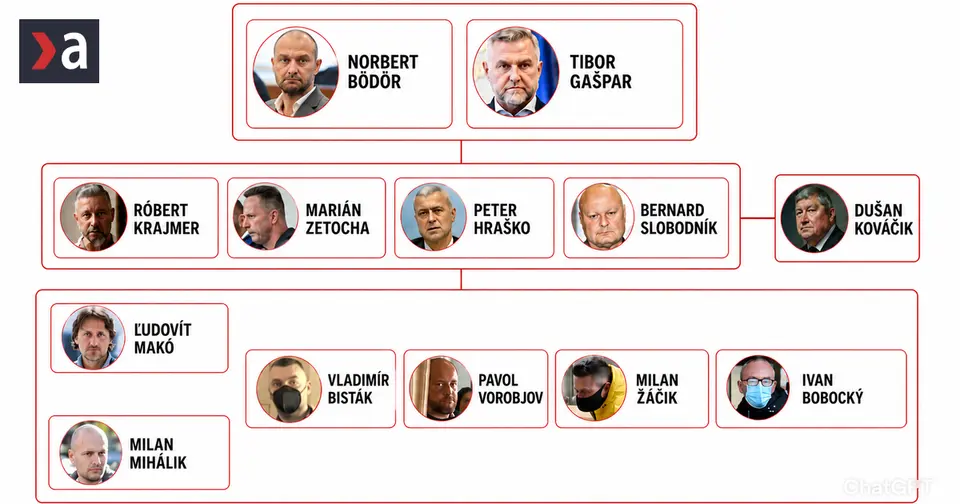
Among the defendants are former police president and current deputy chairman of the National Council for Smer Tibor Gašpar and his distant relative, Nitra businessman Norbert Bödör, close to the Smer leadership.
Criminal Network Directly Within Police Structures
The indictment describes how, between 2012 and 2018, a criminal group operated within the police, controlled from behind the scenes by Norbert Bödör. Its members included police top figures themselves. According to the indictment, Bödör and Gašpar jointly devised a network of collaborators directly within the police in 2012, including placing their people in the highest positions. This network was supposed to perform various tasks for them and their associates — helping selected individuals while causing problems for others.
High-ranking officials appointed by Gašpar — including former head of the National Criminal Agency (NAKA) Peter Hraško, former head of the NAKA anti-corruption unit Róbert Krajmer, and former head of the NAKA financial unit Bernard Slobodník — were supposed, according to the indictment, to pass tasks to subordinates, participate in illegal activities themselves, and pocket bribes.
Meetings on the Sixth Floor of Transpetrol
Bernard Slobodník confessed to extensive criminal activity. In the case, he appears not only as a defendant but also as a witness against others. He described meetings with the Nitra businessman at which cases within the remit of the financial police and other units were discussed, as well as matters related to opposition politicians and the finance ministry.
According to Aktuality, Slobodník testified that he gained the impression that "a group of police officers and officials began to operate within the power structures of the interior ministry, as well as the finance ministry, led by Gašpar and Bödör, with tasks being largely distributed to them by a civilian — Norbert Bödör".
The location of these meetings was supposed to be the sixth floor of the state Transpetrol building. There Bödör was supposed to issue instructions or unlawfully obtain information from ongoing criminal proceedings, from within the police and the prosecutor's office. At one of the meetings, Slobodník was supposed to meet the then special prosecutor Dušan Kováčik. According to the indictment, he was aware of the group's illegal activities, did not take legal action, participated in its meetings, and provided information from live cases.
Bribe for the Váhostav Case
The indictment describes a specific corruption offence as follows: on the sixth floor of the aforementioned building, Bödör was supposed to hand over 20,000 euros to Slobodník in Gašpar's presence so that the investigation of the Váhostav case would not end in the prosecution of Juraj Široký and his son. If it became necessary to question anyone from the Široký family, police officers were not to bring them in, but to call them — and entry to the police headquarters was to take place without inspection. Váhostav had enjoyed success with state contracts during Smer's rule. Slobodník was supposed to receive further tens of thousands after a "suitable" expert opinion was added to the case.
It is precisely this offence that the Foundation Stop Corruption cites as one of those that are statute-barred in relation to Bödör.
Surveillance of Opposition Politicians and Unlawful Vetting
Lower-ranking members of the group were supposed to carry out tasks such as unlawfully vetting individuals and surveilling opposition politicians. At Bödör's request, Gašpar was supposed to instruct subordinates in 2015 to ensure the surveillance of opposition politicians Igor Matovič, Daniel Lipšic and Radoslav Procházka. Rewards from Bödör were handed to them by the former director of the NAKA management support department Marián Zetocha, who was also supposed to provide them with vehicles for surveillance. In this context, police officers Milan Žáčik, Ivan Bobocký and Pavol Vorobjov have testified in the past. Vorobjov was also convicted of unlawfully vetting journalists, including Ján Kuciak.
The indictment also mentions cases where group-loyal police officers were supposed to instead seek problems with selected companies. One of them was the KTAG company of former president Andrej Kiska. The former president was later convicted of tax fraud in connection with billing campaign expenses through this company. Kiska spoke of a political order.
Statute of Limitations and Endangered Witness Testimony
The Purge case has been affected by coalition amendments to the criminal codes from 2024, which introduced lower sentences for corruption and shorter statutes of limitations. An analysis by the Foundation Stop Corruption shows that some offences are statute-barred even in relation to Bödör himself.
On Monday it will also become clear whether the court has halted or will halt criminal prosecution due to the statute of limitations for further offences. A further planned amendment poses a risk to the prosecution, which parliament has yet to debate. If it passes, it will restrict the use of cooperating defendants — including in live cases. However, the prosecution in Purge is built largely on the testimony of those who have confessed to criminal activity.
Source: Aktuality