UK trafficking referrals hit record high as backlog rises and Bill targets 'misuse'
Referrals to the National Referral Mechanism reached a record 25,373 in the year to June 2026, while the government's Immigration and Asylum Bill seeks to tighten disqualification rules.
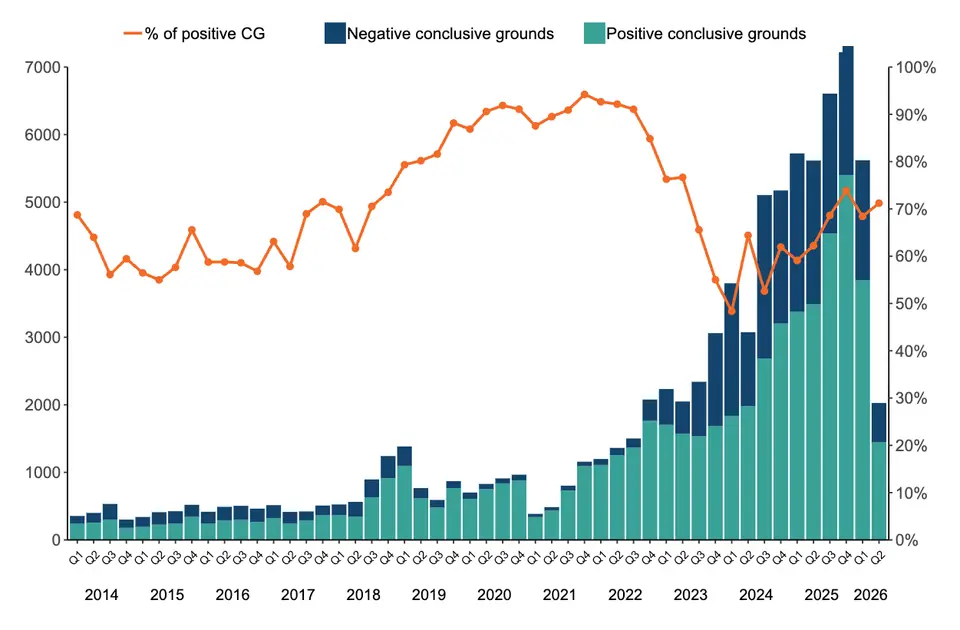
NRM referrals at all-time high as conclusive grounds backlog grows
Referrals to the National Referral Mechanism (NRM) reached 25,373 in the year to June 2026 — the highest annual total since the scheme began — according to the latest trafficking statistics published by the Home Office. As freemovement.org.uk reports, the backlog of cases awaiting a conclusive grounds decision has also risen for the first time since 2022, climbing 23% to 5,656 by the end of June.
The figures were published slightly later than usual; the Home Office attributed the delay to IT issues.
Record referrals and a single-quarter peak
The 25,373 referrals represent a 5% increase on the year to March 2026. April to June 2026 alone produced 6,954 referrals — a single-quarter record and 16% more than the preceding quarter.
The most common nationalities among those referred were UK nationals (22%; 5,548), Eritreans (13%; 3,220) and Somalis (11%; 2,741). Of UK nationals referred, 74% were children, with criminal exploitation the most commonly reported form of abuse affecting that group.
Exploitation reported as having occurred exclusively overseas accounted for 54% of referrals (13,591) — the highest share on record, up from 52% in the year to March 2026. Libya was by far the most frequently cited country (7,351 cases), followed by Sudan (1,647) and Somalia (1,307).
Government agencies made 58% of referrals (14,764), with UK Visas and Immigration (UKVI) accounting for 5,767 of those. NGOs and third-sector organisations submitted just 4% (954). The Fair Work Agency, launched earlier this year to tackle labour exploitation, appeared as a first responder for the first time.
Labour exploitation was the most commonly reported type of exploitation overall, making up 38% of referrals (9,546).
Decision rates and the growing backlog
Of 23,573 reasonable grounds decisions made in the period, 64% were positive. The Single Competent Authority — which handles roughly three-quarters of all referrals — returned a positive rate of 73%, while the Immigration Enforcement Competent Authority, which deals with detained individuals, those with inadmissible asylum claims and non-detained foreign national offenders, recorded a positive rate of just 34%.
At the conclusive grounds stage, 71% of 21,564 decisions were positive: 72% for the Single Competent Authority and 49% for the Immigration Enforcement Competent Authority. The Home Office made fewer conclusive grounds decisions between April and June 2026 as staff were redeployed to address the backlog of reasonable grounds cases.
Data on the reasons for negative decisions is absent from this release. The Home Office changed its recording methodology in April, rendering earlier and later figures incomparable. The reasons for refusal are expected to reappear in the next quarterly release.
The median wait for a conclusive grounds decision stood at 84 days at the end of June, up from 50 days at the end of March, though it appears to have fallen back to 69 days by 31 August. The Home Office has pledged to clear the conclusive grounds backlog by December 2026.
Bad-faith disqualifications remain rare
There were 144 disqualification requests in the year to June 2026 — 137 on public order grounds — compared with 244 in 2025. All public order requests were made before the Home Office paused such decisions on 23 December 2025. Since that pause, only four requests have been submitted, all on bad faith grounds.
Confirmed disqualifications totalled 119 in the period, with all but one finalised before the pause. Only three were on bad faith grounds. Since bad faith disqualification was introduced in January 2023, just 19 people in total have been disqualified on that basis — roughly 0.03% of referrals over the same period, or approximately one in every 3,800 cases.
Immigration and Asylum Bill raises concerns
The statistics are published against the backdrop of the Immigration and Asylum Bill, currently at committee stage, which contains provisions that critics say would make conditions considerably harder for trafficking and modern slavery victims.
Among the proposed measures is a new credibility test under which certain factors — including a delay in making a claim — could count against an applicant. The Bill's explanatory notes state that the NRM is "susceptible to misuse, in particular to delay or prevent immigration removal action."
The Bill would also make disqualification mandatory and expand the definition of bad faith. The figures above, however, show that bad faith disqualifications have so far been exceptionally uncommon.
A separate development concerns skilled worker visa holders. As of 8 October 2026, those who receive a positive conclusive grounds decision are supposed to be able to have their work conditions lifted, allowing them to change employer. Freedom of information data obtained by the Work Rights Centre shows that only 645 skilled worker visa holders were referred to the NRM between January 2022 and August 2025, though that figure may rise now that sponsored workers have a clearer incentive to report exploitation.
Source: Google News UK — Crime (en)