Trump's hush money conviction challenged at New York appellate court
Trump's lawyer argued the hush money case was "infected by multiple fatal errors" before a New York appeals panel. Judges questioned claims of presidential immunity and federal preemption.
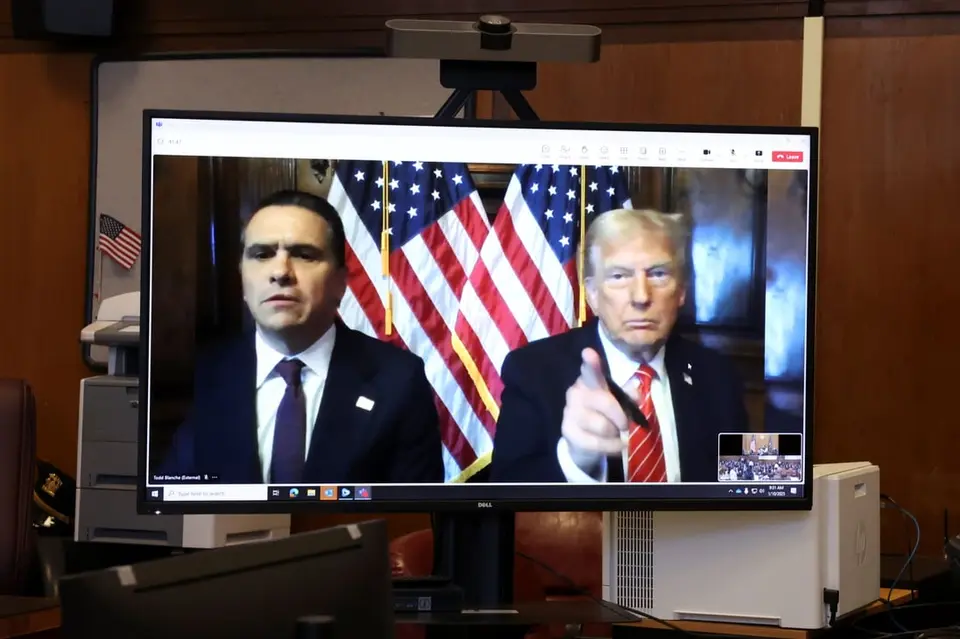
New York judges probe Trump's bid to overturn Stormy Daniels conviction
A panel of five New York appellate judges questioned Donald Trump's defence team on Thursday over their latest effort to overturn his 2024 criminal conviction in the hush money case, courthousenews.com reports.
Trump's attorney Robert Giuffra, of Sullivan & Cromwell, told New York's Appellate Division, First Department, that the case was "infected by multiple fatal errors." The former president was found guilty on 34 counts of falsifying business records and sentenced to unconditional discharge — the first sitting or former commander-in-chief convicted of a crime.
Giuffra argued that Manhattan District Attorney Alvin Bragg had unlawfully relied on the Federal Election Campaign Act of 1971 (FECA) to elevate what would otherwise have been a time-barred misdemeanour into a felony. At trial, state prosecutors alleged Trump had falsified business records to conceal payments made to adult film actress Stormy Daniels, in what they characterised as part of a broader scheme to shape public opinion ahead of the 2016 presidential election.
"The idea that one of 2,300 local district attorneys could bring a case against a presidential candidate over FECA violations goes too far," Giuffra told the bench.
Justice Troy Webber appeared unconvinced that FECA was as central to the case as the defence maintained. She recalled that the payments at issue — reimbursements to Trump's then-personal lawyer Michael Cohen, disguised as standard legal fees — "were not related in any way to the election." She added that they were "a way for your client to avoid maybe a certain type of publicity."
Executive Assistant District Attorney Steven Wu countered that the charges were elevated to felonies precisely because the falsified records were used to commit additional crimes, FECA violations among them. That alone, he argued, did not warrant full dismissal on preemption grounds.
Wu also pushed back on the defence's claim that a set of Trump tweets about the hush money payments should have been suppressed under presidential immunity, characterising them as official presidential communications. Wu called those posts inconsequential relative to the broader evidentiary record prosecutors assembled.
"They object to four tweets," Wu said. "This was a drop in the bucket of evidence against the defendant."
Webber challenged the defence directly on the presidential-act classification of the tweets, asking: "How would this go towards enriching the lives of American citizens?"
Giuffra responded that the posts were connected to Trump demonstrating his "fitness for office" and therefore fell within the Supreme Court's broad immunity interpretation. Justice Martin Shulman showed some sympathy for that position, suggesting that "public messaging by a sitting president" could plausibly be covered under presidential communication authority.
The court did not issue a ruling on Thursday. Justices Bahaati Pitt-Burke, Manuel Mendez and Shlomo Hagler completed the five-judge panel.
Thursday's hearing is the latest in a series of unsuccessful legal challenges Trump has mounted since his conviction. Previous attempts have included arguments that the trial judge was biased and that Bragg pursued the case for political motives. Trump's appellate brief describes the prosecution as "the most politically charged prosecution in our nation's history."
The composition of his legal team has shifted considerably since the trial concluded. Giuffra was brought in after Trump appointed his original trial lawyers to senior Justice Department positions — Todd Blanche as U.S. Attorney General and Emil Bove to a seat on the Third Circuit Court of Appeals.
Source: Google News MT — Crime (en)