Buccafusco case: further medical examinations ordered as one year passes since his death in Vicente López
One year after the death of Octavio Buccafusco following a police intervention in Vicente López, the prosecutor's office has ordered an expansion of the medico-legal examinations to determine the cause of death.
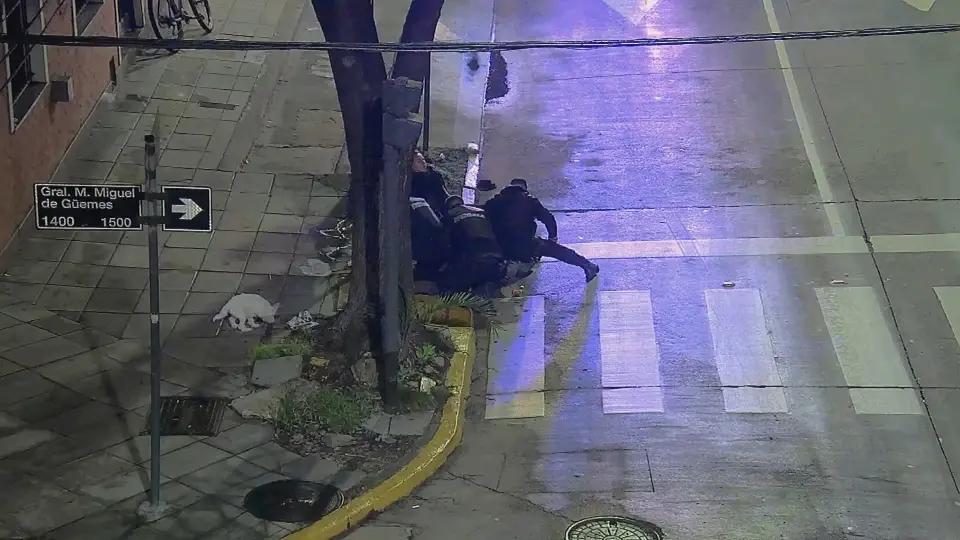
A year without Octavio: the case of his death at the hands of municipal and Buenos Aires police officers enters a new forensic phase
According to argentina.indymedia.org, the prosecutor's office handling the case has ordered the performance of a new medico-legal examination, supplementary and complementary in nature, to determine the causes of death of Octavio Claudio Buccafusco, which occurred on 3 September a year ago in Vicente López, Buenos Aires Province.
That early morning, three officers from the Vicente López Municipal Patrol and one Buenos Aires Police officer subdued Buccafusco on a public street and beat him whilst he was on the ground. "They have him face down for approximately 12, 15 minutes with a knee on his back, on the back of his neck and chest. After those minutes, he stops moving. When he stops moving, everyone gets off him, when everyone gets off him... he never moved again," described Augusto, Octavio's brother, regarding images captured by a security camera and circulated by various media outlets.
Charged with manslaughter, despite family opposition
Ten months after the death, the four officers—three from the Municipal Patrol and one Buenos Aires police officer—were called to give statements. Prosecutor Alejandro Guevara questioned them on charges of manslaughter, framing the events as an accidental death. Guevara bases his position on an initial autopsy that concluded the death was multicausal and that did not determine whether the actions of the officers caused the mechanism of death.
Octavio's family and the Provincial Commission for Memory (CPM), which intervenes in the case as an institutional injured party in its capacity as the Local Mechanism for Prevention of Torture, reject that classification. They argue it was an aggravated homicide, committed by public officials in abuse of their position or function, concurrently with ill-treatment.
"Manslaughter is when a person does not know what they are doing. Here they knew that if they had a person face down for so long crushed under four men, their life was in danger, they could have imagined it and yet they decided to do it anyway," said Augusto.
The defence expert and positional asphyxia
The crux of the controversy is the expert report that underpins the prosecutor's hypothesis, which emphasises Buccafusco's consumption of substances and its impact on the causes of death. The CPM commissioned a report from an independent expert, Marcelo Leonardo Nienkes, who incorporated in his analysis the context in which the death occurred and concluded that Octavio died from positional smothering asphyxia, linked to the irregular intervention of the officials.
Based on that divergence, the defence lawyers for the accused raised the need to expand the medico-legal examination. The prosecutor's office accepted the request and ordered the performance of a new "supplementary and complementary" examination, in which the official examiners Dr Madrid—autopsy physician—and Dr Diamantti—pathologist—, together with defence experts to be appointed, shall analyse the documentation in the case and prepare a comprehensive report that determines the causes of death, the mechanism of production and other relevant details.
The Medico-Legal Department of the Institute of Criminal Investigation and Forensic Sciences of South Greater Buenos Aires shall be responsible for the new examination and shall define the place, date and time for its performance.
The Municipal Patrol and institutional violence
The Buccafusco case was included in the presentation of the CPM's 2026 Annual Report. In the section on security policies, the organisation noted that "in recent years, so-called 'municipal guards' have proliferated in Buenos Aires districts, created outside provincial regulation, assuming powers inherent to the police function—for example, the apprehension of persons or searches of belongings—and using police equipment. This not only represents a breach of institutionality but also a condition of possibility for the increase of state or institutional violence".
Augusto points directly to the way this force operates: "The Vicente López Municipal Patrol operates this way, they are incentivised to hit people, to treat poorly those people who are homeless, who are in a situation of vulnerability, who are out there collecting cardboard to make a living. Nowadays I cannot bring my brother back from the dead but I can do something about it so that this does not happen to anyone else, because Octavio could be your brother, a friend, your son".
Source: Google News AR — Crime